

Before extracting lead, company, or professional data from a website, you need to answer more than one question. The fact that information is publicly visible does not automatically mean that every method of collecting, storing, combining, or using it is permitted.
A responsible data-extraction review should consider the source website’s rules, applicable privacy laws, the type of information being collected, the purpose of the processing, the outreach channel, security controls, retention periods, and the rights of the people represented in the data.
This eight-point web scraping compliance checklist provides a practical framework for sales teams, recruiters, marketers, researchers, and enterprises collecting public web data. It is designed to help you identify issues that require internal review or qualified legal advice before a scraping project begins.
Important: This guide provides general operational information, not legal advice. Privacy, marketing, contract, intellectual-property, employment, and sector-specific rules vary by jurisdiction and use case.
Quick Company Website Data Extraction Checklist
Use this summary before starting a new extraction project:
| Check | Question to Answer | Evidence to Keep |
|---|---|---|
| 1. Purpose and lawful basis | Why are you collecting the data, and what legal basis supports processing personal data? | Purpose statement, lawful-basis assessment, legitimate-interest assessment or consent record |
| 2. Source authorization | Do the website’s terms, access controls, licence, API rules, and technical instructions permit the proposed method? | Terms URL, policy version, permission, licence or API documentation |
| 3. Data minimization | Are you collecting only the fields necessary for the stated purpose? | Approved field list and exclusions |
| 4. Transparency and rights | How will individuals be informed, and how can they access, correct, object to, or delete their data? | Privacy notice, request process and suppression records |
| 5. Outreach compliance | Which email, telephone, SMS, advertising, or direct-marketing rules apply? | Message templates, opt-out process, suppression list and channel-specific review |
| 6. Collection behaviour | Will the extraction create excessive load, bypass controls, or continue after blocking signals? | Rate policy, retry policy, crawl configuration and incident logs |
| 7. Security and retention | Who can access the data, where is it stored, and when will it be deleted? | Access controls, retention schedule, security policy and backup procedure |
| 8. Special risks | Does the project involve children, health, finance, employment decisions, sensitive data, or international transfers? | DPIA, sector-specific review, transfer assessment or legal approval |
1. Define the Purpose and Lawful Basis
Start by documenting exactly why the data is being collected. “Lead generation” is often too broad. A clearer purpose might be:
- Identifying procurement managers at companies in a defined industry
- Finding publicly listed conference speakers for event research
- Building a candidate sourcing list for a specific vacancy
- Comparing publicly advertised products or services
- Creating a directory of companies in a particular region
If the extracted dataset includes information relating to identifiable people, privacy law may apply even when the information is professional, publicly visible, or associated with a company.
GDPR Does Not Always Mean Consent
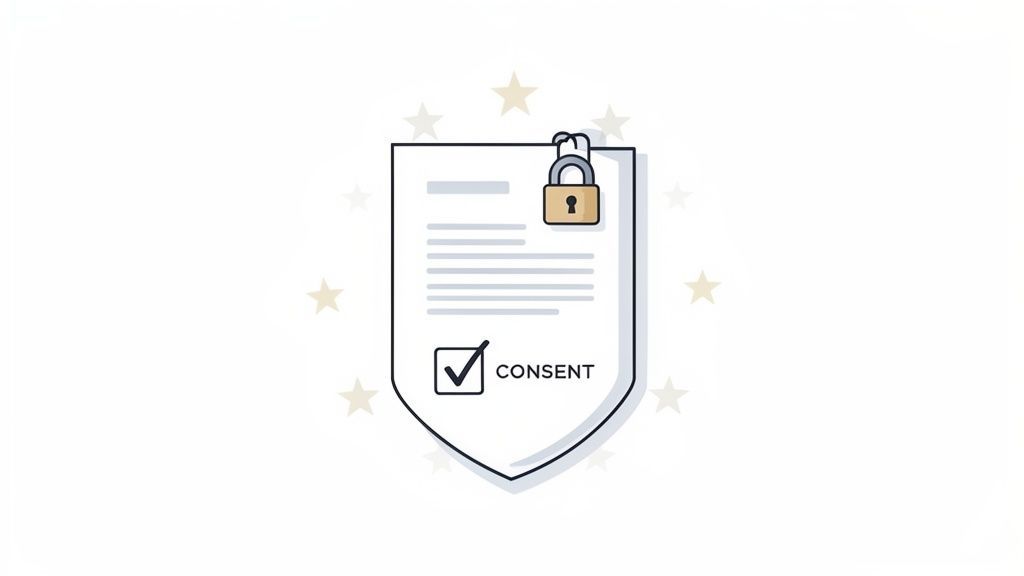
Under the GDPR, processing personal data requires a lawful basis. Consent is one possible basis, but it is not automatically the only or most appropriate basis for professional research or B2B processing.
Depending on the circumstances, an organisation may consider legitimate interests. That requires a documented assessment covering:
- Purpose: Is there a genuine and legitimate interest?
- Necessity: Is the processing reasonably necessary for that purpose?
- Balancing: Do the person’s rights, interests, and reasonable expectations override the organisation’s interest?
The assessment should consider the source, sensitivity, scale, potential harm, relationship with the person, and whether the person would reasonably expect the proposed use.
Implementation Example
A recruiting firm wants to collect the names, current roles, company names, locations, and public professional profile links of software engineers for a specific vacancy.
Before collection, the firm documents:
- The vacancy and sourcing purpose
- The fields it actually needs
- Why less intrusive methods are insufficient
- How candidates will be informed
- How long unresponsive candidate records will be retained
- How candidates can object or request deletion
Actionable Checks
- Write a specific purpose statement.
- Identify the controller responsible for the data.
- Determine which privacy regimes apply.
- Select and document an appropriate lawful basis.
- Do not rely on “it was public” as the entire legal analysis.
- Reassess the lawful basis when data is reused for a different purpose.
2. Review Website Terms, Licences, APIs, and Access Controls
Privacy compliance is only one layer. A website may also impose contractual, technical, copyright, database, or access restrictions.
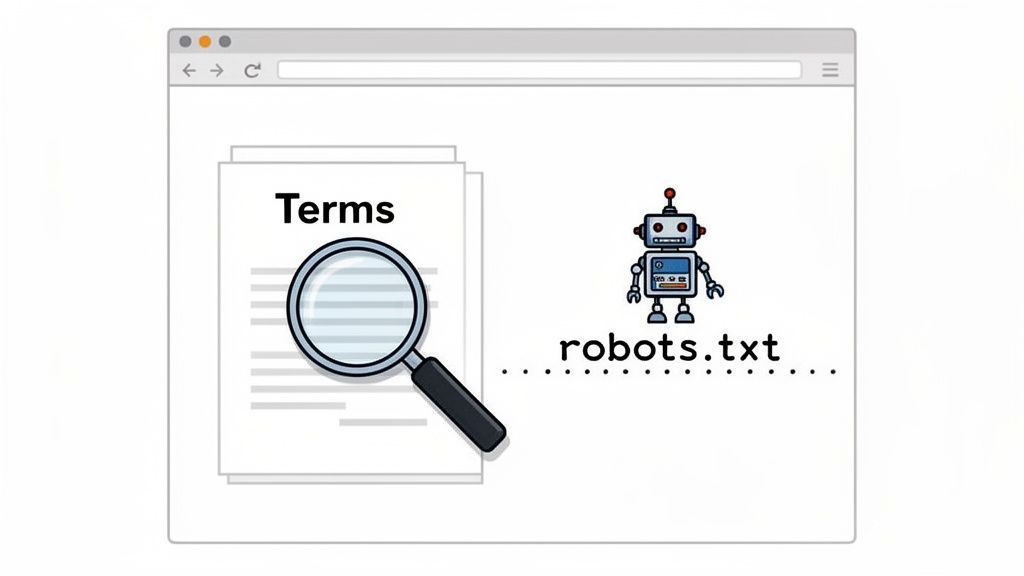
Before extracting data, review:
- The website’s Terms of Service
- Acceptable-use and developer policies
- API documentation and rate limits
- Content or database licences
- Login and account restrictions
- Copyright and database-right notices
robots.txt- Technical access controls such as CAPTCHAs, paywalls, or blocks
What Robots.txt Does and Does Not Mean
A robots.txt file gives automated crawlers instructions about paths a website owner prefers them not to crawl. It is an important operational signal, but it is not a complete legal licence and does not override Terms of Service, privacy law, copyright, database rights, or access controls.
Likewise, the absence of a disallow rule does not automatically mean that every extraction and reuse is permitted.
Prefer Official Access Methods
When a website provides an official API, CSV export, open-data portal, partner feed, or licensed dataset, that is usually preferable to scraping the rendered webpage.
Official methods may provide:
- Clearer authorization
- More stable data structures
- Documented rate limits
- Better data quality
- Defined reuse conditions
- Reduced risk of breaking when the page changes
Actionable Checks
- Search the terms for “scraping,” “crawling,” “automated access,” “data mining,” and “copying.”
- Record the URL and date of the policy reviewed.
- Do not bypass authentication, CAPTCHAs, paywalls, or technical restrictions.
- Check whether the source provides an API or export.
- Obtain written permission where the use is unclear or commercially significant.
- Repeat the review when the website changes its policies.
3. Minimize the Data You Extract
Collect only the information reasonably necessary for the documented purpose. Extracting every available field “in case it becomes useful later” increases compliance, security, and data-quality risk.
Separate Company Data From Personal Data
Not every field creates the same risk.
| Lower-Risk Company Information | Personal or Potentially Sensitive Information |
|---|---|
| Company name | Person’s name |
| General company website | Direct email address |
| Head-office address | Direct telephone number |
| Public product category | Personal profile URL |
| General company phone number | Employment or career history |
| Generic inbox such as info@ | Location linked to an identifiable person |
| Public pricing | Opinions, posts, inferred traits, or sensitive information |
Business contact information associated with an identifiable employee can still constitute personal data.
Avoid Sensitive and High-Risk Fields
Unless the project has been specifically reviewed and approved, avoid collecting or inferring:
- Health information
- Political or religious views
- Race or ethnicity
- Sexual orientation
- Trade-union membership
- Criminal-record information
- Government identifiers
- Financial-account data
- Precise home addresses
- Information about children
Actionable Checks
- Create an approved extraction schema before scraping.
- Mark each field as required, optional, or prohibited.
- Keep general company details separate from direct personal details.
- Do not infer sensitive characteristics from names, photographs, memberships, or posts.
- Review whether the same purpose can be achieved with company-level data.
- Delete fields that are collected accidentally.
4. Provide Transparency and Support Data-Subject Rights
When personal data is obtained from websites or third parties rather than directly from the individual, privacy laws may require the organisation to provide information about the processing.
A privacy notice should explain, where applicable:
- Who controls the data
- What information is collected
- Where it came from
- Why it is processed
- The lawful basis
- Who receives it
- How long it is kept
- Whether it is transferred internationally
- How the person can exercise their rights
- How to object to direct marketing
Create a Rights-Request Process
Your team should be able to locate and act on a person’s record when they request:
- Access
- Correction
- Deletion
- Restriction
- Objection
- Opt-out from sale or sharing where applicable
Deleting a contact from one campaign is not enough when copies remain in exports, CRM records, outreach platforms, enrichment tools, or backup systems.
Actionable Checks
- Publish an accurate privacy notice covering sourced data.
- Retain the original source URL and collection date.
- Create a central process for access, correction, deletion, and objection requests.
- Maintain suppression records so deleted contacts are not imported again accidentally.
- Train sales, recruiting, and marketing teams to recognize privacy requests.
- Define when legal or compliance staff must be involved.
5. Apply the Correct Outreach Rules
Data-extraction compliance and outreach compliance are separate. A business may be allowed to retain certain professional information but still be restricted in how it contacts the individual.
Review the rules for every channel used:
- Telephone
- SMS or messaging applications
- Direct messages
- Online advertising and audience uploads
- Automated calling
United States: CAN-SPAM
For commercial email governed by CAN-SPAM, messages generally need accurate sender and routing information, non-deceptive subject lines, a valid postal address, and a clear opt-out method.
Opt-out requests must be honoured within the required period, and responsibility cannot be avoided simply by outsourcing the email campaign to another company.
European and UK Outreach
European direct-marketing rules involve both data-protection law and jurisdiction-specific electronic-communications rules. The requirements can differ depending on:
- Whether the recipient is an individual, sole trader, partnership, or corporate entity
- Whether the address is personal or generic
- The relationship with the recipient
- The country where the recipient is located
- The channel being used
- Whether consent, legitimate interests, or another rule is relied upon
Do not assume that CAN-SPAM compliance makes an international campaign lawful.
Outreach Best Practices
- Contact only people whose roles are relevant to the message.
- Explain who you are and why you are contacting them.
- Use accurate sender information.
- Avoid deceptive subject lines or false familiarity.
- Provide a simple opt-out.
- Process objections and unsubscribes across every system.
- Do not repeatedly contact people who have declined.
- Do not disclose private or unnecessary personal information in the message.
Actionable Checks
- Map every campaign by country and channel.
- Review email, telephone, SMS, and advertising rules separately.
- Use a central suppression list.
- Test unsubscribe links before launching.
- Ensure contractors and email providers honour suppression instructions.
- Retain evidence of the campaign’s targeting rationale.
6. Use Non-Disruptive Extraction Practices
Even where extraction is permitted, the technical process should not harm or destabilize the source website.
Responsible behaviour includes:
- Limiting request frequency
- Avoiding unnecessary concurrency
- Using cached results where appropriate
- Stopping after repeated errors
- Respecting documented rate limits
- Avoiding repeated requests for unchanged resources
- Using exponential backoff for temporary failures
Respond to Blocking Signals
Stop or slow the workflow when you encounter:
429 Too Many Requests403 Forbidden- CAPTCHA challenges
- Access-denied pages
- Account warnings
- Repeated timeouts
- Explicit cease-and-desist or removal requests
Do not rotate accounts, proxies, identities, or browser fingerprints to defeat technical restrictions without clear authorization.
There Is No Universal Safe Delay
A fixed rule such as “wait three seconds between requests” does not make a scraper compliant. The appropriate rate depends on the source, its published rules, server capacity, access method, licence, and project scale.
For a small manually initiated browser workflow, the source may receive only the page requests the user normally generates. A large crawler making concurrent requests requires a much more formal technical review.
Actionable Checks
- Set project-specific rate and concurrency limits.
- Implement a stop condition for blocks and errors.
- Use official APIs within their documented limits.
- Monitor row counts, failures, and unusual responses.
- Do not repeatedly retry blocked requests.
- Record technical incidents and remediation.

7. Protect the Data and Set a Retention Period
Once data is collected, the organisation becomes responsible for preventing unauthorized access, accidental disclosure, loss, alteration, and inappropriate reuse.
Core Security Controls
- Restrict access according to job responsibilities.
- Use strong authentication and multi-factor authentication.
- Encrypt managed devices and approved storage systems.
- Avoid emailing unprotected spreadsheets.
- Keep software and browsers updated.
- Maintain secure backups where necessary.
- Log significant imports, exports, and administrative actions.
- Review third-party processors and contracts.
Retention and Deletion
Lead databases should not be retained indefinitely without review. Define retention according to purpose and relationship.
For example:
- Unqualified research records may have a short review period.
- Active prospects may be retained while a legitimate sales process continues.
- Candidate records may require a defined talent-pool policy.
- Suppression records may need to be retained to prevent renewed contact.
- Legal claims or contractual obligations may justify separate retention.
ProfileSpider Storage Considerations
ProfileSpider stores saved profiles, lists, tags, and notes locally in the browser’s IndexedDB. This means those saved lists are not maintained as a central ProfileSpider cloud lead database.
However, local-first storage does not remove the user’s compliance responsibilities. Account, billing, credits, team functions, AI extraction, enrichment, and email-finding operations use backend or third-party services where required.
Local browser data also has operational risks:
- Anyone with access to the browser profile may access the data.
- Clearing browser data can delete saved lists.
- Uninstalling the extension can remove locally stored data.
- Exports can be copied or shared outside the browser.
- Team members may create uncontrolled duplicate files.
Export important data for authorized backup, secure the exported files, and delete local or exported copies when they are no longer needed.
Actionable Checks
- Define an owner for each dataset.
- Approve storage locations.
- Set role-based access controls.
- Create a retention and deletion schedule.
- Secure exported CSV, Excel, and JSON files.
- Maintain an incident-response process.
- Assess whether a breach requires regulatory or individual notification.
8. Review International Transfers and High-Risk Uses
A scraping project requires additional review when data crosses borders or is used in a regulated or high-impact context.
International Data Transfers
Collecting data on a computer located outside the individual’s country can itself create an international-transfer issue. Local storage does not automatically avoid the transfer question if EU or UK personal data is collected and stored in another jurisdiction.
Possible transfer mechanisms may include:
- Adequacy decisions
- Standard Contractual Clauses
- Binding Corporate Rules
- Approved certification or codes
- Limited statutory derogations
The correct mechanism depends on the parties, locations, systems, and purpose.
High-Risk or Regulated Uses
Escalate the project for specialist review when data may be used for:
- Employment eligibility or background screening
- Credit or insurance decisions
- Healthcare or patient-related activity
- Fraud, identity, or risk scoring
- Automated decisions with significant effects
- Profiling vulnerable people
- Children’s data
- Sensitive or criminal-record information
- Large-scale monitoring
FCRA
Publicly sourced information should not be treated as a substitute for a legally compliant consumer report or background check. If data is used in employment, housing, credit, or other eligibility decisions, the Fair Credit Reporting Act and related state requirements may apply.
HIPAA
HIPAA does not apply to every company that mentions healthcare. It applies to covered entities, business associates, and protected health information within its scope. The safest approach for ordinary B2B prospecting is to avoid collecting health or patient information entirely.
SOC 2
SOC 2 is not a privacy law or a universal legal requirement. It is an assurance framework used to evaluate controls at service organisations. Enterprise customers may contractually require a SOC 2 report, but it does not by itself make scraping lawful.
Actionable Checks
- Map where data is collected, processed, stored, and accessed.
- Determine whether an international-transfer mechanism is required.
- Conduct a DPIA or similar risk assessment for high-risk processing.
- Keep scraped data out of automated eligibility decisions without specialist review.
- Do not collect sensitive information merely because it is visible.
- Consult qualified counsel for regulated use cases.
8-Point Web Scraping Compliance Checklist
| Checklist Item | Core Requirement | Evidence to Maintain | Risk if Ignored |
|---|---|---|---|
| Purpose and lawful basis | Define the purpose and justify processing of personal data | Purpose statement, lawful-basis analysis and approvals | Unlawful or incompatible processing |
| Website authorization | Review terms, licences, APIs and access controls | Policy links, permission records and API terms | Account restriction, contractual claims or blocked access |
| Data minimization | Collect only necessary and appropriate fields | Approved extraction schema | Higher privacy, security and accuracy risk |
| Transparency and rights | Inform people where required and support rights requests | Privacy notice, request log and suppression process | Regulatory complaints and inability to honour rights |
| Outreach compliance | Apply channel- and country-specific marketing rules | Templates, opt-outs, suppression lists and targeting rationale | Spam complaints, enforcement and sender damage |
| Non-disruptive extraction | Respect rate limits, stop signals and website stability | Crawl settings, logs and incident procedures | Blocks, service disruption and abuse allegations |
| Security and retention | Limit access, protect files and delete data when no longer needed | Security policy, access controls and retention schedule | Breach, uncontrolled sharing and excessive retention |
| Transfers and high-risk uses | Review international transfers and regulated decisions | DPIA, transfer assessment and specialist legal review | Transfer violations or misuse in regulated contexts |
Enterprise Web Scraping Compliance Review
Large organisations should convert this checklist into a repeatable approval process rather than relying on each employee to make independent decisions.
Recommended Enterprise Workflow
- Project intake: Record the source, data fields, purpose, scale, frequency, and recipients.
- Legal review: Review privacy, contract, intellectual-property, outreach, and sector requirements.
- Technical review: Approve access method, rates, authentication, storage, monitoring, and stop conditions.
- Security review: Approve systems, access rights, processors, exports, and retention.
- Risk assessment: Complete a DPIA or other assessment where required.
- Pilot: Test a limited extraction and review accuracy and impact.
- Approval: Document conditions and responsible owners.
- Monitoring: Review policy changes, errors, objections, blocks, and data quality.
- Closure: Delete or archive data according to the retention schedule.
Compliance Documentation Template
For each approved source, record:
- Website and data owner
- Purpose of collection
- Categories of data
- Expected volume
- Collection frequency
- Terms and policy review date
- API or licence availability
- Lawful basis
- Transparency method
- Outreach channel
- Storage location
- International transfers
- Retention period
- Data recipients
- Security controls
- Responsible project owner
- Legal or compliance approval
Using ProfileSpider Responsibly
ProfileSpider is designed to extract structured information from webpages opened by the user and organize the resulting records into local lists.
It can support a controlled workflow by allowing users to:
- Extract one current page at a time
- Review results before saving them
- Retain source URLs
- Add tags and notes
- Export CSV, Excel, or JSON
- Store saved profiles and lists locally in the browser
However, no scraping tool makes a project compliant automatically. The user remains responsible for:
- Choosing appropriate websites
- Reviewing source terms
- Defining a lawful purpose
- Minimizing the fields collected
- Handling data-subject rights
- Complying with outreach rules
- Securing and deleting exported data
- Avoiding prohibited or high-risk uses
Key principle: A privacy-oriented product design can reduce some operational risks, but compliance depends on the entire collection and use process—not only where the tool stores the final list.
From Checklist to Responsible Data Collection
The most useful compliance question is not simply, “Can this page be scraped?” A stronger review asks:
- Should this data be collected?
- Which fields are necessary?
- Is the access method authorized?
- Would the person reasonably expect this use?
- How will they be informed?
- What happens if they object?
- How will the data be secured?
- When will it be deleted?
Compliance does not guarantee that a campaign will be successful, and public data does not guarantee unrestricted use. A well-designed process reduces unnecessary data collection, improves traceability, limits security exposure, and creates clearer accountability across sales, recruiting, marketing, and research teams.
Frequently Asked Questions
Is web scraping legal?
There is no single global rule that makes all scraping legal or illegal. The answer depends on the source, access method, website terms, data type, jurisdiction, purpose, scale, copyright or database rights, and how the information is subsequently used.
Is publicly available professional data still personal data?
Yes, when it relates to an identifiable person. A name, work email, direct telephone number, role, profile URL, or employment history can still be personal data even when published for professional purposes.
Does GDPR always require consent for lead scraping?
No. GDPR requires an appropriate lawful basis. Consent is one possible basis, while legitimate interests may be considered in some contexts after a documented necessity and balancing assessment.
Does robots.txt give permission to scrape?
No. It provides crawler instructions but is not a complete legal licence. Terms, privacy rules, access controls, copyright, database rights, and other obligations still need to be reviewed.
Does local storage make scraping GDPR compliant?
No. Local storage may reduce certain cloud-storage risks, but lawfulness, transparency, minimization, security, retention, international transfers, and rights handling still apply.
Does CAN-SPAM allow every cold email campaign?
No. CAN-SPAM establishes requirements for covered commercial email in the United States, but other federal, state, international, platform, contractual, and privacy rules may also apply.
Does CCPA apply to every business collecting California data?
No. CCPA and CPRA obligations depend on whether the organisation and processing fall within the law’s scope. Covered businesses must provide applicable disclosures and honour relevant consumer rights.
Should an enterprise scrape data without a written review?
Large or recurring projects should have documented legal, technical, security, retention, and business-owner approval before launch.