

Your reliance on a traditional lead database is quietly sabotaging your growth. These static lists are often filled with decayed data, leading to low engagement rates, bounced emails, and wasted resources. The core problem isn't just the outdated contact information; it's the fundamental model of buying pre-packaged, low-intent leads that anyone can access. For modern sales, recruiting, and marketing teams, this approach is no longer competitive. It’s a costly cycle of purchasing stale contacts that damages your brand reputation with every irrelevant outreach attempt.
This outdated model creates significant strategic issues beyond just cost. Privacy regulations like GDPR and CCPA make holding large, unverified databases a compliance risk. Furthermore, top performers are not waiting for leads; they are actively building dynamic, high-intent audiences based on real-time signals. Traditional, static lead lists and outdated systems can actually hinder growth. Learn more about the pitfalls of these legacy prospecting methods and why they are no longer sufficient for competitive growth.
This guide provides a roadmap to the best alternatives to lead databases, helping you build a modern, effective prospecting engine. We've compiled a detailed list of tools, platforms, and workflows that replace static lists with fresh, accurate, and high-intent data. For each alternative, we provide a direct link, honest pros and cons, pricing insights, and best-fit use cases to help you find the right solution for your specific needs. It's time to stop buying lists and start building a real pipeline.
1. ProfileSpider
ProfileSpider represents a significant step forward for professionals seeking powerful alternatives to lead databases. It’s an AI-powered, no-code Chrome extension designed to transform any webpage containing people or company information into a structured, exportable database with a single click. This tool is built for speed and efficiency, eliminating the technical barriers often associated with data extraction and scraping. For recruiters and sales pros, it's the modern way to build hyper-targeted lists directly from the source.
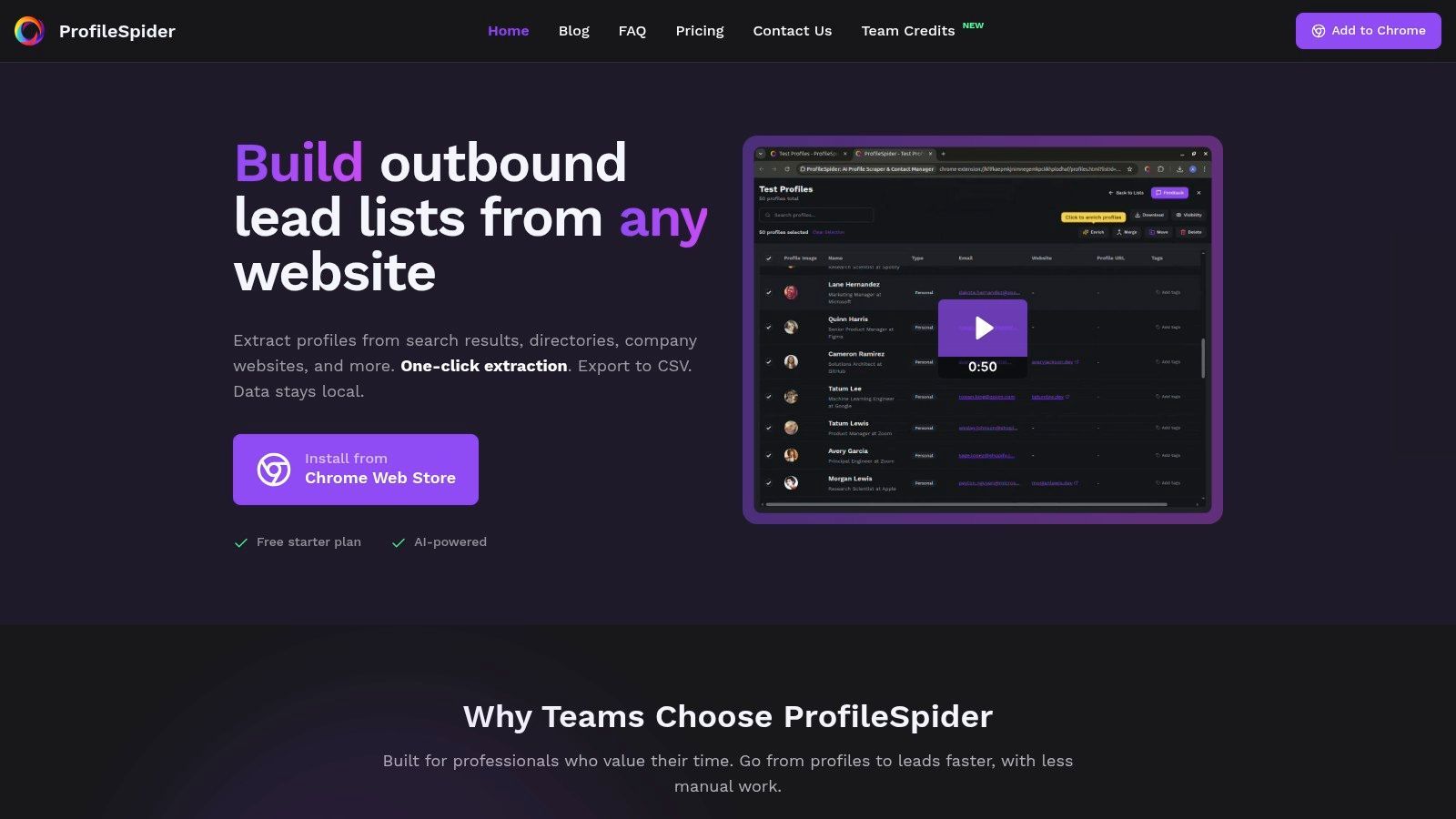
Unlike traditional scrapers that require users to configure CSS selectors or write code, ProfileSpider's AI automatically identifies and extracts key data points. It works across diverse site structures, from LinkedIn and professional directories to conference speaker lists and company "About Us" pages. The extension pulls names, job titles, emails, phone numbers, and social media links, presenting them instantly within your browser.
Standout Features and Use Cases
One of its core strengths is its local-first privacy model. All extracted data is stored directly in your browser's IndexedDB, meaning your lists are never uploaded to a server unless you choose to export them. This approach gives you complete control over the data you collect, a critical advantage for privacy-conscious teams.
Another key advantage is its enrichment capability. You can direct the tool to visit individual profile URLs from an initial list to gather more detailed information, filling in gaps in your data automatically. This is especially useful for sales and recruiting teams who need to build complete prospect or candidate profiles without manual copy-pasting.
- Best For: Sales reps, recruiters, marketers, and researchers who need to build targeted contact lists quickly without technical expertise.
- Pricing: Offers a free plan for up to 10 profiles per page. Paid plans start with a Starter tier (25 profiles/page), scale to Pro (50 profiles/page), and Power (200 profiles/page). Pricing is credit-based (1 credit per page processed), with monthly subscriptions and non-expiring top-up credit packs available.
- Practical Tip: Use the tagging and notes features to segment your lists directly within the extension before exporting. This keeps your data organized and ready for direct import into a CRM or Applicant Tracking System (ATS).
Considerations and Limitations
ProfileSpider is a Chromium-based extension, so it requires a compatible browser like Chrome, Edge, or Brave. Since it operates on content visible within your browser, its effectiveness can be limited by paywalls or login requirements. As with any data collection tool, users are responsible for ensuring their use of the extracted data complies with all relevant legal and privacy regulations.
2. LinkedIn Sales Navigator
LinkedIn Sales Navigator is a powerful tool for social prospecting, allowing sales teams to build lead lists directly from LinkedIn’s massive professional network. Instead of purchasing static contact lists, it provides an active environment to find decision-makers based on real-time data and account signals. This makes it one of the most effective alternatives to lead databases for account-based marketing (ABM) and personalized outbound strategies.
The platform excels at identifying warm paths into target accounts. Features like TeamLink reveal shared connections, creating opportunities for introductions rather than cold outreach. Its advanced search filters for both people and companies, combined with buyer intent signals and saved search alerts, help you pinpoint prospects who are actively looking for solutions like yours.
Key Considerations
- Best For: B2B sales teams focused on high-value, relationship-based selling and ABM.
- Data Quality: Exceptionally high, as it's based on first-party, user-updated LinkedIn profiles, minimizing data decay.
- Limitations: It intentionally gates direct contact information. While you get InMail credits, you won't find a direct export of email addresses or phone numbers. This means it often needs to be paired with an email finder or a profile scraping tool like ProfileSpider to extract visible contact details for use outside of LinkedIn.
- Pricing: Seat-based subscription model (Core, Advanced, Advanced Plus) that can become costly for large teams.
Sales Navigator is not a replacement for a CRM but a source for building highly qualified, relevant prospect lists that can be synced directly into systems like Salesforce and HubSpot.
Website: https://business.linkedin.com/sales-solutions
3. Clay
Clay is a data orchestration and workflow automation platform that functions as a powerful engine for building hyper-personalized prospect lists from scratch. Instead of providing a single, static database, it gives you access to over 100 different data providers, web scraping, and AI agents in one visual canvas. This makes it a top-tier alternative to lead databases for teams that demand source transparency and complete control over their enrichment process.
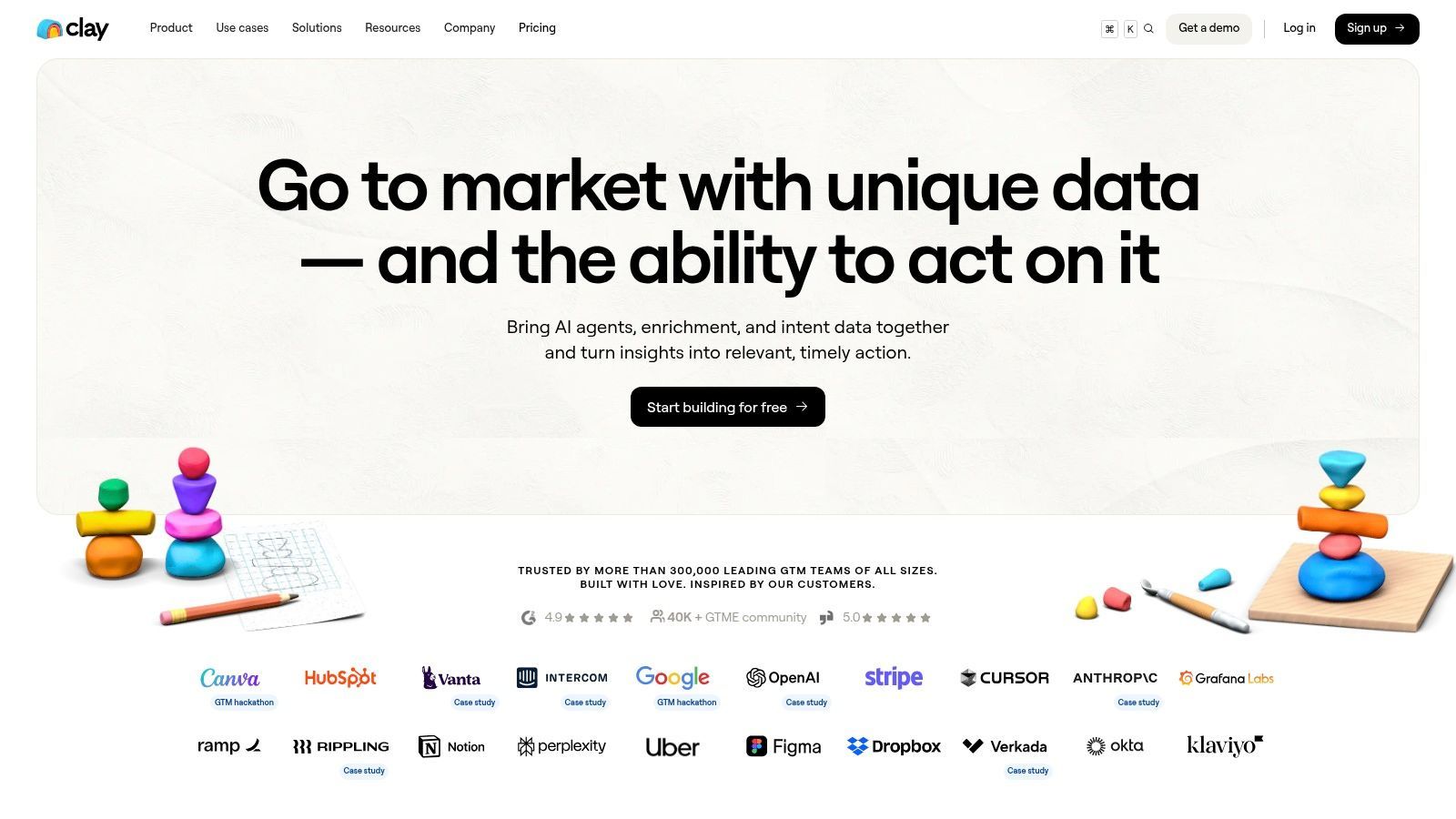
The platform’s strength lies in its "waterfall" enrichment model, where you can query multiple providers sequentially until you find the data point you need. For example, if the first provider fails to find an email, Clay automatically tries the next one in your sequence. This cascading logic dramatically increases data coverage. Combined with its AI features for researching websites and drafting personalized messages, Clay allows you to build highly targeted and context-aware outbound campaigns at scale.
Key Considerations
- Best For: Growth and sales operations teams that need to build complex, customized lead generation workflows and are comfortable with a more technical, modular approach.
- Data Quality: Variable but potentially very high. Quality depends entirely on the providers you choose to use in your waterfall sequence. It gives you the tools to find the best data, but you must build the process yourself.
- Limitations: There is a significant learning curve. New users must experiment to find the optimal combination of data sources for their needs, and managing credit consumption requires careful planning. It is less of an out-of-the-box solution and more of a powerful toolkit. You can learn more about how it compares to other options in our guide to the best data enrichment tools.
- Pricing: A credit-based model on top of a monthly subscription. This offers wholesale-style pricing for data but can be difficult to forecast for teams unfamiliar with this structure.
Clay is an ideal choice for teams wanting to move beyond the limitations of single-source databases and build a proprietary data enrichment machine.
Website: https://www.clay.com
4. PhantomBuster
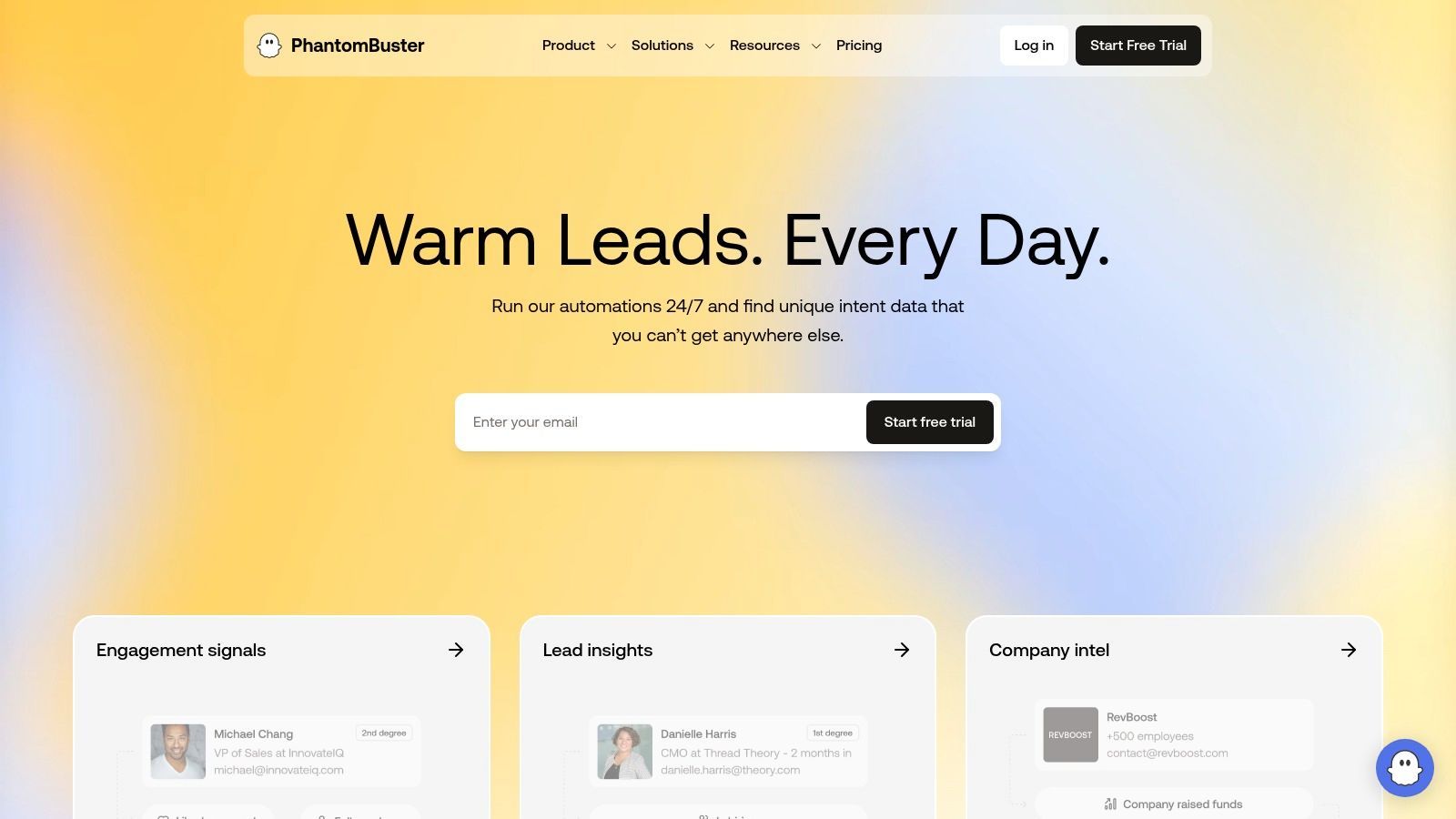
PhantomBuster is a no-code automation platform that allows sales and marketing teams to build dynamic lead lists by extracting data from across the web. Instead of buying a static prospect list, you can create repeatable workflows that pull fresh information from social networks like LinkedIn, business directories like Google Maps, and even company websites. This makes it a powerful and scalable alternative to lead databases for teams that need customized data on demand.
The platform operates using pre-built automations called "Phantoms" that can be chained together into complex "Flows." For example, you can use one Phantom to extract a list of LinkedIn profiles from a group, another to visit each profile and gather more data, and a third to find a professional email address. This approach provides granular control over how you build and enrich your own prospect database.
Key Considerations
- Best For: Growth teams and SDRs who need to build highly specific lead lists at scale from multiple online sources.
- Data Quality: Data is as fresh as the source it's scraped from (e.g., LinkedIn, Google Maps). Quality depends on the accuracy of the source platform and the precision of your Phantom’s setup.
- Limitations: The platform operates within the rate limits of the websites it scrapes, requiring careful scheduling to avoid account restrictions. The execution time and credit-based system can also become a constraint for very high-volume users.
- Pricing: Tiered subscription model based on execution time per day, number of Phantom slots, and email discovery credits.
PhantomBuster integrates directly with CRMs like HubSpot and Salesforce, allowing you to feed your newly built lists directly into your sales and marketing funnels for immediate action.
Website: https://phantombuster.com
5. Hunter
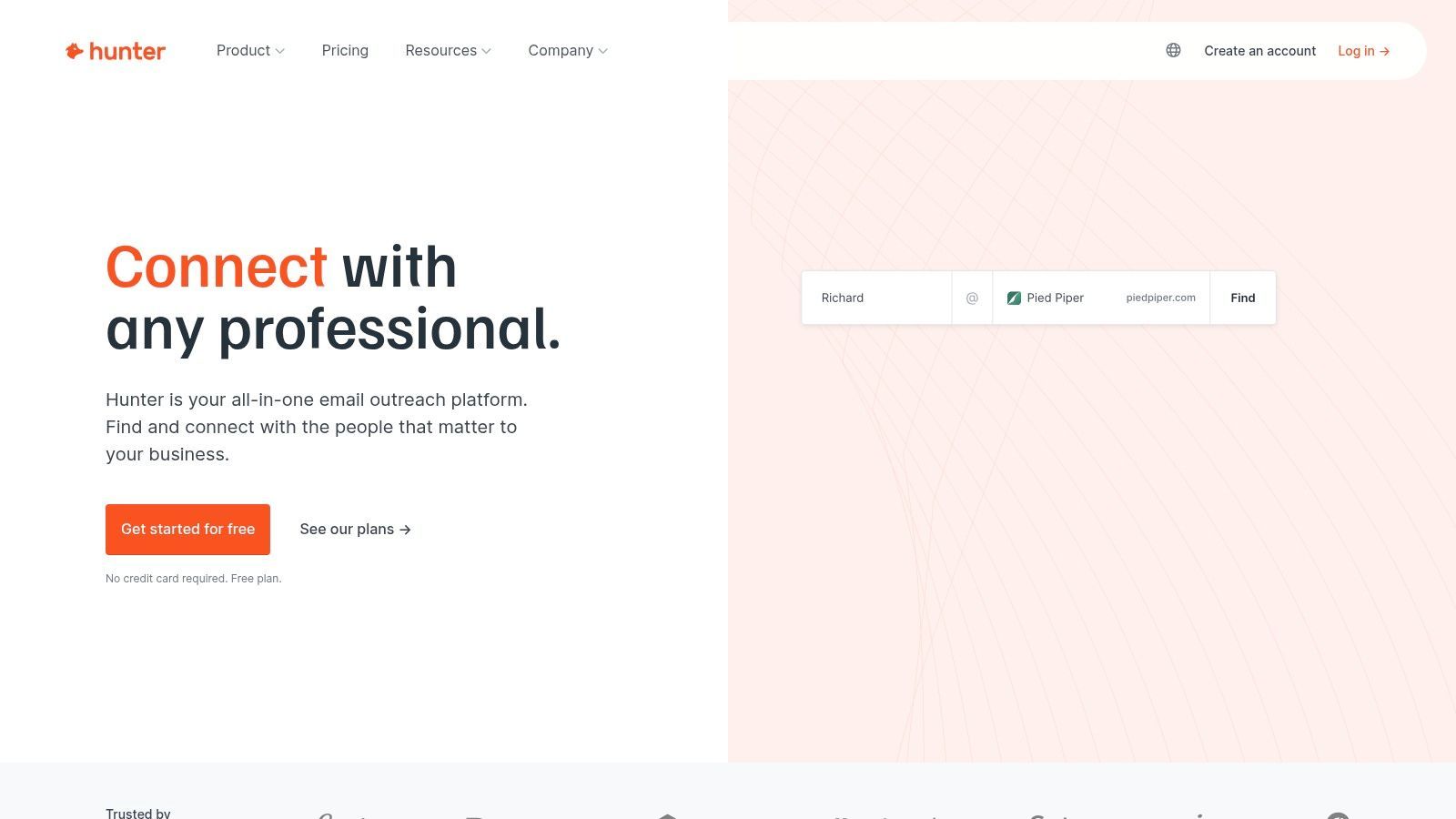
Hunter is a highly focused email discovery and verification tool, designed to find professional email addresses associated with a specific company domain. Instead of providing a pre-built list, it empowers users to generate their own targeted contact lists by starting with a known company. This approach makes it one of the most practical alternatives to lead databases when you have a list of target accounts but need to identify the right people within them.
The platform's strength lies in its simplicity and accuracy. The Domain Search feature quickly returns known email patterns and publicly indexed email addresses for a given company, often with confidence scores. This workflow pairs exceptionally well with social prospecting on platforms like LinkedIn; once you identify a decision-maker, you can use Hunter to find their likely email address. For guidance on this process, you can find more information on how to find someone's email on LinkedIn.
Key Considerations
- Best For: Sales teams, recruiters, and marketers who need to find and verify email addresses for specific target accounts.
- Data Quality: Good, with a strong focus on verification to minimize bounce rates. The platform provides confidence scores for each email found.
- Limitations: It offers very little data enrichment beyond the email address and job title. Its discovery capabilities depend entirely on the domains you provide, so it doesn't help with initial company discovery.
- Pricing: A freemium model with monthly credits. Paid plans scale based on the number of searches and verifications needed, with generous annual discounts.
Hunter is an essential utility for turning a list of names or companies into a list of actionable email contacts, bridging the gap between social prospecting and direct outreach.
6. Dropcontact
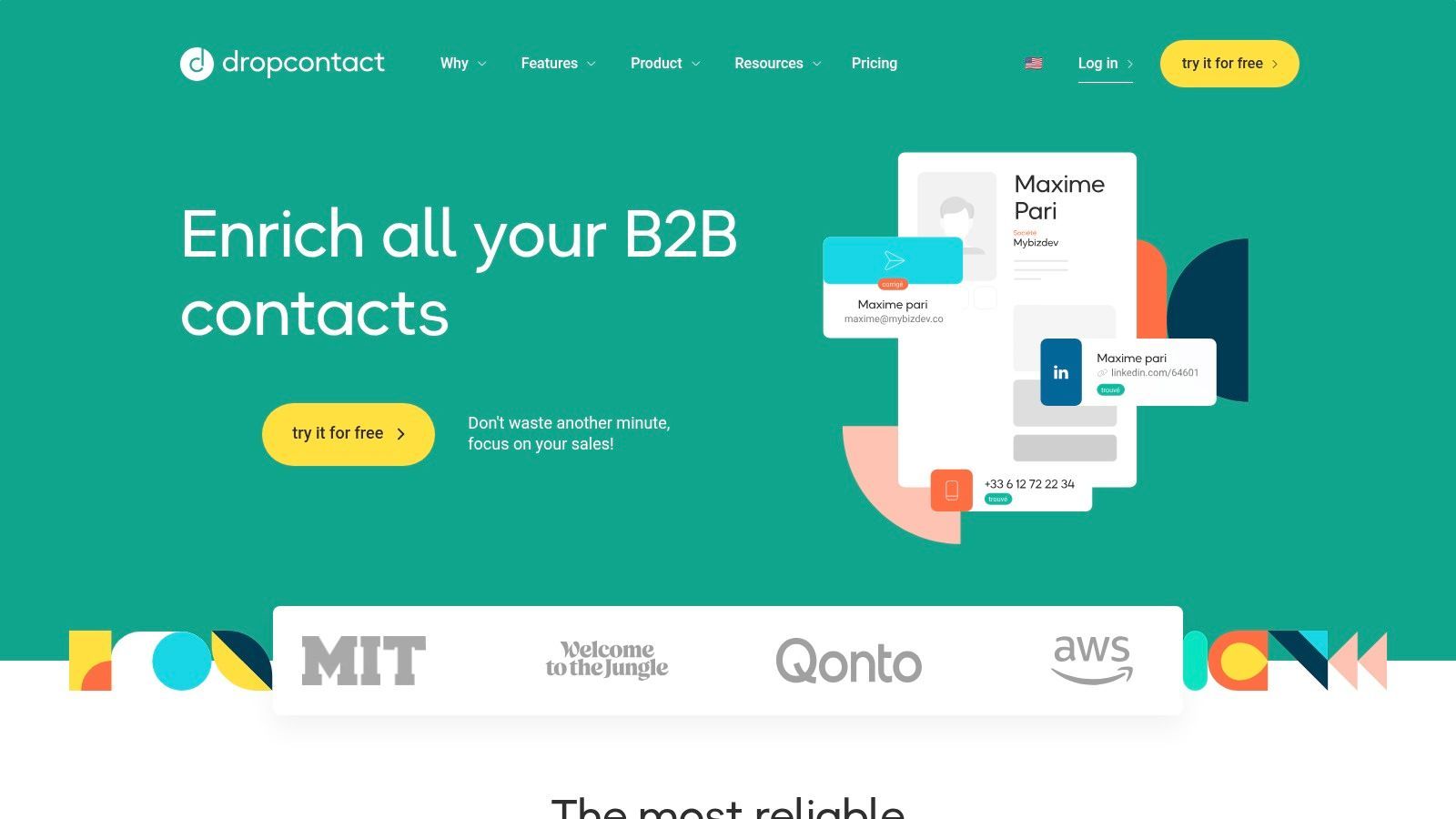
Dropcontact is an email finder and data enrichment tool that stands out for its GDPR-first approach. Instead of pulling from a static database, it algorithmically generates and validates B2B email addresses in real-time, making it a powerful and compliant alternative to lead databases, especially for teams operating in or selling to Europe. It enriches contact or company records with verified professional emails, civility, and other key firmographic data points.
This service is designed to complement other prospecting workflows, like sourcing leads from LinkedIn. You can provide a first name, last name, and company website, and Dropcontact will return a validated email address. Its native integrations with CRMs like HubSpot and Salesforce allow for continuous, automated enrichment of your existing records, ensuring data accuracy without manual list uploads.
Key Considerations
- Best For: Sales and marketing teams that need highly accurate, GDPR-compliant B2B email addresses to supplement their outbound or CRM data.
- Data Quality: High, with advanced algorithms to handle catch-all servers and validate emails. Its real-time generation model avoids the data decay common in static lists.
- Limitations: Its strength is email and company data, so it offers less U.S. phone number data compared to U.S.-focused competitors. Pricing is credit-based, which can make budgeting less predictable than a flat-rate subscription.
- Pricing: Pay-as-you-go or subscription model based on credits. Credits are only used for successful enrichments and are re-credited if no data is found, which is a fair approach.
Dropcontact works well as a data enrichment layer on top of your lead generation process, rather than being the source of the leads itself.
Website: https://www.dropcontact.com
7. BuiltWith
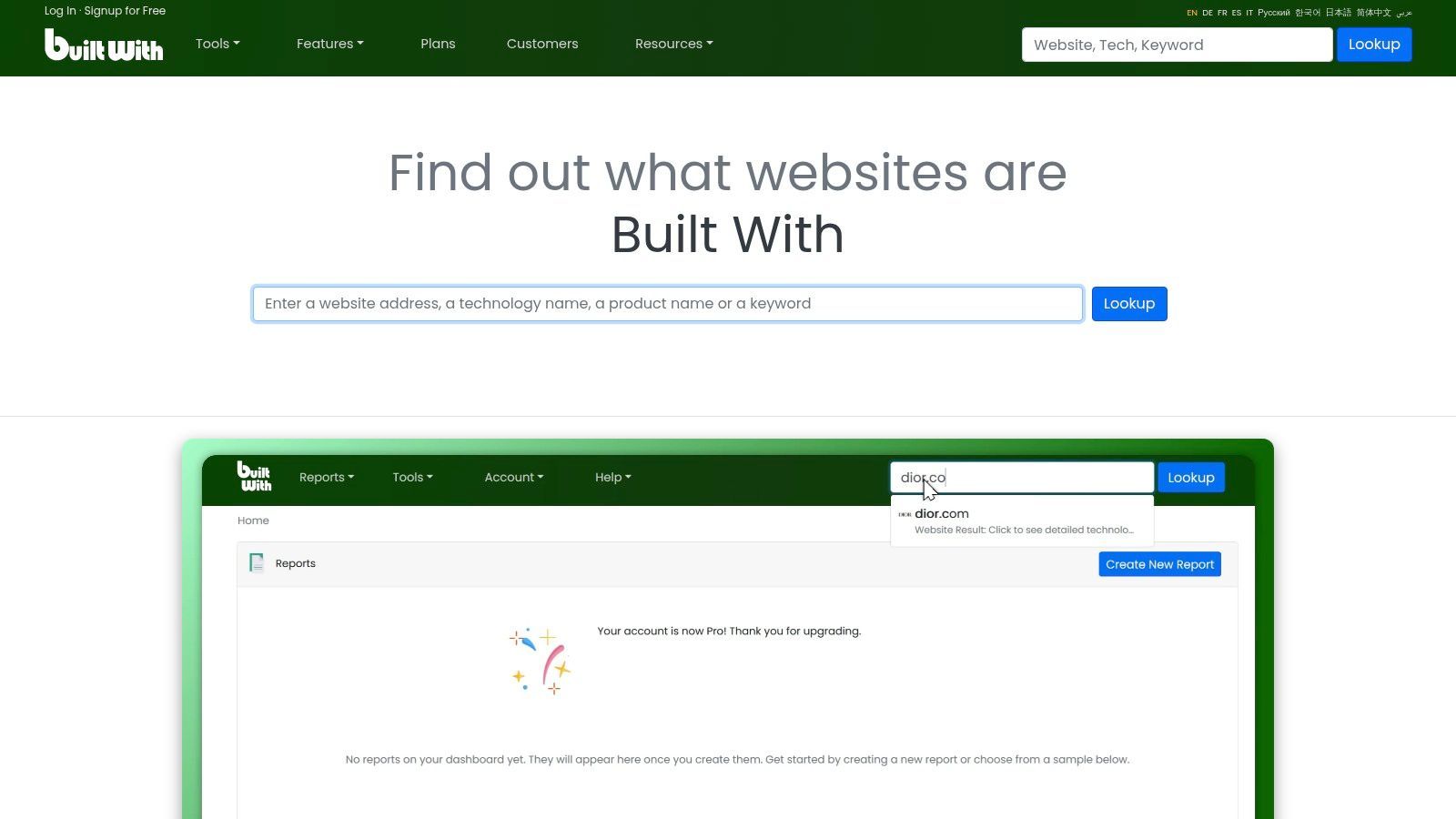
BuiltWith offers a powerful technographics-based approach to lead generation, allowing you to build prospect lists based on the software and technology a company uses. Instead of buying generic contact information, this platform lets you identify accounts using a specific CRM, marketing automation tool, or e-commerce platform. This makes it one of the most effective alternatives to lead databases for sales teams selling complementary tech or targeting competitors' customers.
The platform provides deep insights into a company’s tech stack, including historical data on technology adoption and removal. This is extremely valuable for identifying companies that have recently dropped a competitor’s solution or are investing in a technology ecosystem that aligns with your product. You can build highly targeted lists based on specific keywords, technologies, or even store categories.
Key Considerations
- Best For: B2B tech companies, sales teams focused on competitive displacement, and partner marketing programs.
- Data Quality: Highly reliable technographic data with extensive coverage of millions of websites, providing a strong signal of purchase intent and tech maturity.
- Limitations: While excellent for identifying target companies, mapping the right contacts at those companies often requires an additional enrichment step with another tool. The contact data provided can be less comprehensive than dedicated contact databases.
- Pricing: Subscription-based with several tiers (Basic, Pro, Team). The pricing can be a significant investment for smaller businesses or solo users.
BuiltWith excels at the first step of account-based marketing: identifying the perfect accounts. The ability to export lists in CSV format or integrate them directly into CRM workflows makes it a practical starting point for hyper-targeted outbound campaigns.
Website: https://builtwith.com
8. Wappalyzer
Wappalyzer offers a unique angle on lead generation by focusing on technographics, which is the technology stack a company uses. Instead of just providing company and contact details, it allows you to build prospect lists based on the software, web frameworks, and analytics tools your targets have installed. This makes it an ideal alternative to lead databases for sales and marketing teams whose products integrate with or compete against specific technologies.
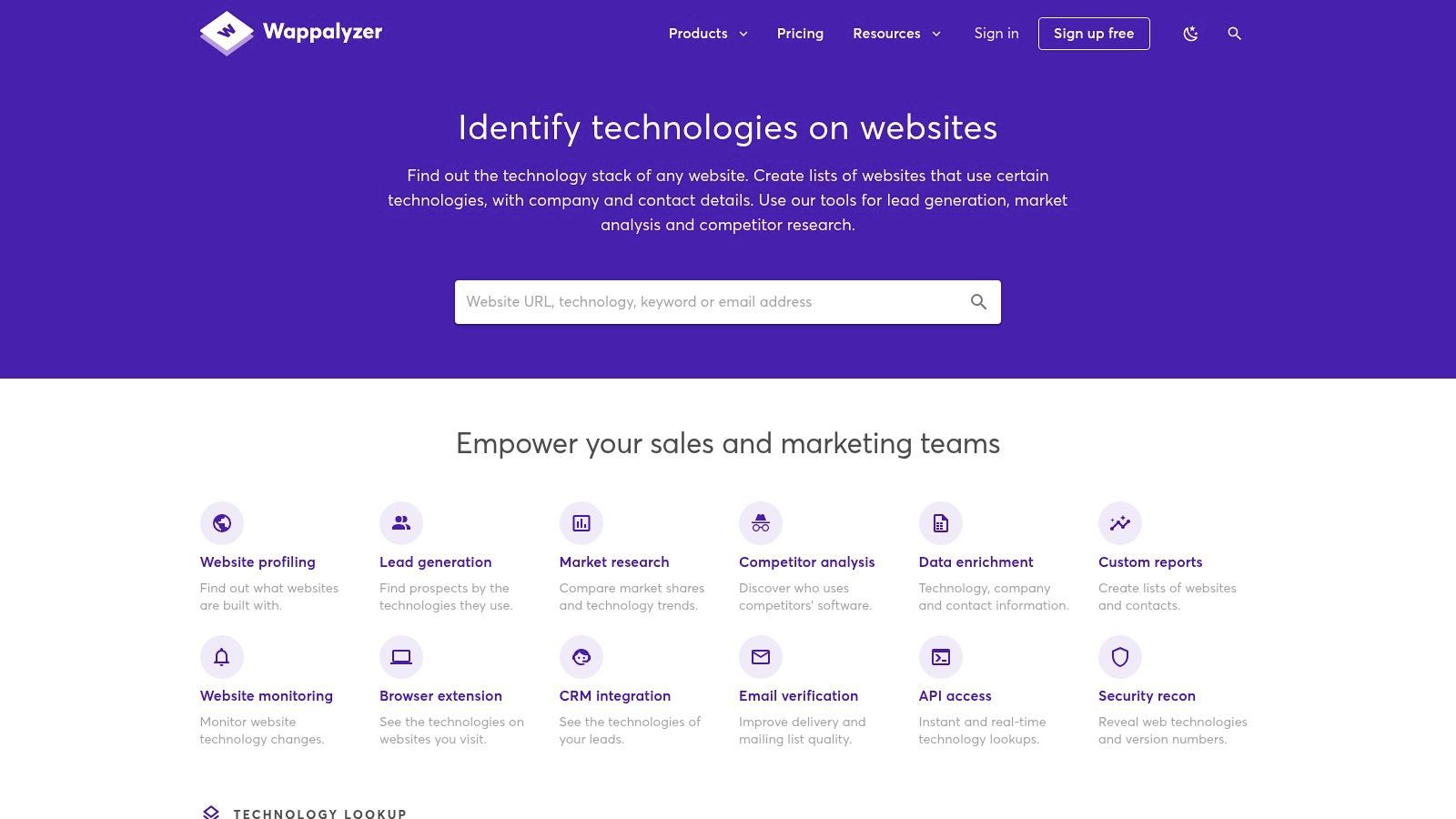
The platform is excellent for identifying highly relevant accounts with a demonstrated need. For example, a marketing agency can find all websites using HubSpot but not a specific SEO tool, creating a perfect pitch opportunity. Its browser extension provides on-the-fly tech lookups, while its list-building features and alerts notify you when a target company adds or removes a technology, signaling a potential opening.
Key Considerations
- Best For: B2B companies selling software, plugins, or services that depend on a customer's existing technology stack.
- Data Quality: Technographic data is generally accurate and updated frequently. However, the contact and firmographic data is less deep than what you'd find in a full-scale sales intelligence platform.
- Limitations: Its primary strength is technographics, so the depth of contact-level information (like job titles or direct dials) can be limited. The free tier is quite restricted, primarily serving as a trial for the paid features.
- Pricing: Offers transparent, credit-based, and subscription pricing that is often more accessible than larger competitors. Plans scale based on the volume of lookups, list credits, and API calls.
Wappalyzer is a powerful, specialized tool for creating targeted lists that traditional databases cannot easily produce, making your outreach more relevant and timely.
Website: https://www.wappalyzer.com
9. Dealfront (Leadfeeder)
Dealfront, which incorporates the well-known Leadfeeder tool, offers a powerful, inbound-focused approach to lead generation. Instead of buying static lists of cold contacts, it de-anonymizes your B2B website traffic by matching visitor IP addresses to company profiles. This gives your sales and marketing teams a real-time list of businesses that have already shown interest in your brand, making it one of the most effective alternatives to lead databases for identifying high-intent accounts.
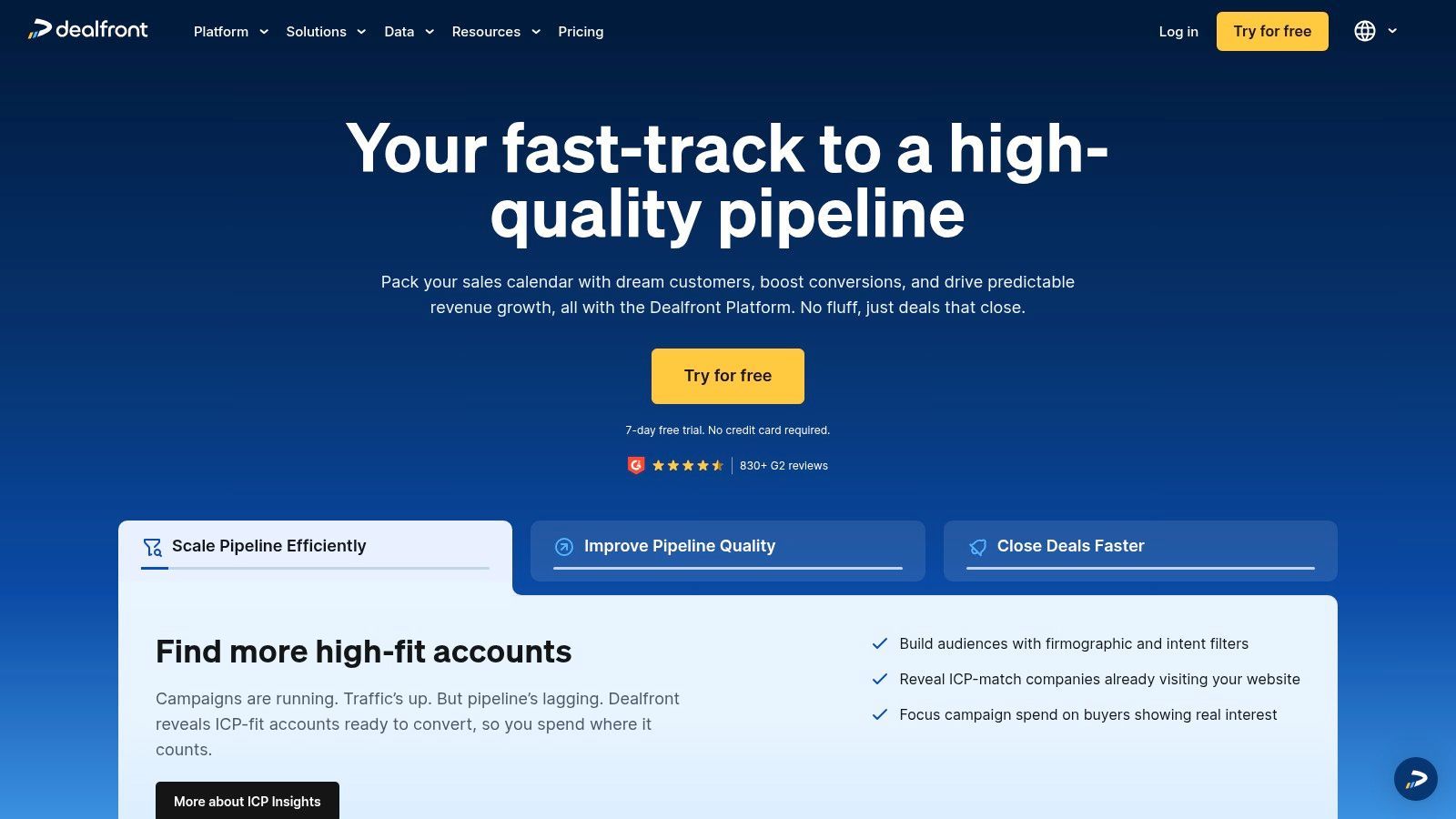
The platform is designed to turn anonymous visitors into actionable sales opportunities. By identifying which companies are browsing your site and what pages they view, you can trigger timely and relevant outreach. Dealfront provides detailed firmographic data, behavioral insights, and contact information for key decision-makers within those visiting companies, allowing you to connect with the right people at the moment of peak interest.
Key Considerations
- Best For: B2B marketing and sales teams looking to capitalize on existing website traffic and prioritize high-intent, inbound leads.
- Data Quality: The company identification data is strong, especially for EU-based businesses. Contact data quality depends on the credits used for reveals and third-party sources.
- Limitations: Its accuracy relies on IP-to-company mapping, which isn't always perfect. The core function identifies the company, not the individual visitor, so finding the exact person requires an extra step.
- Pricing: A free trial is available. Paid plans are often based on the volume of unique companies identified, which can be more scalable than per-seat models, but pricing often requires a direct quote.
Dealfront excels at fueling account-based marketing (ABM) strategies and can push identified leads directly into your CRM, creating a seamless workflow from anonymous visit to qualified opportunity.
Website: https://www.dealfront.com
10. Bombora Company Surge
Bombora Company Surge shifts the focus from who to when. Instead of supplying static contact lists, it identifies which of your target accounts are actively researching topics relevant to your products and services. By tracking content consumption across a massive B2B publisher co-op, it provides intent data that makes it one of the most strategic alternatives to lead databases for timing outbound efforts and prioritizing marketing spend.
This approach helps go-to-market teams move from cold outreach to informed engagement. A "Surge" score indicates a company is showing more interest in a specific topic than its historical baseline, signaling a potential buying window. This data can be used to trigger sales plays, launch targeted ad campaigns, or personalize messaging around a prospect’s current challenges, turning a cold start into a warm conversation.
Key Considerations
- Best For: Mid-market and enterprise ABM programs that need to prioritize accounts and personalize outreach based on buying signals.
- Data Quality: The intent signal is based on aggregated, third-party behavioral data. Its accuracy depends on the relevance of its 18,000+ topic taxonomy to your business.
- Limitations: It provides account-level intent, not contact-level. You still need a separate tool to identify and find contact information for the right decision-makers within a surging account. The topic-level signals also require careful planning to avoid acting on noise.
- Pricing: Custom pricing based on annual contracts. The entry cost is higher, making it less suitable for small businesses or teams just starting with intent data.
Bombora is not a contact database; it’s an intelligence layer that integrates with your existing CRM and marketing automation platforms to make your entire go-to-market strategy more efficient and timely.
Website: https://bombora.com
11. SparkToro
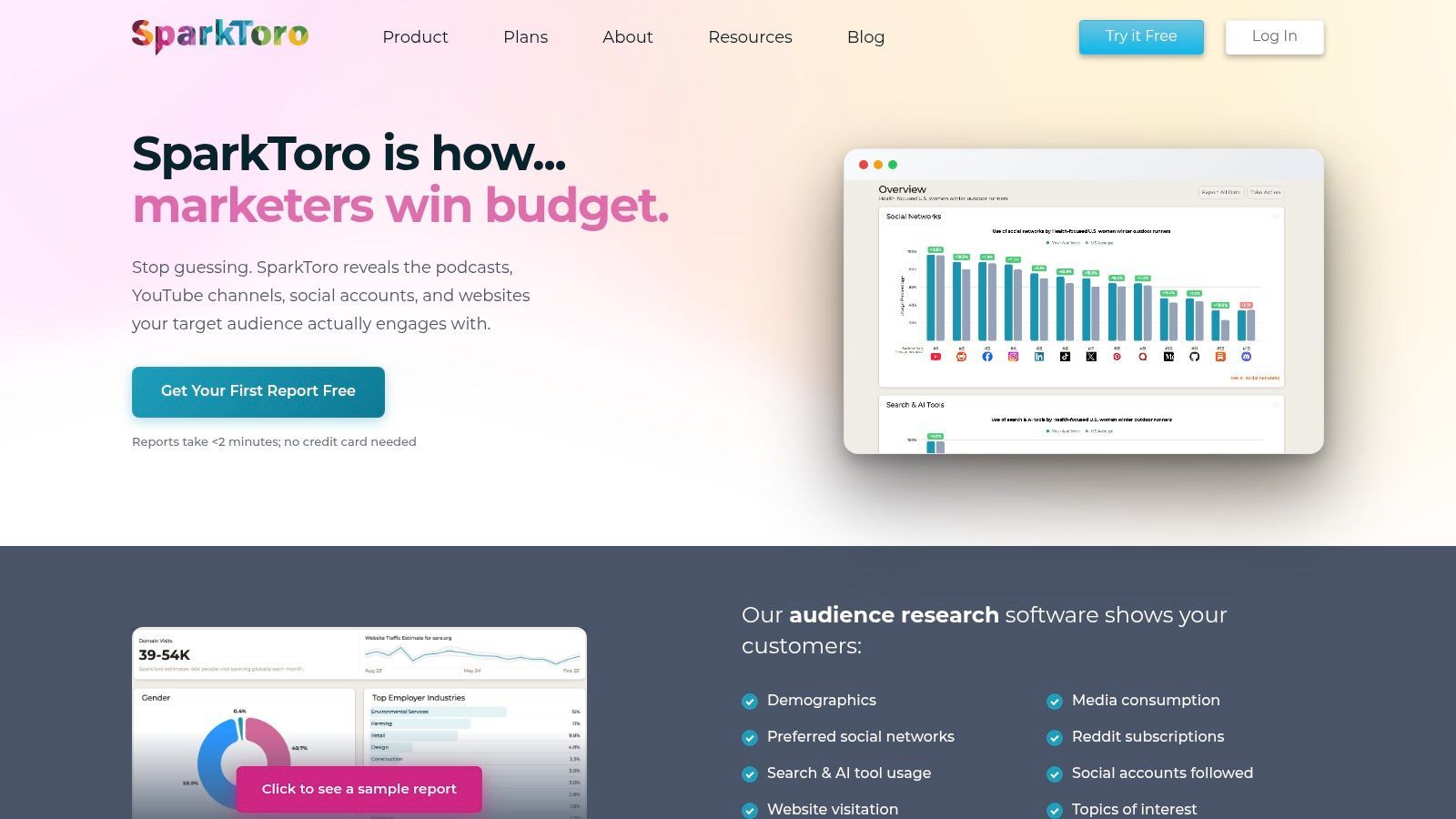
SparkToro is an audience research platform that shifts the focus from finding individual contacts to discovering where your ideal customers congregate online. Instead of providing a list of names and emails, it reveals the websites, social accounts, podcasts, and YouTube channels your target audience follows and trusts. This makes it an exceptional alternative to lead databases for building highly relevant, channel-native outreach and partnership strategies.
The platform helps you answer the crucial question: "Where can I reach my buyers?" By understanding the sources of influence for a specific audience, you can build prospect lists of potential partners, podcast hosts, or event organizers who already have your customers' attention. This approach allows for warmer, more contextual outreach than a standard cold email blast.
Key Considerations
- Best For: Marketers, sales teams, and founders looking to build channel partnerships, guest content opportunities, and influencer marketing campaigns.
- Data Quality: High, as it’s based on aggregated public social and web profile data, reflecting genuine audience behavior and influence.
- Limitations: It is not a direct contact database. While paid tiers provide some publisher contact details, its primary output is a list of influential sources, which often requires a separate tool or process to find specific contact information for 1:1 outreach.
- Pricing: Offers a free plan with limited monthly searches, with paid subscriptions (Basic, Business, Agency) that increase search quotas and add features like contact info and list exports.
SparkToro is ideal for top- and mid-funnel research, enabling you to build a go-to-market strategy around the actual watering holes your audience frequents, rather than just buying a static list of contacts.
Website: https://sparktoro.com
12. G2 Buyer Intent
G2 Buyer Intent provides a unique approach to lead generation by capturing first-party buying signals directly from its software review marketplace. Instead of offering a static database, it alerts you when companies are actively researching your product, competitors, or category. This makes it an exceptional alternative to lead databases for identifying prospects who are already in the market and evaluating solutions.
The platform goes beyond simple web traffic by tracking high-value actions like viewing your pricing page, comparing your product to alternatives, or reading reviews in your category. These signals provide crucial context, allowing sales teams to prioritize outreach to accounts demonstrating clear purchase intent. It transforms prospecting from a cold, volume-based game into a focused, intelligence-driven strategy.
Key Considerations
- Best For: SaaS sales and marketing teams looking to identify and prioritize mid-to-low-funnel accounts that are actively evaluating software.
- Data Quality: High, as it's based on real-time, first-party behavioral data from a trusted source. The intent signals are fresh and directly tied to buying activity.
- Limitations: Its value is almost exclusively for B2B software and service vendors. Pricing is opaque and sold as an add-on, often requiring an annual commitment. It identifies which companies are looking, but not always the specific individuals, so it may need to be paired with other tools.
- Pricing: Custom pricing based on package and data volume; sold as an add-on to a G2 Seller Profile subscription.
G2 Buyer Intent is ideal for complementing account-based marketing (ABM) strategies by feeding your CRM with a steady stream of highly qualified, in-market accounts.
Website: https://www.g2.com/products/g2-seller-solutions/
Top 12 Lead Database Alternatives — Comparison
| Product | Core features | Quality ★ | Value & Pricing 💰 | Target audience 👥 | Standout ✨ |
|---|---|---|---|---|---|
| ProfileSpider 🏆 | AI one-click extraction, dual profile detection, subpage enrichment, local-first storage, CSV/Excel/JSON export | ★★★★★ Fast & accurate | 💰 Free (10/page); Starter 25; Pro 50; Power 200 — credit-based | 👥 Recruiters, Sales, Marketers, Researchers, SMBs | ✨ Recommended — local-only storage, no setup, up to 200 profiles/page |
| LinkedIn Sales Navigator | Advanced people/account filters, Saved searches, CRM sync, InMail | ★★★★★ First-party graph | 💰 Seat-based premium | 👥 ABM, Enterprise sales, Account execs | ✨ Warm paths, decision-maker signals |
| Clay | 100+ enrichment sources, AI agents, workflows, API integrations | ★★★★☆ Source-rich | 💰 Credits-based; variable | 👥 Data ops, SDRs, Researchers | ✨ Source transparency; cascading enrichment |
| PhantomBuster | No-code automations (Phantoms), schedulers, integrations | ★★★★☆ Scalable | 💰 Subscription + execution/time quotas | 👥 Growth teams, Ops, Automators | ✨ Repeatable cross-channel scraping & workflows |
| Hunter | Domain Search, Email Finder, Verifier, Chrome add-on | ★★★★☆ Reliable emails | 💰 Credit model; free tier & annual discounts | 👥 Sales reps, Recruiters, Marketers | ✨ Strong email verification; Sheets integration |
| Dropcontact | Pay-on-success email enrichment, CRM sync, LinkedIn URL matching | ★★★★☆ GDPR-focused | 💰 Pay-on-success (EUR); credits re-credited on no-result | 👥 EU teams, GDPR-sensitive orgs | ✨ High validity rates; CRM-native enrichment |
| BuiltWith | Technographics, lead lists by tech, historical trends | ★★★★☆ Robust coverage | 💰 Premium pricing; per-list exports | 👥 BD, Product, GTM teams | ✨ Precise tech-based ICP targeting |
| Wappalyzer | Tech lookups, lead lists, API enrichment, alerts | ★★★☆☆ Budget-friendly | 💰 Published pricing + free monthly lookups | 👥 SMBs, GTM, Dev-focused teams | ✨ Cost-effective technographics & API |
| Dealfront (Leadfeeder) | IP-to-company, firmographics, lead scoring, CRM push | ★★★★☆ Inbound-focused | 💰 Quote-based; volume pricing | 👥 Marketing, ABM, Inbound teams | ✨ De-anonymizes web visitors for CRM |
| Bombora Company Surge | Topic-level intent scores, taxonomy, integrations | ★★★★☆ Intent-grade | 💰 Annual enterprise pricing | 👥 ABM, Mid/Enterprise GTM teams | ✨ Large-scale third-party intent signals |
| SparkToro | Audience research (sites, social, podcasts), publisher lists | ★★★★☆ Channel insight | 💰 Paid tiers; research quotas | 👥 Marketers, Content & Growth teams | ✨ Where buyers actually hang out (channel-first) |
| G2 Buyer Intent | First-party buying signals from G2 marketplace, activity scoring | ★★★★☆ High-intent signals | 💰 Add-on; enterprise contracts | 👥 SaaS vendors, RevOps, SDRs | ✨ Product-stage buying signals for prioritization |
Building Your Modern Prospecting Stack: From Static Lists to Dynamic Audiences
The era of buying static, often outdated, lead databases is giving way to a more intelligent and effective approach. As we've explored, the modern prospecting landscape is not about finding a single replacement for your old list provider. Instead, it’s about building a dynamic, multi-tool stack that generates fresh, relevant, and accurate contact information on demand. This shift moves your team from being passive list buyers to active audience builders.
The core takeaway is that high-quality prospecting now relies on sourcing and enrichment as distinct, but connected, activities. You no longer need to accept a pre-packaged list of questionable origin. Tools like LinkedIn Sales Navigator and SparkToro help you identify the right people and communities, while intent data providers like Bombora and Dealfront tell you when to reach out. Browser-based scrapers such as ProfileSpider then put the power directly in your hands, allowing you to ethically source public profile data from virtually any website where your ideal customers congregate. This targeted, real-time sourcing is fundamentally different from purchasing a list that has been resold countless times.
Key Principles for Modern Prospecting
Moving away from traditional databases requires a change in mindset. The goal is to create a living, breathing system for lead generation, not a one-time data dump. The most successful teams combine tools to create powerful workflows. For example, you might use G2 to identify companies researching your competitors, then use ProfileSpider to collect key decision-maker profiles from their company websites or LinkedIn pages, and finally use an enrichment tool like Clay or Hunter to find and verify their email addresses before syncing everything to your CRM. This layered strategy produces a lead that is not just a name on a list but a qualified prospect with demonstrated interest and verified contact details.
The best alternatives to lead databases empower you to be specific and timely. You can target attendees of a virtual event, members of a specific professional group, or employees at companies that just started using a complementary technology. This level of precision was once impossible with bulk data providers.
Your Migration Checklist: Moving Beyond Static Databases
Transitioning your team can feel daunting, but a structured approach simplifies the process. Here is a practical checklist to guide your move toward a more dynamic prospecting model:
- Audit and Analyze: Start by evaluating your current data sources. What is your actual cost per qualified lead from your existing database? How high is your email bounce rate? Understanding these baseline metrics will demonstrate the ROI of investing in new tools.
- Define Your Triggers: Revisit your Ideal Customer Profile (ICP). Go beyond firmographics and identify the key buying signals and triggers relevant to your business. Is it a new funding round, hiring for a specific role, or adopting a new technology? Your chosen tools should help you track these signals.
- Select a Primary Sourcing Tool: Choose your main engine for finding people. For many, this will be LinkedIn Sales Navigator for its powerful filters or a versatile scraper like ProfileSpider for its ability to extract profiles from any public source, giving you unmatched flexibility.
- Layer in Enrichment and Verification: Once you have a list of names and companies, you need accurate contact data. Select a tool like Hunter or Dropcontact to append and validate email addresses. This step is critical for maintaining your sender reputation and ensuring deliverability.
- Integrate and Automate: Connect your new tools to your CRM. The goal is a seamless flow of information from initial discovery to outreach. Use workflow automation tools like Clay to chain these actions together, minimizing manual work and creating a powerful, automated lead-generation machine.
Ultimately, the future of prospecting is about quality, relevance, and respect for privacy. By building a custom stack, you gain control over your data, improve your outreach effectiveness, and build a more sustainable pipeline. This approach not only generates better results but also aligns with modern data privacy standards, ensuring your outreach is both welcome and compliant.
Ready to start building fresh, targeted prospect lists today? ProfileSpider offers the fastest, most private way to begin. Install the free browser extension to instantly extract public profile data from any website and see for yourself how easy it is to create your own high-quality lead lists.