

If you're looking at buying a lead list, you've probably seen prices all over the map. They can range from just pennies to several dollars per contact, and bulk lists often go for anywhere from $100 to over $5,000. But that initial price tag? It’s almost always a distraction.
What it doesn’t tell you about are the hidden costs—the outdated data, the dismal conversion rates, and the legal headaches that really determine the list’s value.
Why the Price Tag Is Just the Beginning
When you buy a lead list, you're not just buying a spreadsheet of names and emails. You're supposedly investing in your future sales pipeline. The problem is, most of these lists are more of a gamble than a solid investment.
Think of it like buying a used car without checking its history. It might look like a bargain on the lot, but when the engine sputters out a week later, you realize the sticker price was the least of your worries. The real cost of a lead list comes from all the problems that crop up after you’ve paid the invoice.
The Hidden Costs of a "Cheap" Lead List
Every list vendor out there will promise you high-quality, targeted leads. But the reality is often a different story. A "cheap" list can quickly become your most expensive mistake, and here's why:
Wasted Hours: Your team ends up burning valuable time chasing ghosts. They’re calling people who left their jobs months ago, emailing addresses that bounce, and dialing disconnected numbers. B2B data decays at a staggering rate of 2.1% per month, which means over 22% of your list could be completely useless within a year.
Brand Damage: Nothing sours a potential customer faster than sloppy, irrelevant outreach. When you contact the wrong person with the wrong message, you don’t just get ignored—you get marked as spam. This hurts your email deliverability across the board, making it harder to reach even the prospects who do want to hear from you.
Compliance Risks: In the age of GDPR and CCPA, you can't afford to be careless with data. Using improperly sourced lists isn't just bad practice; it's a serious legal liability. The fines for violations can be massive, turning that "bargain" list into a financial nightmare.
A purchased lead list is just a snapshot in time. The moment it's created, the data starts to decay. The longer it sits, the more it turns from a potential goldmine into a pile of wasted effort and risk.
Instead of getting fixated on the initial price, a better alternative is building your own fresh, targeted lists. With a no-code tool like ProfileSpider, you get full control over data quality from day one. You know exactly where the information came from and how relevant it is, ensuring your outreach is built on a solid foundation. This approach tackles the core problems of pre-built lists, delivering a real, measurable return on your effort.
What Actually Determines Lead List Prices
That price tag on a lead list can be a bit of a mirage, swinging from just pennies per contact all the way up to several dollars. So, what’s really behind that massive range? A few key factors drive the cost, and understanding them is the only way to avoid getting burned by bad data.
Think of it like buying ingredients for a business dinner. You can get cheap, generic supplies, or you can source fresh, high-quality ingredients. Both result in a meal, but the final product—and how your clients feel afterward—will be worlds apart. The same idea applies to your lead data.
Quality and Recency: The Undeniable Price Drivers
The single biggest lever on price is data quality. Any reputable list provider invests in regular verification and data cleansing. That effort costs money, so they’ll naturally charge more than a fly-by-night operation that just scrapes together outdated info.
Recency is a very close second. A list compiled yesterday is exponentially more valuable than one that’s been sitting around for six months. B2B data decays at a shocking rate—people switch jobs, companies get acquired, and email addresses go dark. Freshness is your insurance against wasting time and money on ghosts.
A high-quality, recently verified lead list is an asset that fuels growth. An old, unverified list is a liability that drains your budget and your team's morale.
Industry Niche and Data Exclusivity
The price also starts to climb the more specialized or hard-to-reach your target audience is. For example, a list of marketing managers in New York City is fairly common and relatively cheap. But what about a list of Chief Technology Officers at Series B fintech startups in Europe? That’s a whole different ballgame. The rarity and difficulty in sourcing that data will command a premium.
This infographic nails the hidden costs of going cheap, showing how that initial price tag is directly connected to wasted hours, a damaged brand, and serious compliance risks.
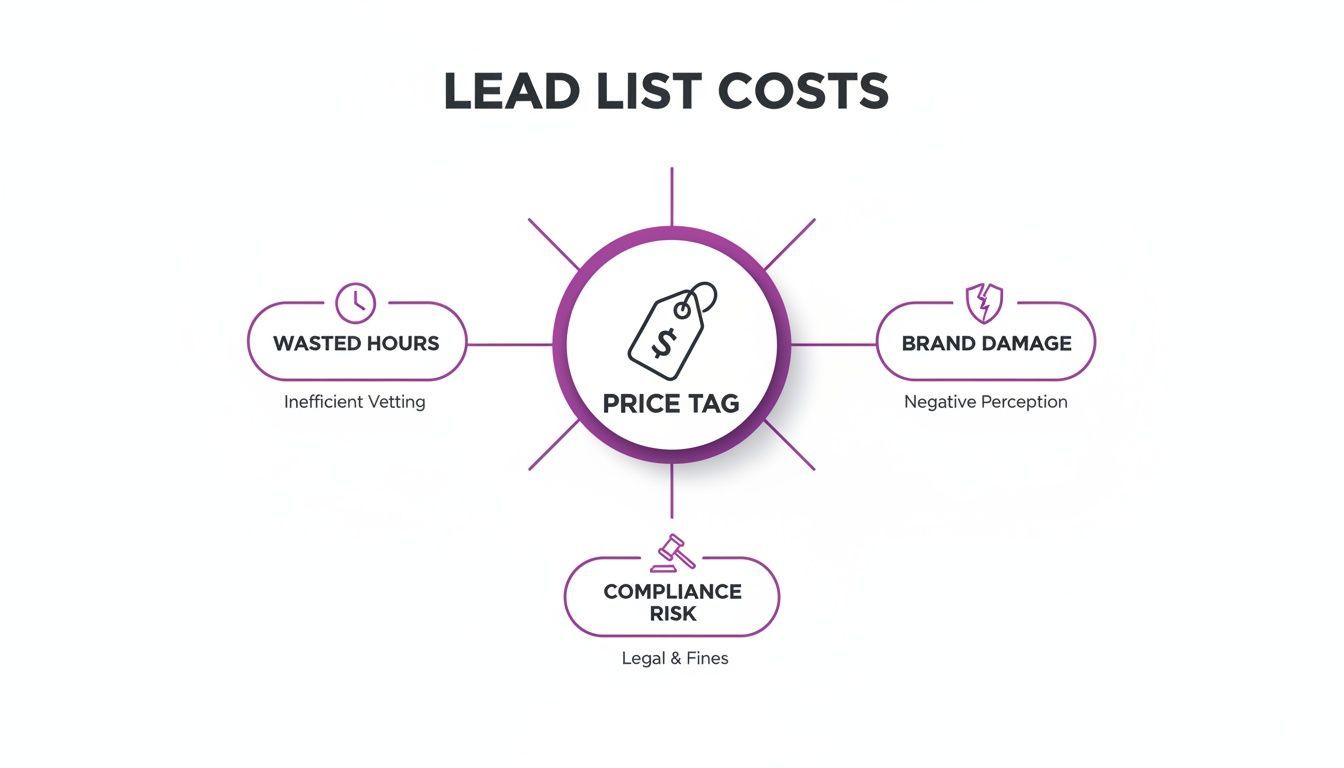
The takeaway here is that the upfront price is never the true cost. It's just the down payment on the operational headaches and reputational damage that inevitably follow a low-quality list.
Another huge factor is exclusivity. Most vendors are selling the same lists over and over again to multiple buyers—including your direct competitors. If you can get your hands on an exclusive list sold only to you, it will be much more expensive, but it can hand you a massive competitive edge.
Data Enrichment and Compliance Costs
The depth of the data matters, too. A basic list with just names and emails will always be on the lower end. But the cost ticks up with every valuable data point added through enrichment.
Here are a few common enrichment points that add both value and cost:
- Direct-dial phone numbers instead of a generic switchboard.
- Firmographic data like company size, annual revenue, or tech stack.
- Social media profiles (like LinkedIn URLs) for personalized outreach.
- Buying intent signals that flag a prospect actively researching solutions like yours.
Finally, compliance is a non-negotiable cost. A reputable provider invests in sourcing data ethically and ensuring it complies with regulations like GDPR and CCPA. This adds to the price, but it shields you from crippling fines. Cheap lists almost always cut corners here, putting all that risk squarely on your shoulders. You can see how this fits into the bigger picture in our guide on the pricing model for your lead data business.
While bargain-bin lists on platforms like Fiverr for $5 to $50 might look tempting, they're often a Trojan horse of bad data. On the other end, specialized agencies might charge anywhere from $500 to over $3,500 for reliable, vetted datasets. With email lists losing up to 22.5% of their validity every year, a cheap list becomes a false economy fast. This is exactly why many modern sales and recruiting teams are ditching the list-buying game and building their own instead.
Calculating the Real ROI of Your Lead List
The price you pay upfront for a lead list is just the down payment. The real investment comes from the time and resources your team sinks into working that list. To figure out if the purchase was worth it, you have to look past the invoice and calculate its true Return on Investment (ROI).
This isn't just about revenue—it's about profitability.
A cheap list that generates zero sales is infinitely more expensive than a premium list that closes even one solid deal. Calculating the real ROI provides the clarity to make smarter decisions.
The Basic Formula for Lead List ROI
To get started, you'll need to track a few key numbers. The formula itself is straightforward, but its power comes from being honest about all the associated costs.
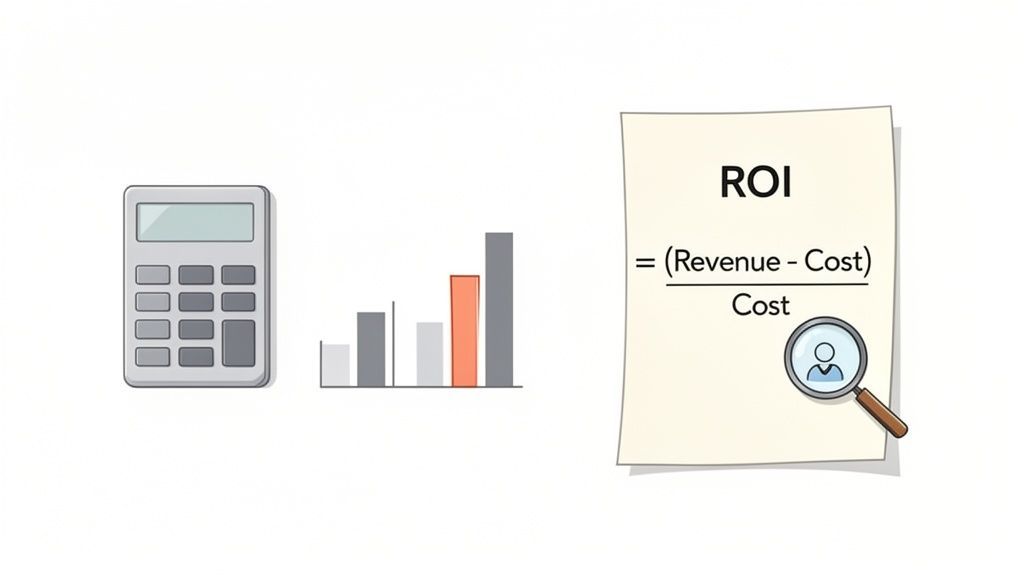
ROI = ( (Revenue from List - Total Campaign Cost) / Total Campaign Cost ) * 100
Here’s what to include in that "Total Campaign Cost":
- List Purchase Price: What you paid the vendor.
- Labor Costs: Your team's time spent on outreach (calls, emails, follow-ups).
- Tool & Software Costs: Expenses for your CRM, email automation platform, or dialer.
Let's walk through a quick example. Say you buy a list of 1,000 leads for $250.
A Tale of Two Lists: An ROI Example
Your team spends about 20 hours on outreach. With salaries and overhead, their time is worth $500. You also spend $50 on software for the campaign. This makes your Total Campaign Cost $800 ($250 + $500 + $50).
From this campaign, you convert 5 customers, and each has a Customer Lifetime Value (LTV) of $300. Your total revenue is $1,500.
Now, let's plug those numbers into the formula:
- ROI = ( ($1,500 - $800) / $800 ) * 100 = 87.5%
An 87.5% ROI looks fantastic on paper. And this is where many teams stop their analysis. But they're missing a critical piece that reveals the true quality of their investment.
Digging Deeper with Effective Cost Per Lead
The standard ROI calculation has a major flaw: it assumes every lead on your list was viable. We know that's never the case. Purchased lists are notorious for duds—bounced emails, wrong numbers, and contacts who left their jobs months ago.
This is where the Effective Cost Per Lead (eCPL) comes in. This metric recalculates your cost based only on the leads that were actually valid.
eCPL = Total Campaign Cost / Number of Valid Leads
Let's go back to our example. Out of the 1,000 leads you bought, you discover 300 were invalid (30% data decay). That means you only had 700 valid leads to work with.
So, your eCPL is:
- eCPL = $800 / 700 = $1.14 per lead
Suddenly, that list doesn't feel so cheap. You really paid $1.14 for every usable contact, not the 25 cents you thought. This metric gives you a brutally honest look at what you actually paid and is essential for comparing the true value of different lead sources.
For a more detailed breakdown, you can learn more about lead generation ROI calculation in our comprehensive guide.
Build Your Own Lists for Better Results
Instead of wrestling with the high costs and questionable quality of purchased lead lists, smart sales pros and recruiters are taking matters into their own hands. The alternative is simple: build your own hyper-targeted lists from the ground up. This approach solves the biggest problems with pre-packaged data—it's stale, a compliance nightmare, and engagement rates are often terrible.
When you build your own list, you switch from being a passive buyer to an active creator. You’re no longer rolling the dice on a vendor's old data; you're creating a fresh, proprietary asset that belongs only to you. This is how top performers consistently build a high-quality pipeline.
The Power of On-Demand Data Extraction
Imagine identifying the perfect source of leads—a specific LinkedIn search, a conference attendee page, an industry directory, or a company’s team page. Instead of paying a third party for that same public information, you can extract it yourself, right when you need it. This is exactly where a no-code profile scraper becomes your secret weapon.
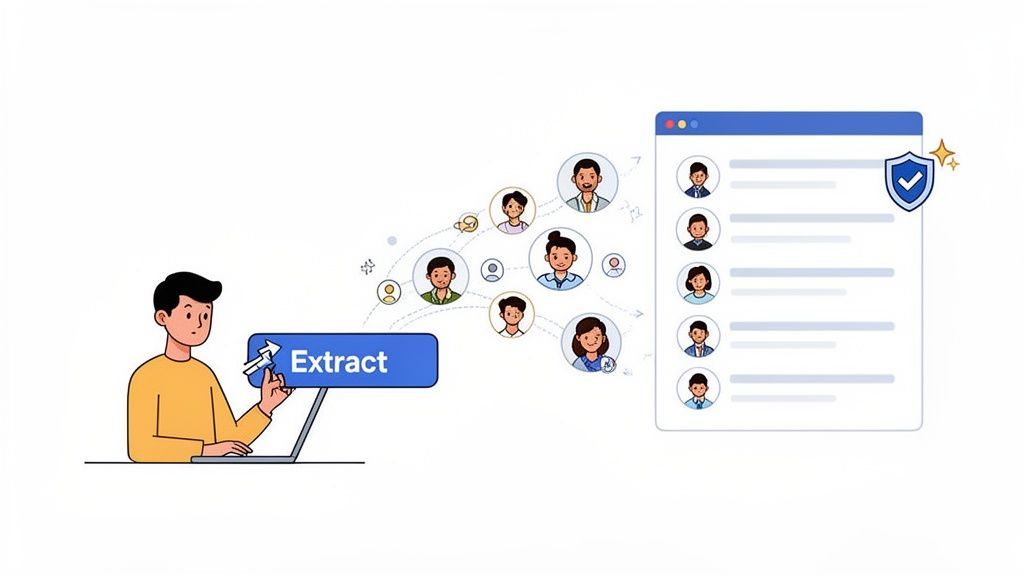
Tools like ProfileSpider make this incredibly easy. You just go to the page with your ideal prospects, activate the tool with one click, and instantly pull structured data like names, titles, companies, and contact info. The process ensures your information is as current as the source page itself, practically eliminating data decay from the equation.
It really is that easy: find a source, extract the profiles with a click, and you've got organized data ready for your workflow. You're not just getting a list of contacts; you're building a verified, relevant, and private database.
Core Benefits of Building Versus Buying
Making the switch to a DIY approach has massive advantages over buying lists. It completely changes the economics of lead generation by focusing on value and quality, not just volume.
Unmatched Accuracy and Relevance: The data you pull comes directly from the live source. This means you get the most up-to-date information possible, targeting only the profiles that perfectly match your ideal customer or candidate.
Superior Cost-Effectiveness at Scale: Purchased lists come with a hefty upfront cost and diminishing returns. But building your own with a tool like ProfileSpider is incredibly economical. You pay small amounts to process pages, which drives your cost per qualified lead way down. The free plan even lets you extract up to 10 profiles per page at no cost.
Inherent Compliance and Privacy: You're in complete control of the data collection process. Since the information is pulled live from public sources and stored locally on your device, you sidestep the compliance minefields that come with third-party data brokers. You know exactly where the data came from.
Complete Exclusivity: This is a huge advantage. The list you build is yours and yours alone. Your competitors can't just go out and buy the same spreadsheet, giving you a serious edge in your outreach.
By building your own lists, you turn public web data into a private competitive advantage. You are no longer renting access to stale contacts; you are creating a fresh, strategic asset that fuels your growth.
This self-service model puts the power back where it belongs: with sales teams, recruiters, and marketers. You can react to market changes on the fly, building new lists for new campaigns without waiting on a vendor. For a deeper dive, check out our guide on effective list building. This method transforms lead generation from a costly expense into a scalable, high-ROI activity.
How to Evaluate Lead List Providers
If buying a list is still the only way forward for your business, you have to be incredibly careful. The market is flooded with vendors, and telling the good from the bad can be a real challenge. Let's walk through an actionable checklist to help you vet providers and avoid getting burned.
This framework is your defense against shoddy data and shady practices. By organizing your questions into these critical categories, you can make a safer choice and minimize the financial risk.
Vet Data Quality and Accuracy
First, you need to grill vendors on their data quality. Vague answers are a massive red flag. Your goal is to get a crystal-clear picture of how they maintain their database and what guarantees they offer.
Here are the essential questions to ask:
- What is your data verification process? Do they use automated tools, manual checks, or a mix of both? How often is the data refreshed?
- Do you offer an accuracy guarantee? Many reputable providers will guarantee a certain percentage of valid contacts (e.g., 95% deliverability) and offer credits or a refund for anything that falls short.
- Can I see a sample of the data before I buy? Never purchase a list blind. A small, relevant sample is the best way to test the data's quality and format before you commit real money.
Demand Clarity on Compliance and Sourcing
In the age of GDPR and CCPA, you simply can't afford to be casual about compliance. A cheap list can quickly morph into a legal nightmare if the data was sourced unethically. Protecting your business means demanding total transparency.
Your vendor's compliance is your compliance. If they can't prove the data was sourced ethically and with consent, the legal risk falls squarely on your shoulders.
Ask them directly:
- Where and how was this data sourced? Push for specifics. Was it from public records, opt-in forms, or scraped from public profiles?
- Is your data compliant with GDPR, CCPA, and other regulations? They should be able to provide clear documentation or point to their policies on privacy laws.
When you're evaluating potential providers, look for platforms that offer robust tools to search for investors, as this often indicates a more sophisticated approach to data segmentation. And if you're curious about the pros and cons of building your own lists versus buying, it’s worth understanding the difference between lead scraping vs lead databases.
Asking these tough questions upfront will significantly cut down on the risk of a bad investment and protect your brand's reputation.
To make this process even easier, we've put together a simple scorecard you can use.
Vendor Evaluation Scorecard
Use this checklist to score potential lead list vendors on the factors that truly matter for quality and compliance.
| Evaluation Criteria | Key Question to Ask | Importance (High/Med/Low) |
|---|---|---|
| Data Source Transparency | "Can you tell me exactly how and where you sourced this specific list?" | High |
| Data Verification Process | "How often is your data verified and updated, and what's your process?" | High |
| Accuracy Guarantee | "Do you offer a written accuracy or deliverability guarantee? What is it?" | High |
| Compliance (GDPR/CCPA) | "Can you provide documentation on your compliance with privacy laws?" | High |
| Data Sample Availability | "Can I get a relevant sample of the data before making a purchase?" | High |
| Data Enrichment Options | "What data points are included, and can you add others like firmographics?" | Medium |
| Contract & Terms | "Are there usage restrictions? Is this a one-time purchase or a subscription?" | Medium |
| Customer Support | "What kind of support do you offer if I run into issues with the data?" | Low |
By systematically running each potential vendor through this scorecard, you’ll get a much clearer, side-by-side comparison that goes beyond just the price tag. It forces you to focus on the things that prevent headaches down the road.