

On paper, AI-powered lead generation sounds like a dream: an endless, automated stream of perfect prospects. But as many sales and recruiting teams have discovered, the reality is often messier. The biggest roadblocks with AI lead gen typically boil down to poor data quality, tricky compliance risks, and a glaring lack of real-world context.
This can quickly turn your shiny new automation budget into a money pit, leaving your team buried in useless contacts and damaging your brand's reputation.
This guide will break down these common challenges and pitfalls. We won't just point out the problems; we'll provide a clear, practical framework for overcoming them. The goal isn't to ditch AI, but to pair its raw speed with smart, human-led strategy—creating a system that actually delivers quality leads, not just a mountain of them.
Why AI Isn't a Silver Bullet
The promise of a perfectly curated prospect list generated at the click of a button often falls flat. This isn't just a small hiccup; it points to a much bigger problem. A staggering 95% of generative AI pilots—including those for lead generation—are failing to deliver measurable business impact, getting stuck in pilot mode without ever moving the needle. For sales, marketing, and recruiting teams, this means the AI that promised to solve everything is instead creating massive integration headaches.
The True Cost of Blind Automation
This incredibly high failure rate drives home a critical point. Jumping on the AI bandwagon without understanding its limitations leads to problems that go way beyond a simple lack of ROI.
You'll quickly run into challenges like:
- Wasted Budgets: Pouring money into tools that spit out low-quality, unusable, or non-compliant leads.
- Frustrated Sales Reps: Forcing your team to manually clean and double-check AI-generated lists completely defeats the point of automation.
- Damaged Reputation: Nothing kills your brand's credibility faster than sending sloppy, poorly targeted, or just plain wrong outreach.
For those evaluating specific tools, an honest FirmPilot review of AI marketing platforms offers some valuable, in-the-trenches insights into their actual performance and limitations. It’s all about finding that sweet spot where AI supports human strategy, rather than trying (and failing) to replace it.
The 'Ghost Lead' Problem Plaguing AI Platforms
One of the biggest headaches in AI lead generation is the 'ghost lead' problem. These are the contacts that haunt your CRM—outdated, duplicated, or just plain wrong. Many AI tools are designed to cast an incredibly wide net, scraping up data from all over without much thought for verification. What you're left with is a bloated, messy list that starts draining your resources before you even send the first email.
Think about it. Your team gets a list of 1,000 "AI-powered" leads. They’re excited. But in reality, they might spend the next few days just trying to weed out hundreds of contacts that are completely useless. It’s not just inefficient; it's a massive blow to morale and a waste of money. The promised shortcut quickly becomes a manual cleanup nightmare.
The True Cost of Dirty Data
This isn't a rare occurrence. Imagine setting up an AI tool, only to find that, like 44% of organizations, you have to manually double-check every single list it spits out because they're loaded with junk.
Consultants report that a raw list of 1,000 AI-sourced contacts often gets whittled down to just 600 viable leads after a proper cleaning. That’s a staggering 40% loss rate right off the bat. Sales reps can end up wasting up to 30% of their time sorting through this digital trash instead of actually selling.
Poor data quality kicks off a domino effect of expensive problems:
- Wasted SDR Time: Every minute spent scrubbing a list is a minute not spent having a real conversation with a potential customer.
- Damaged Sender Reputation: Sending emails to a long list of invalid addresses leads to high bounce rates. Before you know it, your domain is on a blacklist, and your future campaigns are dead in the water.
- Skewed Campaign Metrics: Bad data makes your numbers look terrible. Your cost-per-lead skyrockets, and you end up making bad strategic decisions based on flawed analytics.
"The core issue with many AI lead platforms is that they optimize for quantity over quality. They deliver a massive list to justify their value, but leave the expensive and time-consuming task of verification to the user."
This is how the initial promise of hands-off automation quietly turns into more manual work for your team. The table below breaks down the very real business impact of relying on unverified AI lead lists.
The Hidden Costs of Poor AI Lead Data Quality
| Area of Impact | Direct Consequence | Business Cost |
|---|---|---|
| Sales Team Productivity | Reps spend hours verifying and cleaning lists instead of selling. | Lost sales opportunities and high employee frustration. |
| Marketing Campaign ROI | High email bounce rates and low engagement from irrelevant contacts. | Wasted ad spend, inflated cost-per-lead, and poor campaign performance. |
| Sender Reputation | Emails sent to invalid addresses trigger spam filters and blacklists. | Sabotaged deliverability for all future email outreach efforts. |
| Data & Analytics | Flawed data leads to inaccurate reporting and forecasting. | Poor strategic decisions based on a skewed view of the market. |
| Brand Perception | Reaching out to the wrong person or using outdated information. | Damaged credibility and a negative first impression. |
As you can see, the ripple effects of bad data touch nearly every part of your go-to-market strategy, turning a seemingly small issue into a significant financial drain.
How ProfileSpider Overcomes This Challenge
The only real way to solve the 'ghost lead' problem is to take back control over your data source. Instead of trusting a black-box AI that pulls contacts from who-knows-where, you need a smarter, no-code approach.
This is where a tool like ProfileSpider provides a one-click solution. It allows you to point it directly at a high-quality source page—like a conference speaker list, a curated industry directory, or a company's team page. With a single click, it extracts the profiles, guaranteeing that every contact is relevant from the start. This simple workflow change moves you from a passive victim of bad data to an active strategist who owns lead quality. It’s also a crucial step in avoiding the common pitfalls that lead to outdated contacts.
The diagram below gives you a stark visual of how often generative AI pilots, including those for lead generation, just don't deliver. A lot of that comes down to fundamental issues like data quality.
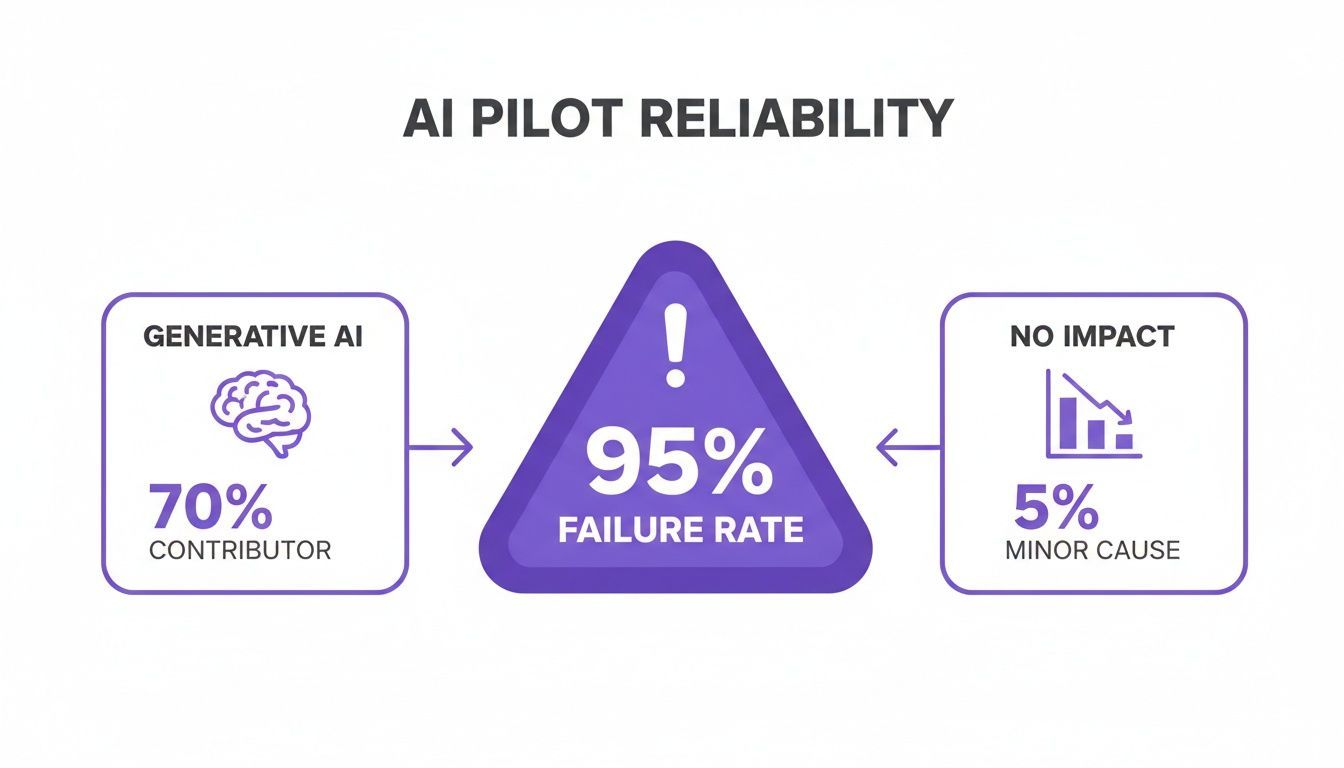
That massive failure rate is a clear warning. It highlights just how critical it is to have a strategy that puts data quality and control ahead of blind automation.
Navigating the Black Box of Data Sourcing
One of the biggest problems with AI lead generation is that you often have no idea where the data is actually coming from. Many platforms operate like a “black box.” They spit out a list of contacts, but the origin story—where that info was found, how old it is, and if it was scraped legally—remains a complete mystery.
This isn't just a minor inconvenience; it's a massive business risk. Using data from an unknown source can easily land your company in hot water, especially with today's strict privacy laws.
The High Stakes of Compliance
Regulations like the General Data Protection Regulation (GDPR) in Europe and the California Consumer Privacy Act (CCPA) don't mess around. These laws give people real power over their personal data, including the right to know exactly how you got it. If you can't trace a lead's origin, you can't prove you have any right to contact them.
The penalties for getting this wrong are steep. A single violation can lead to fines in the millions, not to mention the hit to your brand's reputation. Trust is hard to build and incredibly easy to lose.
The "black box" model forces you into a dangerous gamble. You're trusting a third-party vendor with your company's legal and financial well-being without any way to verify their claims.
- GDPR Violations: Fines can soar up to €20 million or 4% of a company’s global annual revenue, whichever is higher.
- CCPA Penalties: Civil penalties can hit $7,500 per intentional violation. For a big lead list, that adds up fast.
- Brand Damage: Get a reputation for shady data practices, and you’ll find it much harder to win over customers and partners.
How ProfileSpider Overcomes This Challenge
The only way to navigate this compliance minefield is to ditch the black box and embrace a transparent, user-driven approach. Instead of buying mysterious lists from traditional scrapers, you need to control your data source from the start. This is where the difference between cloud-based scrapers and modern browser-based tools really matters. To dig deeper, check out our guide on browser-based lead collection vs traditional scrapers.
With a no-code tool like ProfileSpider, you're the one in the driver's seat. You pick the exact webpage—a conference attendee list, a professional directory, a company’s team page—and the tool extracts the data locally on your machine with one click. This simple workflow gives you total control over data provenance, which is just a formal way of saying you have a clear, documented trail of where every piece of data originated.
This method completely changes the risk equation. Because you chose the source, you always have the context to justify your outreach. Your lead generation becomes both effective and, just as importantly, fully compliant.
Why AI Struggles with Context and Nuance
One of the biggest letdowns with AI lead generation is its inability to grasp human context. Sure, an AI can scan a company's website and pull every person with "Director" in their title. But it has no idea which of those is the actual decision-maker for your product. It might hand you the Director of Human Resources when you desperately need the Director of Demand Generation.
This creates a massive gap between raw data and actual intelligence. Without context, data is just noise. This blindness to context leads directly to poorly targeted outreach. You waste time, and worse, you damage your brand's credibility. Pitching a sales tool to a media relations manager you scraped from a press release is a classic mistake—it screams that you haven't done your homework.

The Human-in-the-Loop Solution
The best way to sidestep this problem is to use a human-in-the-loop approach. It’s a simple strategy: combine your own professional expertise with the AI's raw processing speed. This ensures every lead isn't just accurate but also perfectly relevant.
So, instead of vaguely asking an AI to "find leads in the tech industry," you use your industry knowledge to point it at a high-quality source. Maybe you target a recent speaker list from a specific SaaS conference. You've already done the hard part—you know everyone on that list is a relevant expert or decision-maker.
By selecting the source yourself, you provide the context that AI inherently lacks. You’re not just outsourcing the entire process; you're strategically directing the AI to perform a specific, high-value task.
This hybrid model turns the AI from a frustrating black box into a powerful assistant. You handle the high-level strategy and sourcing, and the tool automates the mind-numbing labor of pulling all the data.
How ProfileSpider Overcomes This Challenge
This is exactly where a modern, no-code tool like ProfileSpider shines. It doesn't try to guess who you should contact. Instead, it puts you in the driver's seat as the expert. In a simple one-click workflow, it allows you to:
- Pinpoint Your Source: Go directly to a webpage you've already vetted, like a list of award winners or a professional association's member directory.
- Execute with Precision: Use the one-click extraction to instantly capture profiles from that specific, context-rich source.
- Maintain Full Control: Because you're driving the process, you always know the exact origin and relevance of every single contact on your list.
This approach ensures you’re building a list of highly qualified, contextually appropriate prospects, not just a list of names. To see how this human-led automation plays out in other fields, check out our breakdown of what AI can and can't do in recruiting. It’s all about using automation to enhance your judgment, not replace it.
The Arms Race Against Anti-Scraping Technology
Many AI lead generation tools are unreliable because most traditional, cloud-based platforms are locked in a constant battle with websites' anti-bot technologies. This ongoing arms race is a huge reason these tools get blocked, deliver flaky results, and ultimately fail to live up to the hype.
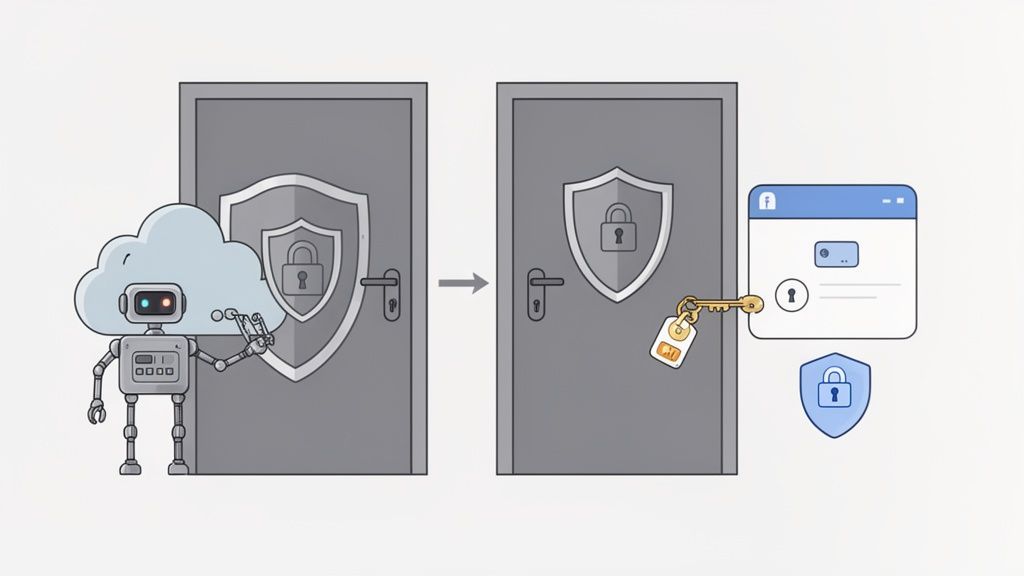
A cloud-based scraper is like an unwanted visitor trying to sneak into a secure building. It sends a flood of rapid-fire requests from generic data center IP addresses—a dead giveaway for any decent security system. Websites immediately throw up the digital equivalent of a brick wall: CAPTCHA's, rate limits, and IP blacklists that stop the scraper dead in its tracks. The result for you? Failed jobs, half-baked data, and a lead source you just can't count on.
Why a Local, Browser-Based Approach Wins
Now, imagine walking into that same building as an authorized guest with a keycard. That's how a modern browser extension like ProfileSpider operates. Because it runs locally within your authenticated browser session, every request it makes looks like normal, human activity. There are no suspicious IPs or unnaturally fast clicks to set off any alarms.
The big difference is that a local tool works with your existing permissions, not against the website's security. It piggybacks on your authenticated access, which makes its activity virtually impossible to detect and far less likely to ever get blocked.
This simple technical distinction is the secret to reliably gathering data from protected platforms where those big, automated cloud tools consistently fail.
How ProfileSpider Overcomes This Challenge
The constant cat-and-mouse game played by cloud scrapers directly poisons the quality of the leads they manage to find. When a tool is getting blocked on and off, it can only grab bits and pieces of data, leaving you with useless, patchy lists.
By working from your local browser as a simple, no-code extension, ProfileSpider sidesteps this entire mess. It gives you a stable, one-click way to extract profiles, ensuring the data you collect is complete and reliable every single time. To dig deeper into this strategy, you can learn how to avoid getting blocked when scraping leads just by choosing the right kind of tech for the job.
Building a Hybrid Intelligence Lead Strategy
The future of lead generation isn't about letting AI take the wheel completely. Relying blindly on automated platforms is a recipe for disaster—think bad data, sketchy privacy issues, and a total lack of context.
The real breakthrough comes when you stop trying to replace human expertise and start amplifying it. The winning strategy is a "hybrid intelligence" model, one that pairs AI's raw speed for data extraction with your hard-won experience in sourcing and vetting prospects. Your professional judgment is, and always will be, the most valuable part of this equation.
The Power of Human-Directed Automation
This is a practical workflow that directly solves the core limitations of AI lead generation. When you're the one choosing the data source—say, a hand-picked list of speakers from a niche industry conference or a specialized professional directory—you're providing the critical context AI can't possibly grasp on its own. This simple shift puts you back in control of lead quality and compliance right from the start.
See AI not as a magic button, but as a hyper-efficient assistant. It crushes the tedious, manual work, freeing you up to focus on high-level strategy and building genuine relationships.
Following this model ensures every lead isn't just another name on a spreadsheet, but a relevant, well-vetted prospect who actually fits your ideal customer profile.
Putting Hybrid Intelligence into Practice
This is exactly why we built ProfileSpider. It’s designed from the ground up for this modern, hybrid approach, perfectly merging human insight with machine efficiency. The tool automates the mind-numbing task of data collection, but you always remain in the driver’s seat, steering the entire strategy.
Here’s what that looks like in the real world:
- You Provide the Strategy: You use your market knowledge to pinpoint a high-value source of potential leads.
- AI Provides the Speed: ProfileSpider rips through your chosen source and extracts the profiles with a single click, saving you hours of manual copy-pasting.
- You Control Compliance and Quality: Because you chose the source and the data is processed locally on your machine, you have complete transparency and control over where that data came from.
This workflow doesn't just work around AI's limitations; it turns them into strengths. Your lead generation becomes faster, more efficient, and more importantly, smarter, more targeted, and built on a foundation of quality you can actually trust.