

A B2B lead generation funnel isn't just a marketing concept; it's the strategic engine that takes a complete stranger and guides them, step-by-step, until they become a paying client. Think of it as a roadmap for your customer's journey, broken down into clear stages—Awareness, Consideration, and Decision. This structure lets you create laser-focused marketing and sales plays for each step, which is how you build predictable revenue.
Your Blueprint for a Modern B2B Lead Generation Funnel
Let’s be clear: building a solid lead generation funnel for a B2B company isn’t about casting a wide net and hoping for the best. It’s about precision. It's about engineering a scalable system that consistently turns prospects into high-value customers. We're moving past abstract theories here and into solving real business problems at every single stage of the journey.
And that whole process hinges on one thing: a deep, almost obsessive understanding of your Ideal Customer Profile (ICP).
Seriously, if you don't have a crystal-clear picture of who you're targeting, every dollar and hour you spend trying to fill your funnel will be a waste. Who are they, really? What are their biggest headaches at work? Where do they hang out online looking for answers? Nailing these questions down is the foundation for everything else you'll do.
The Modern B2B Funnel Stages and Objectives
To guide prospects from a casual "hello" to a signed contract, you have to meet them where they are. Their journey isn't always a straight line, but it does follow a pretty logical path of needs and questions.
The table below breaks down the core stages, the main goal for each, and how to measure success along the way.
| Funnel Stage | Primary Objective | Key Metrics |
|---|---|---|
| Awareness (TOFU) | Capture attention and generate initial interest from the ICP. | Website Traffic, Social Engagement, Content Downloads, Brand Mentions |
| Consideration (MOFU) | Nurture interest and educate qualified leads on potential solutions. | MQLs, Email Open/Click Rates, Webinar Attendance, Demo Requests |
| Decision (BOFU) | Convert highly qualified leads into sales opportunities and new customers. | SQLs, Opportunities Created, Conversion Rate, CAC, LTV |
Each stage demands a different mindset and a unique set of tactics. You can't just throw the same content at someone in the Awareness stage as you would a lead who's ready to see a demo.
Mapping the B2B Customer Journey
This journey can be visualized to better understand how a large number of initial prospects get narrowed down into actual customers.
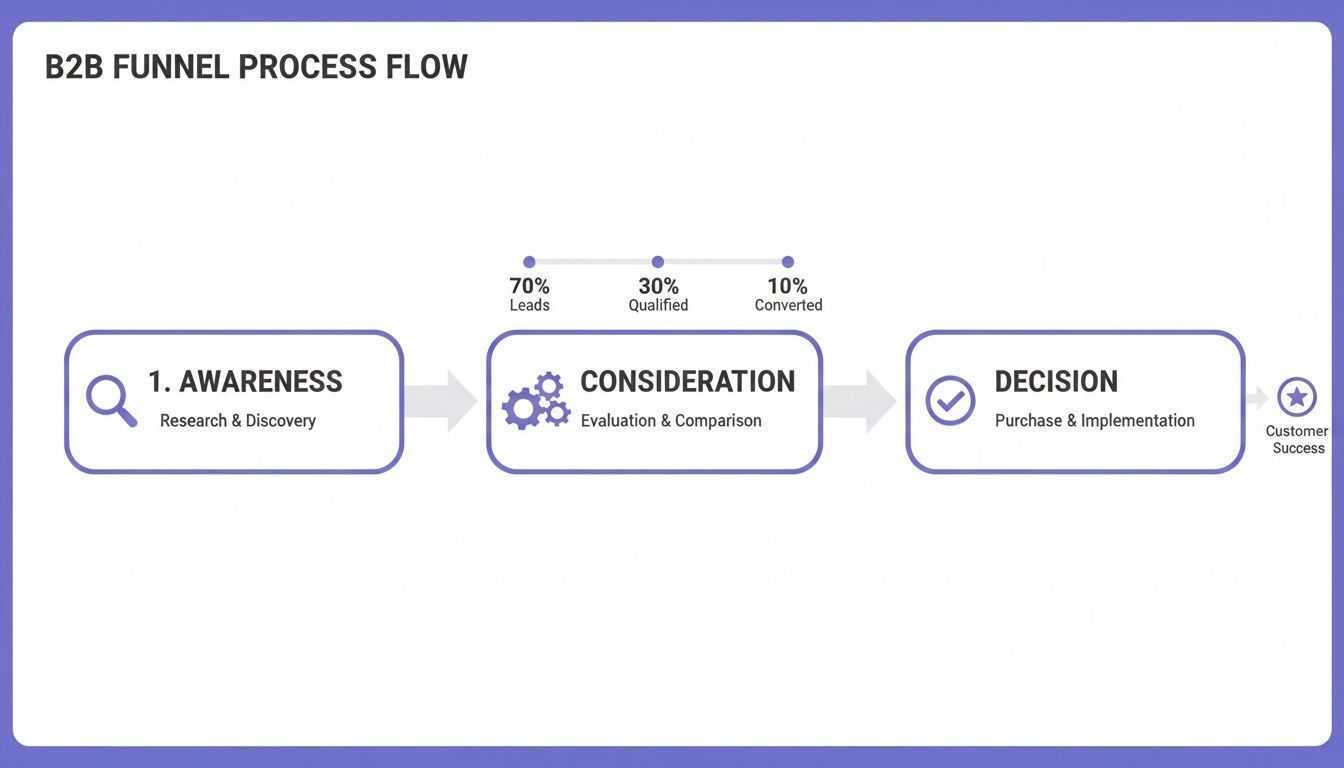
As you can see, the numbers drop at each stage. Your job is to make those drop-offs as small as possible by delivering the right value at the right time.
The Real Challenge: Lead Quality
Here's the problem every B2B company runs into: getting a steady stream of high-quality prospects into the top of the funnel. And quality is the key word.
It’s no surprise that 91% of marketers see lead generation as their number one priority. But here's the kicker: a painful 80% of new leads never actually close. Why? Most of the time, they were either the wrong fit from the start or they weren't nurtured correctly.
A leaky funnel isn't a marketing problem; it's a fundamental business problem. The goal is to generate future customers who will stick around, not just fill a spreadsheet with names.
This is where having the right tools makes all the difference. Instead of wasting budget on stale, inaccurate lists, top-performing teams are using smarter solutions to get precise prospect data. Building an accurate and targeted prospect database is the true first step to a healthy, efficient funnel. This modern approach ensures the people entering your funnel are a perfect match for your ICP from day one. That alone dramatically boosts your odds of conversion and cuts down on wasted time for everyone.
Attracting Your Ideal Customer at the Top of the Funnel
The top of your lead generation funnel for a B2B company—what we call the "Awareness" stage—is where you make your first impression. The goal here isn't a hard sell. It’s about attracting the right people by offering real value and positioning your brand as a credible, helpful resource. Think of it less like casting a wide, hopeful net and more like setting out smart, targeted bait.
Success at this stage comes down to one thing: knowing where your Ideal Customer Profile (ICP) hangs out online and what problems keep them up at night. You need to create and share content that answers their questions before they even know they need a solution like yours.
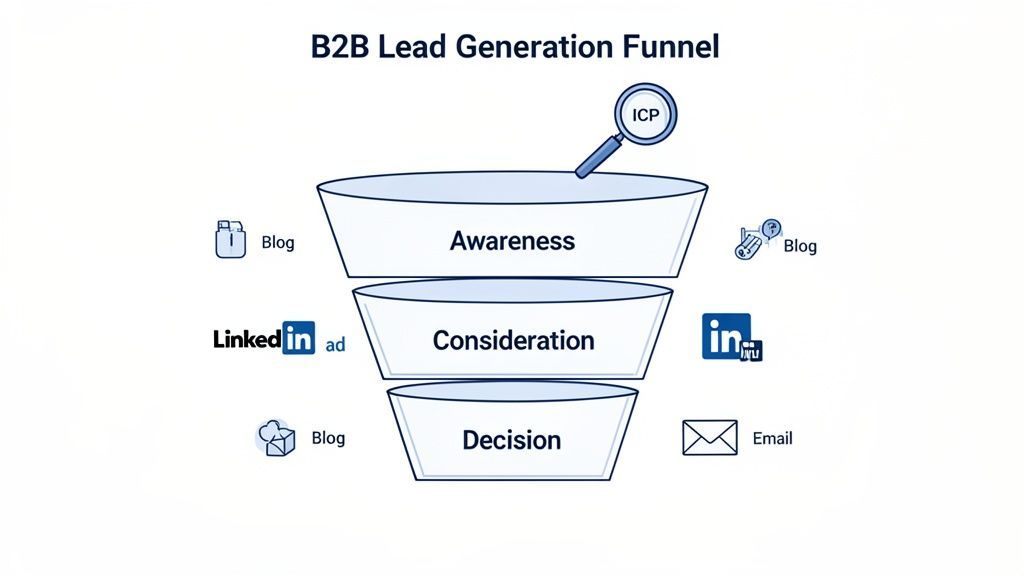
This is the natural home for tactics like SEO, content marketing, and a killer social media presence. Your prospects are out there actively searching for solutions, and your job is to be the one who shows up with the answers.
Building Your TOFU Content Engine
To really grab someone's attention, you need a solid mix of content that speaks directly to their needs. This is the stuff that draws prospects into your world.
- Educational Blog Posts: Go after common industry problems with SEO-optimized articles. For example, a cybersecurity firm might publish a piece like, "5 Common Data Security Blindspots for Mid-Sized Tech Companies."
- In-Depth Guides and Whitepapers: Offer up a meaty, comprehensive resource that prospects can download in exchange for an email. This is how you build authority and get a tangible asset into their hands.
- Webinars and Virtual Events: Host live sessions digging into a hot topic. Webinars are gold for generating high-intent leads who are hungry for knowledge.
- Social Media Engagement: Don’t just broadcast—engage. Jump into relevant LinkedIn conversations, share useful insights, and build a real community. We’ve got a whole playbook on this in our social media lead generation guide.
The secret ingredient here is consistency. One great blog post isn't going to change your business, but a steady drumbeat of valuable content will build serious momentum and make your brand the go-to source in your space.
Challenge: Fueling Your Outreach and Paid Campaigns
While great content brings people to you, proactive outreach and paid ads are the accelerators that fill your funnel fast. But this is exactly where most teams get stuck. They hit a massive bottleneck trying to find accurate, relevant prospect data. Let’s be honest: building lists manually is a soul-crushing, error-prone waste of time.
The quality of leads entering your funnel directly dictates the quality of customers coming out. Garbage in, garbage out. Investing in precise, clean data at the TOFU stage is the single biggest lever you can pull for long-term funnel health.
Let's walk through a real-world scenario. Say you're targeting Marketing VPs at SaaS companies who are attending a big industry conference next month.
The Traditional Method (The Grind):
- Hunt down the conference website and hope they published a speaker or attendee list.
- Start the mind-numbing process of copying and pasting names, titles, and companies into a spreadsheet.
- Head over to LinkedIn to search for each person, verify their details, and find their profile URL.
- Fire up another tool to try and guess their email address.
- After hours—or even days—you end up with a list that's probably full of mistakes.
The Modern, One-Click Workflow:
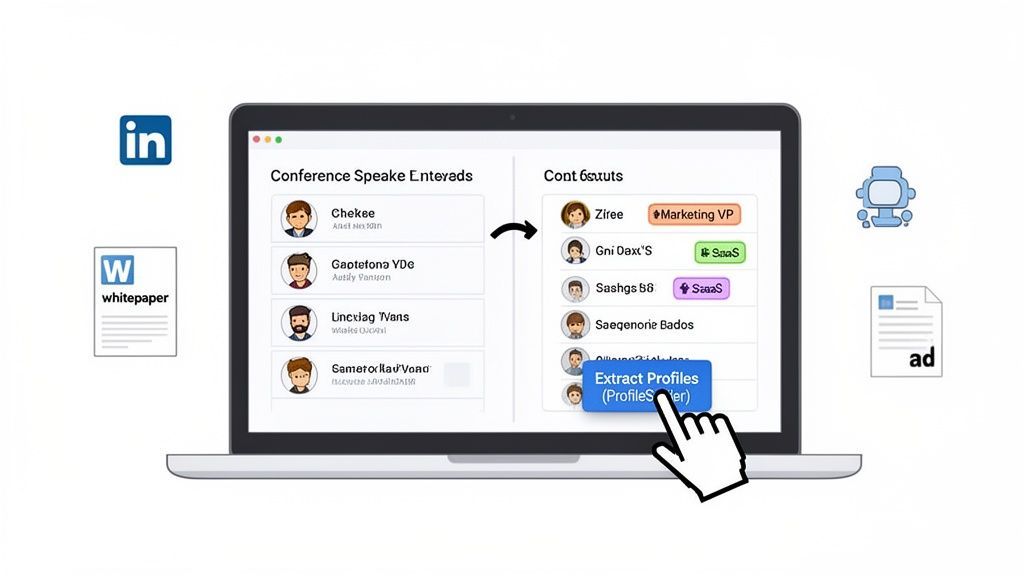
This is the kind of manual work that tools like ProfileSpider were built to eliminate. It overcomes this common challenge by turning a tedious, multi-day task into a single click.
- Navigate to the tech conference's speaker page.
- Open the ProfileSpider Chrome extension.
- Click "Extract Profiles."
That's it. The AI-powered, no-code tool instantly scans the page, pulling every profile into a clean, structured list with names, titles, and company info. You now have a hyper-targeted list ready for a personalized cold outreach sequence or for creating a laser-focused custom audience in your next LinkedIn Ads campaign.
This workflow directly solves the TOFU challenge by giving you the high-quality fuel you need for your outbound lead generation and paid channels with speed and precision that’s impossible to match manually. It frees up your sales and marketing teams to do what they do best: focus on strategy and building relationships, not data entry.
Converting Website Visitors into Qualified Leads
Alright, you've done the hard work of getting your ideal prospects to your website. Now what? This is where the game really shifts. We're moving into the Middle of the Funnel (MOFU), and the goal is to turn those anonymous visitors into actual, known leads.
In the B2B space, this is more than just grabbing an email address. It’s the very beginning of a potential business relationship. Success here comes down to one thing: offering something so valuable that a prospect is happy to trade their contact information for it. This is where you need smooth landing pages, dead-simple forms, and lead magnets they can't resist. A clunky experience or a weak offer will stop a great lead cold.
Crafting High-Conversion Lead Capture Points
To start turning that traffic into tangible leads, your website can't just be a digital brochure. It needs to be an active part of your lead generation funnel b2b strategy, armed with assets designed for one purpose: conversion.
- Compelling Lead Magnets: This is your value exchange. Offer something genuinely useful that solves a real problem for your ICP. Think comprehensive e-books, exclusive webinars, data-packed case studies, or even a free tool. The value needs to be so obvious that giving you an email feels like a bargain.
- Frictionless Forms: Keep. It. Simple. Seriously. At this stage, a name and business email are often all you need. Every extra field you add—phone number, company size, favorite color—is another reason for them to bail. You can always gather more intel later in the process.
- Optimized Landing Pages: Every lead magnet deserves its own dedicated landing page. Strip away all navigation and distractions. The page should have a single, crystal-clear call-to-action (CTA) and focus entirely on the benefits of the offer. Make them feel like they need to download it right now.
The Art of Lead Qualification and Scoring
Let's be honest: not all leads are created equal. A student downloading your whitepaper for a research project is worlds away from a VP of Operations requesting a demo. This is why lead qualification is non-negotiable. Without it, your sales team will burn through hours chasing people who have zero intention of ever buying.
The goal is to filter the curious from the genuinely interested. We usually do this by splitting leads into two main buckets.
- Marketing Qualified Lead (MQL): This person has engaged with your marketing—they downloaded that e-book or attended your webinar. They fit your target profile and have shown some interest, but they aren't waving a "buy now" flag just yet.
- Sales Qualified Lead (SQL): An SQL is a different beast. They've taken a significant step that shows clear buying intent. Maybe they requested a price quote, started a free trial, or hit your "Contact Sales" button. These are the hot leads your sales team needs to jump on immediately.
A well-defined lead scoring system is the secret handshake between marketing and sales. It automates this whole qualification dance, making sure your reps are only spending time on leads with the highest chance of closing. This dramatically speeds up your sales cycle and boosts ROI.
Accelerating Qualification with Modern Tools
Even with a slick qualification process, you often start with just a name and maybe a company from a webinar sign-up. The old way? An SDR would get that lead and then spend way too much time manually digging through LinkedIn to find their job title, location, and other key details to see if they're even a good fit.
This manual data entry is a huge bottleneck. A modern workflow blows right past it.
Picture this: An SDR gets a new MQL. Instead of manual research, they find the person's profile on a professional network, pop open the ProfileSpider extension, and instantly pull down a complete, rich profile. With one click, that lead's record in the CRM is updated with their exact title, industry, and location. The whole thing takes seconds, not minutes.
This allows the SDR to qualify leads with lightning speed and pinpoint accuracy. You're turning a slow, tedious chore into an efficient, data-driven move. By speeding up this simple enrichment step, you get that lead into a meaningful sales conversation that much faster. If you want to dive deeper, our guide on how to build email lists has even more strategies for this.
Nurturing Leads from MQL to Sales-Ready
This is where the rubber meets the road. All that work you did to build awareness and capture leads pays off right here. You’ve successfully guided people from strangers to interested prospects. Now it’s time for the final, most crucial phase of your lead generation funnel b2b strategy: nurturing those MQLs into actual, sales-ready opportunities.
This is the Bottom of the Funnel (BOFU), and it’s where deals are made.
Too many companies drop the ball by immediately tossing a fresh MQL over to the sales team. That’s a recipe for a premature pitch that falls flat because the prospect simply isn’t ready. Nurturing is the bridge. It’s a series of automated, yet deeply personal, touchpoints designed to build trust and solidify your position as the expert they need.
Crafting Nurture Sequences That Actually Work
Let's be clear: effective nurturing is not about sending a generic "just checking in" email every Tuesday. It's a strategic, multi-touch campaign that delivers the right message, on the right channel, exactly when it matters most.
The goal is to combine smart automation with genuine personalization to stay top-of-mind.
- Email Drip Campaigns: This is your foundation. But instead of just pushing your product, provide real value. Did they download a whitepaper on logistics? Send them a case study about how you solved a logistics nightmare for a similar company. Invite them to a product demo webinar that specifically addresses the challenges in their industry.
- LinkedIn Engagement: Don't live solely in the inbox. A well-timed LinkedIn connection request or a thoughtful comment on a prospect's recent post makes your outreach feel human. It shows you’re paying attention.
- Smart, Trigger-Based Follow-Ups: Your automation should be watching for buying signals. If a lead clicks a link in your email about a specific feature, that's your cue. Trigger a follow-up that dives deeper into that exact topic.
For any of this to work in B2B, you need accurate contact info. Learning How to Find Someone's Email from LinkedIn Programmatically can be a massive advantage, ensuring your carefully crafted sequences don’t just bounce into the void.
Personalization Isn't a Buzzword—It's a Requirement
If you take one thing away from this section, let it be this: generic, one-size-fits-all campaigns are dead. They get ignored, deleted, or marked as spam.
The numbers don't lie. Email is still the king of the B2B lead generation funnel, with 88% of businesses relying on it. But the magic is in the execution. Personalized campaigns see 29% higher open rates and a whopping 41% higher click-throughs. And when you layer in automation? You can boost nurturing success by 32%. (You can dive deeper into B2B lead generation trends on reachmarketing.com).
But how do you personalize when you're managing hundreds of leads? The answer is clean, structured data that allows for smart segmentation. This is where a great data extraction tool becomes your secret weapon.
The difference between a nurturing email that gets opened and one that gets deleted is relevance. Using specific data points like a prospect's job title or industry allows you to speak directly to their world, not just at it.
Let's walk through a real-world scenario. You just hosted a webinar and now have a list of attendees. You run that list through a tool like ProfileSpider and get a perfectly clean spreadsheet with columns for 'Name,' 'Company,' and 'Title.'
Now, you can stop blasting and start targeting:
- Segment by Job Title: You create two distinct email sequences. One goes to VPs and C-level execs, focusing on high-level strategy and ROI. The other is for Directors and Managers, highlighting tactical benefits and ease of implementation.
- Segment by Industry: To all your leads from SaaS companies, you send a case study featuring a well-known SaaS client. You send a completely different one to your leads in Manufacturing.
- Personalize the Opening Line: You use the
{Company}field to craft an opener that feels personal, like, "Saw you were at the webinar. I was just looking at {Company} and was impressed by..."
Trying to do this with messy, manually compiled data is a nightmare. Clean data is the raw material for automation that feels personal, and it will dramatically improve your response rates.
The Sales Handoff: Making it Seamless
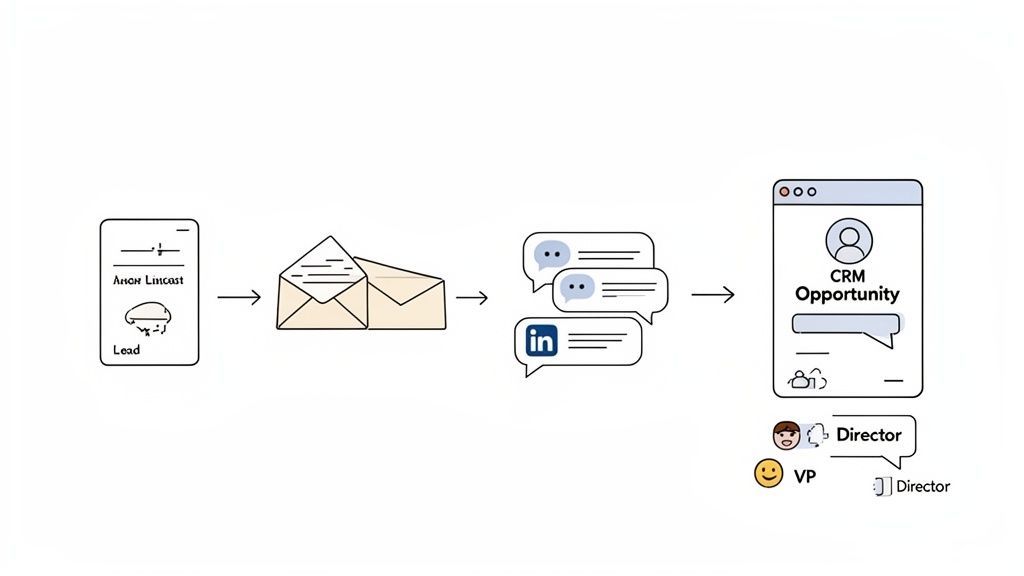
Your CRM is the brain of your operation. Every single interaction—every email opened, link clicked, or LinkedIn message exchanged—needs to be logged automatically. This builds a rich profile of each lead’s journey and engagement.
The moment a lead hits a certain lead score or performs a high-intent action (like visiting your pricing page for the third time), your system should fire off an alert to the sales rep.
This handoff has to be buttery smooth. The rep needs to see the lead's entire history at a glance. This way, they can start the conversation with context and relevance ("I saw you were interested in our integration features...") instead of a cold, generic intro. This seamless transition from marketing to sales is the final, critical step in turning a well-nurtured lead into a closed deal.
Fine-Tuning Your Funnel with Data and Technology
A high-performing lead generation funnel for a B2B company is never a "set it and forget it" asset. It’s a living, breathing system that needs constant attention, analysis, and refinement. Think of it less like a finished building and more like a high-performance engine—it needs regular tuning to operate at peak efficiency. This final piece of the puzzle is all about using data and technology to drive continuous improvement.
Without a clear view of your performance, you're flying blind. You might be burning cash on ads that attract terrible leads, or you could have a leaky landing page that’s costing you valuable sign-ups. Data is the flashlight that illuminates these dark corners, showing you exactly where to focus your efforts.
Key Metrics You Absolutely Must Track
To really get a pulse on the health of your funnel, you need to keep a close eye on a handful of critical metrics. These numbers cut through the noise and tell the real story of your marketing and sales effectiveness.
- Conversion Rates (by Stage): This is the percentage of leads moving from one stage to the next. If you see a big drop-off between Awareness and Consideration, it could mean your lead magnet is weak or your blog’s call-to-action is confusing.
- Cost Per Lead (CPL): Simply divide your total marketing spend by the number of new leads you brought in. This metric is your gut check for channel efficiency, showing you which ones are actually worth the investment.
- Customer Acquisition Cost (CAC): This is the big one. It's the total cost of your sales and marketing efforts divided by the number of new customers you signed. The golden rule? Your CAC needs to be significantly lower than your Customer Lifetime Value (LTV).
- Sales Cycle Length: How long does it take to turn a fresh lead into a closed deal? A long sales cycle can signal friction in your process, like slow follow-up times or nurturing sequences that aren't hitting the mark.
Tracking these metrics isn't about filling up a spreadsheet. It's about finding actionable insights. A rising CAC, for instance, is a blaring red flag. It forces you to ask the hard questions: Is our targeting off? Is our messaging falling flat? Is the sales team hitting a wall?
The Power of A/B Testing and Smart Analysis
Once your data points to a potential bottleneck, it's time to start running experiments to fix it. This is where A/B testing becomes your best friend. You can systematically test different versions of almost any element in your funnel to see what truly resonates with your audience.
You can test everything—the headline on a landing page, the color of a CTA button, the subject line of a cold email, even the entire structure of your pricing page. By changing just one variable at a time and measuring the impact, you can make data-driven decisions that deliver incremental, consistent improvements.
To really nail this, you need a deep understanding of the entire customer journey. It helps you pinpoint friction and optimize every touchpoint, a process detailed in a practical guide to customer journey analytics.
Building Your Modern Tech Stack
Trying to manage a modern B2B funnel without the right technology is an exercise in frustration. Your tech stack is the central nervous system of your entire lead generation process, automating mundane tasks, gathering critical data, and empowering your teams to work smarter, not harder.
Putting together the right set of tools is foundational to making your funnel work. Here’s a look at the core components every B2B team needs.
Essential Tech Stack for a B2B Lead Generation Funnel
| Tool Category | Example Tools | Primary Function in the Funnel |
|---|---|---|
| CRM | HubSpot, Salesforce | Manages all lead and customer data, tracks interactions, and serves as the single source of truth. |
| Prospecting Tool | ProfileSpider | Extracts high-quality, targeted prospect data from any website to fuel the top of the funnel. |
| Marketing Automation | Marketo, Pardot | Builds and executes automated email nurture sequences, lead scoring, and multi-channel campaigns. |
| Analytics | Google Analytics | Tracks website traffic, user behavior, and conversion goals to measure TOFU and MOFU performance. |
When these tools work together, you create a seamless flow of data and action. For instance, a sales rep can use ProfileSpider to instantly pull a list of conference attendees into a clean CSV. That data is then uploaded to HubSpot, which automatically triggers a personalized email sequence you built in Marketo. The whole workflow is efficient, scalable, and completely data-driven.
ProfileSpider is particularly powerful in this stack because of its simplicity and privacy-first design; it gives you the essential, high-quality data to feed your entire ecosystem with just a single click. To see this in action, check out our guide on how web scraping can automatically feed your CRM sales pipeline.