

Qualifying sales leads isn't just a process; it's the art of focusing your sales team's energy where it counts most. It’s about defining your ideal customer, scoring leads based on how well they match that profile, and using smart discovery questions to confirm they have the budget, authority, need, and a realistic timeline to buy. This isn’t about creating hurdles; it’s about strategically filtering your funnel so your sales team talks only to prospects who are serious about a solution. The result? A massive boost in efficiency and, more importantly, conversion rates.
To see how qualification fits into the broader buyer journey from awareness to close, review our funnel.
This article is part of our broader guide to lead scraping. If you want the complete end-to-end workflow—including lead sources, scraping methods, enrichment, data quality, CRM activation, and compliance—see: Lead Scraping Guide: How to Scrape, Enrich, and Convert Leads at Scale.
Why Lead Qualification Is Your Most Powerful Sales Lever
Treating lead generation as a pure numbers game is a recipe for burnout. When you pour every single name into the top of your sales funnel, you're not just wasting time—you're exhausting your best reps and crushing team morale. Revenue suffers right alongside it.
Lead qualification isn't a tedious chore; it's the essential filter that separates real buyers from casual browsers.
The true cost of chasing bad leads is insidious. Every hour a rep spends on a prospect who was never going to buy is an hour they could have spent closing a deal with a perfect-fit customer. That misstep directly hammers your bottom line and stretches out sales cycles unnecessarily.
From Marketing Interest to Sales Opportunity
The process starts with the critical handoff between a Marketing Qualified Lead (MQL) and a Sales Qualified Lead (SQL). An MQL is someone who has shown initial interest—perhaps they downloaded a whitepaper or attended a webinar. They've raised their hand, but they aren't necessarily ready to talk business.
An SQL, on the other hand, is the real deal. They’ve been vetted against your criteria and flagged as a genuine, sales-ready opportunity.
This is where high-performing sales teams separate themselves from the pack. By prioritizing quality over sheer quantity, your team can:
- Shorten Sales Cycles: Reps talk to people who are already warmed up and actively looking for a solution.
- Increase Conversion Rates: Conversations are more relevant and targeted, which naturally leads to better outcomes.
- Improve Sales Forecasting: A pipeline filled with genuinely qualified leads is one you can actually trust and predict.
The data backs this up. A staggering 79% of marketing leads never convert to sales, and the primary culprit is a lack of proper qualification. To really dig into the mechanics of this, check out our comprehensive guide on qualifying sales leads effectively.
When teams get serious about qualification, the numbers can be dramatic. Lead-to-MQL conversion rates can jump from a dismal 11% for unqualified prospects to as high as 40%. That's nearly a 4x boost in performance.
Ultimately, a disciplined qualification process transforms your sales efforts from hopeful guesswork into a predictable revenue machine. It ensures that when a lead gets passed to sales, it's not just another contact record—it's a vetted opportunity ready for a real conversation. For a deeper look into those early signals of interest, our guide on what is a warm lead is a great place to start.
Define Your Ideal Customer and Build a Scoring Model
Great qualification begins long before you hop on a discovery call. The foundational work starts with a deep, shared understanding of exactly who you're selling to. If you skip this step, you’re sending your sales team into the field blind, hoping they stumble upon the right people.
This foundational step involves creating an Ideal Customer Profile (ICP). Think of it as a blueprint for the perfect client—one that gets the most value from your product and, in turn, provides the most value to your business.
Building Your Ideal Customer Profile
A good ICP is a living document, not a static checklist you create once and forget. It should give your marketing and sales teams a crystal-clear target.
To build an effective ICP, you need to analyze three key areas:
- Firmographics: The basic company DNA. Think industry, company size, annual revenue, and geographic location. Are your best customers typically mid-market tech companies with 200-500 employees? Be that specific.
- Technographics: What's in their current tech stack? Knowing the CRM or marketing automation platform they use can instantly reveal integration opportunities or highlight pain points your product solves.
- Buying Triggers: These are the events that signal an urgent need. Did they just secure a new round of funding? Hire a new VP of Sales? These triggers are flashing green lights, indicating a prime window of opportunity.
This is all about filtering out the noise. You want to take a massive pool of leads and narrow it down to a focused group of qualified opportunities for your sales team, just like this:
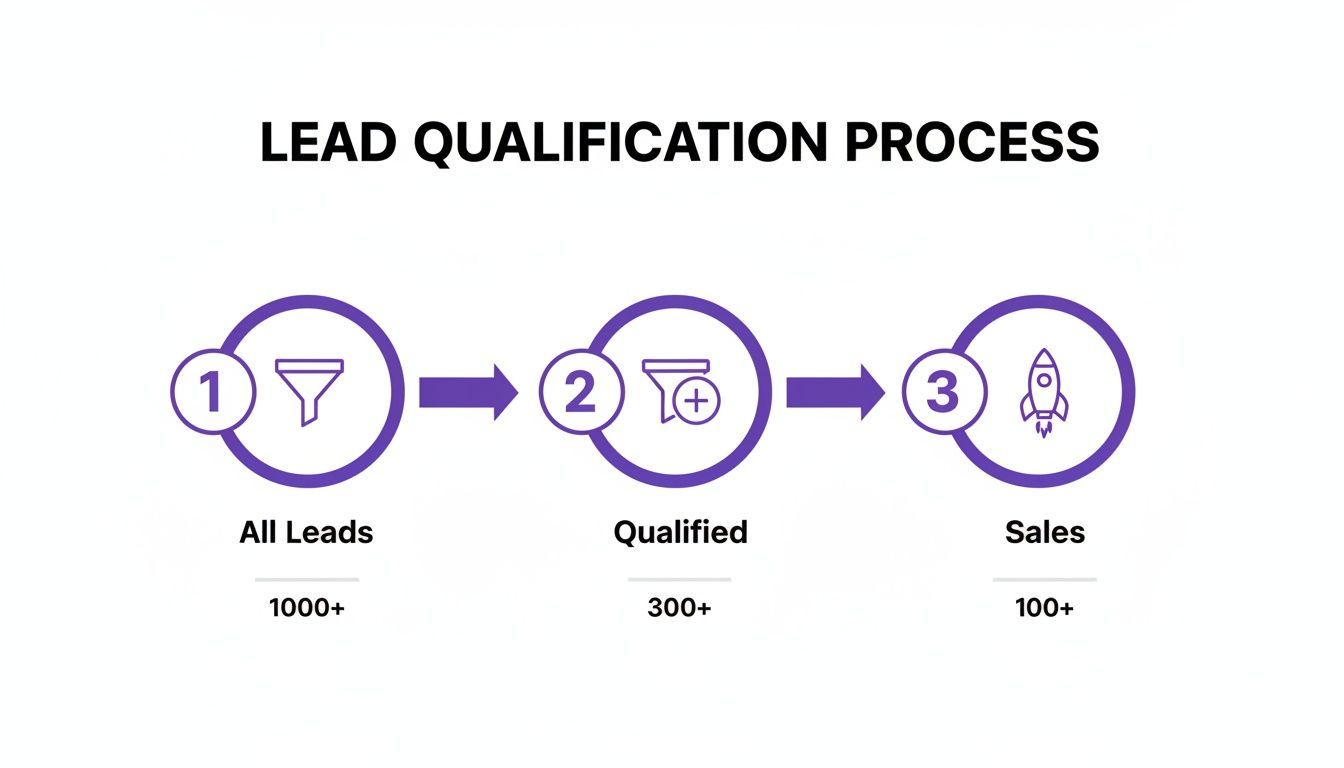
See how it funnels down? That’s the efficiency you gain from having a solid qualification model from the get-go.
With your ICP defined, the next move is to build a lead scoring model. This system automatically assigns points to leads based on who they are (demographics) and what they do (behaviors), creating a clear hierarchy so your team can focus their energy with surgical precision.
Crafting a Practical Lead Scoring Model
What Is Lead Scoring and How Does It Work? In short, it’s a dynamic way to rank leads by their sales-readiness. You'll assign positive (or even negative) points based on explicit information they provide and implicit behaviors they demonstrate.
A lead's score tells a story. A high score doesn't just mean they fit your ICP; it means their recent actions show they're actively looking for a solution right now.
Explicit data is information prospects share directly, such as:
- Job Title: A C-suite executive might get +15 points, while a manager gets +5.
- Company Size: If they’re in your ICP’s sweet spot, give them +10 points.
- Industry: A lead from a target industry? That’s another +10 points.
Implicit data is based on their behavior, which reveals their level of interest:
- Pricing Page Visit: This is a huge buying signal. Definitely worth +20 points.
- Demo Request: This is the strongest signal of all. Award them +30 points.
- Webinar Attendance: They’re engaged and learning. That deserves +5 points.
To help you visualize this, here’s a sample model you can adapt.
Sample Lead Scoring Model
| Category | Attribute/Action | Points Assigned | Rationale |
|---|---|---|---|
| Firmographic Fit | Company Size (e.g., 200-500 employees) | +10 | Aligns with our target market segment. |
| Firmographic Fit | Industry (e.g., SaaS, FinTech) | +10 | Indicates a high-value vertical for our solution. |
| Role/Seniority | Job Title (e.g., VP, Director, C-Level) | +15 | Decision-maker or key influencer. |
| Website Behavior | Visited Pricing Page | +20 | Strong indicator of buying intent. |
| Website Behavior | Downloaded Case Study | +10 | Shows interest in proof and results. |
| High-Intent Action | Requested a Demo | +30 | The clearest signal they are ready to talk. |
| Engagement | Attended a Webinar | +5 | Demonstrates active engagement with our content. |
This system is a game-changer. Research shows that nurtured leads can generate 451% more qualified leads than those left alone, and a lead score between 41-60 is often the sweet spot for a sales handoff—where 40% of all qualified leads tend to cluster.
By combining a strong ICP with an intelligent scoring model, you ensure that every lead your sales team contacts is already primed for a meaningful conversation. And if you want to take your profiles to the next level, check out some of the best data enrichment tools to fill in any gaps.
Mastering Discovery Calls with Qualification Frameworks
A high lead score gets you in the door, but a great conversation is what turns that meeting into a real opportunity. Once you've got a prospect on the phone, the game shifts from data points to dialogue. This is your chance to use proven frameworks—not as rigid scripts, but as conversational roadmaps to determine if there's a mutual fit.
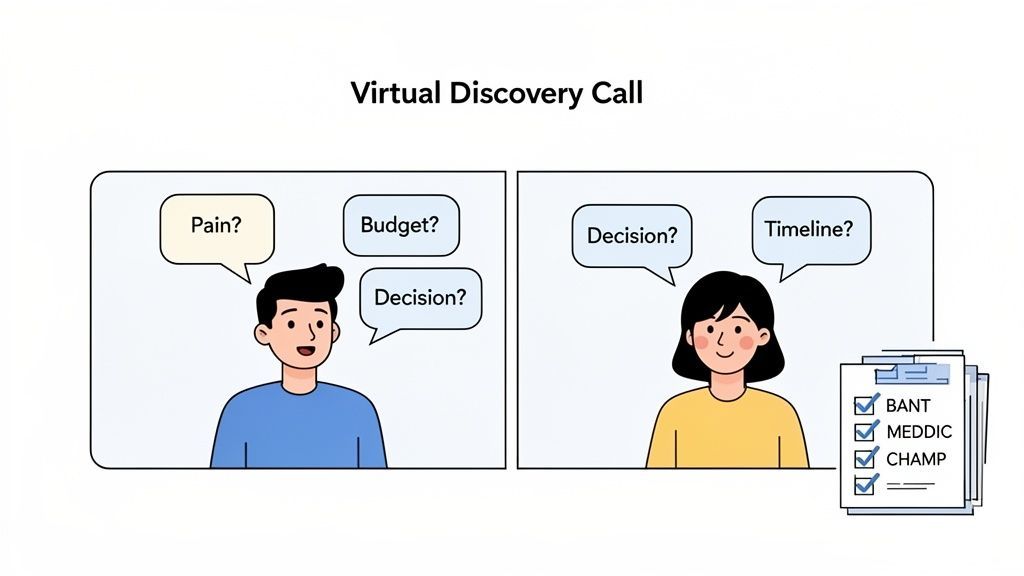
The discovery call is where you dig deep. You’re there to uncover the pain points that keep them up at night, identify who truly holds the purse strings, and understand their internal decision-making process. It’s less of an interrogation and more of a consultation. The goal is to build enough trust that they'll share the critical details you need to know whether this is a golden opportunity or a dead end.
Choosing The Right Framework For Your Sales Process
Not all qualification frameworks are created equal. The best one for your team depends on your typical sales cycle, average deal size, and the complexity of your customer's environment. Think of them as different lenses for viewing the same opportunity.
- BANT (Budget, Authority, Need, Timeline): The classic framework. BANT is direct and excellent for shorter sales cycles where you need to quickly confirm the basic pillars of a deal.
- CHAMP (Challenges, Authority, Money, Prioritization): A modern, customer-centric take on BANT that puts the prospect's Challenges first. It helps you build rapport by immediately focusing on their pain.
- MEDDIC (Metrics, Economic Buyer, Decision Criteria, Decision Process, Identify Pain, Champion): The heavyweight champion for complex enterprise deals. MEDDIC is built for high-value sales with multiple stakeholders, forcing a deep, forensic analysis of the opportunity.
For many teams, starting with BANT or CHAMP provides a solid foundation. You can always add more complex elements as your deals get bigger.
From Acronyms To Actual Conversations
The real skill is weaving these frameworks into your calls so it feels like a natural conversation. Nobody wants to be on the receiving end of a checklist. Instead of bluntly asking, "What's your budget?" you can get the same information with more finesse.
For example, to understand their Need (BANT) or Challenge (CHAMP), you could ask:
- "What was the tipping point that made you start looking for a solution to [problem] right now?"
- "If you did nothing about this, what would the impact on the business look like in six months?"
And to figure out Authority, try questions like:
- "When you've brought in new tools in the past, who else on the team usually gets involved in the evaluation?"
- "Could you walk me through what the typical decision-making process looks like for a purchase like this at your company?"
These questions do more than just check a box. They open up a real dialogue, giving you a clearer map of the political and operational landscape you're navigating. As you gather this intel, you're not just qualifying; you're actively laying the groundwork for a solid pipeline. For a deeper dive, our guide on how to build sales pipeline has more strategies.
A discovery call isn't about you qualifying the lead. It's about you and the lead qualifying each other. The best reps make the prospect feel like they are being helped, not sold to.
That consultative mindset is what separates top performers from everyone else. It builds the trust you need for the prospect to open up and give you the information you really need.
Comparing Lead Qualification Frameworks BANT vs MEDDIC vs CHAMP
Picking a framework is a strategic choice that shapes how your team approaches every conversation. This table breaks down the core components of three popular qualification frameworks to help sales teams choose the best fit for their process.
| Framework | Core Focus | Best For | Key Question Example |
|---|---|---|---|
| BANT | The four core pillars of a deal. | Short to medium sales cycles; transactional sales. | "Is there a budget allocated for solving this problem this quarter?" |
| CHAMP | Starting with the customer's pain point. | Consultative sales; relationship-focused teams. | "What's the biggest challenge your team is facing with [process] right now?" |
| MEDDIC | Deep analysis of the buying process. | Complex, high-value enterprise sales with multiple stakeholders. | "What specific metrics will the economic buyer use to judge the success of this project?" |
Ultimately, the "best" framework is the one your team will use consistently and effectively. Pick one, train your reps on the why behind the questions, and then tweak your approach based on what's bringing in the best-qualified opportunities. At the end of the day, active listening and thoughtful follow-up questions will always be more powerful than any acronym.
Automate Lead Research to Accelerate Qualification
Before a rep can score a lead or plan their outreach, they need accurate, foundational data. But gathering this information has historically been a major bottleneck that sabotages speed and efficiency. Manual data entry is the silent killer of any high-velocity sales team, draining motivation and slowing the entire qualification process to a crawl.
The Traditional Method: A Manual Grind
Picture the traditional, manual workflow. A sales rep finds a high-potential account and needs to build a contact list of the key decision-makers.
That process typically looks like this:
- Navigate to the company’s "About Us" or "Team" page.
- Open a blank spreadsheet or CRM record.
- Manually highlight, copy, and paste each person's name.
- Tab back to the website, then copy and paste their job title.
- Repeat this tedious cycle for every single person on the page.
- Then, search for each contact on LinkedIn to find their profile URL, adding another layer of mind-numbing work.
The result is a process that can take hours for just a handful of target accounts. Worse, it’s a breeding ground for human error. A simple copy-paste mistake can lead to misspelled names, incorrect titles, and wasted outreach. This manual grind is the polar opposite of a modern, efficient qualification engine.
The real cost of manual data entry isn't just the time lost; it's the opportunity cost. While a rep is wrestling with a spreadsheet, a competitor is already on the phone with a qualified prospect.
The Modern, One-Click Workflow with ProfileSpider
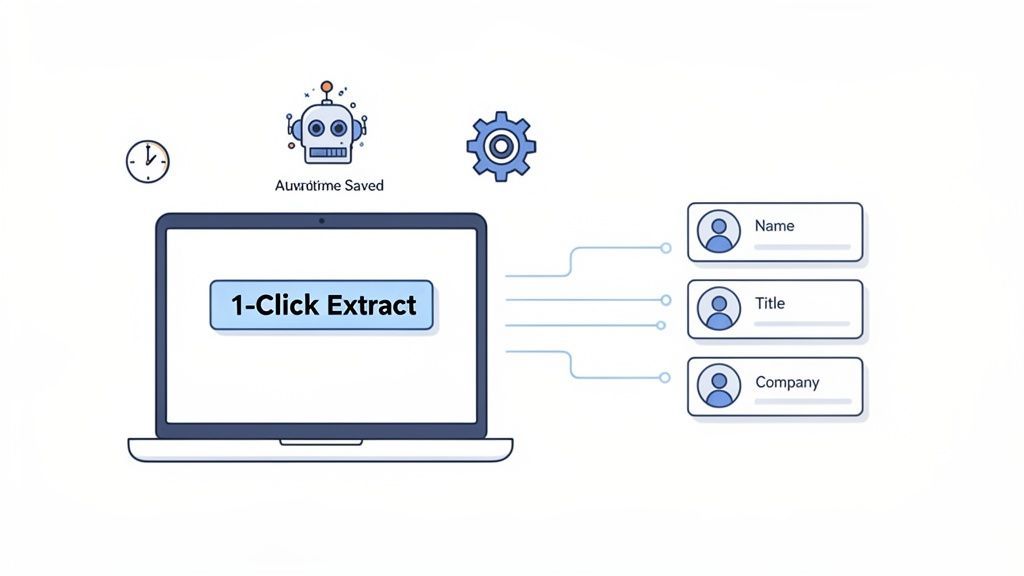
Now, contrast that with a modern, automated approach. Instead of treating lead research as a chore, top-performing teams use tools to turn it into a one-click action. This is where a no-code profile scraper like ProfileSpider completely changes the game. It simplifies the entire process into a single step.
Here’s the streamlined workflow:
- A sales rep lands on the same company leadership page.
- Instead of opening a spreadsheet, they click the ProfileSpider browser extension.
In seconds, the tool's AI scans the page, identifies all individual profiles, and extracts key data—names, titles, company information, and even social media links—into a structured, clean format. This data can then be exported directly to a CSV or pushed into a CRM, ready for immediate lead scoring and enrichment.
The Business Impact of Automation
Moving to an automated workflow for lead research isn't just about saving time; it fundamentally reshapes your qualification process and drives serious business value.
The primary benefits include:
- Reclaiming Valuable Selling Time: Reps save hours every week, which they can reinvest into high-value activities like making discovery calls, nurturing relationships, and closing deals.
- Ensuring Data Accuracy: Automation eliminates the copy-paste errors that plague manual entry. Clean, accurate data is the bedrock of effective personalization and reliable lead scoring.
- Accelerating Speed-to-Lead: By instantly capturing contact data, reps move from identification to qualification in minutes, not hours. This speed is critical for capitalizing on a prospect's interest before it fades.
- Rapid Lead Enrichment: With basic contact info captured, reps can quickly enrich profiles with more details like verified emails or direct dials, making the lead scoring process faster and more precise.
By replacing tedious manual tasks with smart, one-click automation, you build a much more agile and efficient qualification engine. For teams looking to master this, we have a detailed guide on how to use AI scraper tools to generate sales leads.
Create a Seamless Handoff from Marketing to Sales
The gap between marketing and sales is where promising leads go to die. It's a notorious chasm where a Marketing Qualified Lead (MQL) with a high score and clear interest can vanish before a sales rep ever has a meaningful conversation.
Bridging this gap requires a process that’s less like a handoff and more like a perfectly synchronized relay race. This isn't just about sending an email notification. It’s about creating a clear, documented agreement that defines the exact moment a lead is ready for sales and the precise actions that must follow. Without this, you create friction, lose momentum, and leave revenue on the table.
Defining the MQL to SQL Transition
The transition from an MQL to a Sales Qualified Lead (SQL) has to be crystal clear. This is the official trigger for the handoff, and it should be based on a combination of scoring and verified data, leaving zero room for ambiguity.
The criteria for this graduation usually include a few key things:
- Hitting a Specific Lead Score: The lead has crossed a predetermined point threshold (say, 60 points), signaling a strong fit and high intent based on their firmographics and recent behavior.
- Verifying Critical Qualification Data: Key data points have been confirmed. This could mean verifying they match your Ideal Customer Profile (ICP) in terms of company size, industry, and the lead's job title.
- A High-Intent Action: The lead has done something that screams immediate interest, like requesting a demo, viewing your pricing page multiple times, or starting a free trial.
This combination ensures that sales reps aren't just getting a name and an email. They're getting a pre-vetted opportunity that warrants their immediate attention.
Your Rulebook: The Service Level Agreement
A Service Level Agreement (SLA) is the formal contract between your marketing and sales teams that governs this whole process. It documents mutual commitments and sets clear expectations, so everyone is accountable.
Your SLA should explicitly define:
- Lead Qualification Criteria: The exact definition of an SQL that both teams have signed off on.
- Response Time: How quickly the sales team must follow up with a newly assigned SQL.
- Follow-up Cadence: The minimum number of contact attempts a rep has to make before a lead can be moved out of the active pipeline.
- Data Transfer Protocol: The specific information that must be passed from your marketing automation platform to the CRM.
This agreement eliminates the classic "blame game" and creates a unified team laser-focused on one thing: turning qualified leads into customers.
A well-defined SLA is the backbone of any high-performing sales process. It turns subjective opinions about lead quality into objective, measurable standards that drive accountability and real performance.
Arming Reps with the Right Information
A successful handoff is only as good as the information you give the sales rep. Sending over a lead with just a name and company is setting them up for a cold, awkward conversation. The rep needs the full story to walk into the conversation with context and confidence.
The data flowing into your CRM should absolutely include:
- Lead Source: Where did they come from? (e.g., organic search, webinar, paid ad).
- Engagement History: Which pages did they visit? What content did they download?
- Key Firmographic Data: Company size, industry, location, and any relevant tech stack info.
- Lead Score Breakdown: Why did they score so high? What specific actions triggered the handoff?
This context lets a rep tailor their outreach instantly. Instead of a generic, "I saw you downloaded our ebook," they can open with, "I noticed you spent time on our integration page for Salesforce; are you looking to solve [specific problem]?" That level of personalization is only possible with a seamless data flow.
Finally, don't underestimate the power of speed. Speed-to-lead is the ultimate qualifier. Leads contacted within just five minutes are 9 times more likely to convert, and even a one-hour follow-up can yield 450% higher response rates. You can explore more compelling sales statistics that highlight why this is so critical.
The first responder wins the deal 35-50% of the time, making a fast, data-rich handoff an absolute necessity.
Frequently Ask Questions About Qualifying Leads? We've Got Answers.
Even with the best frameworks and automation tools, the real world of sales qualification is complex. It’s where your perfect process meets the unpredictable reality of human conversations and winding buying cycles. Let's tackle some of the most common hurdles sales professionals face every day.
Getting these details right is what separates a decent qualification process from a truly great one.
What's the Biggest Mistake Sales Teams Make When Qualifying Leads?
Treating qualification like a one-time checklist.
Many teams see it as a rigid gate: a lead either passes or fails, and that's the end of it. But real qualification is an ongoing discovery process. A lead who isn't ready today could become your biggest champion in six months. Teams that simply discard these "disqualified-but-promising" leads are leaving a shocking amount of money on the table.
Another classic mistake is getting hung up on budget. A prospect might not have a line item for your solution yet, but a painful enough problem will always find a way to get funded. When reps focus too much on the "B" in BANT without digging into the "N" (Need), they end up ditching valuable opportunities that just needed a bit more runway to take off.
How Do I Qualify a Lead When I Can't Reach the Decision-Maker?
This is a classic gatekeeper scenario where many deals stall. The key is to shift your mindset: your goal isn't just to get past your initial contact; it's to turn them into an internal champion who sells for you when you're not in the room.
Stop trying to extract information and start empowering them. Give them the tools they need to look like a hero—a crisp business case, a sharp one-pager, or a link to a killer case study they can forward to their boss.
Your questions should be designed to help you map the organization and equip your new champion:
- "Who else usually gets involved when you're looking at solutions like this?"
- "What kind of information would be most helpful for you to build a strong case internally?"
- "When you talk to your leadership, what are the key metrics they're focused on right now?"
You can also get a massive head start by using a tool like ProfileSpider. Before you even pick up the phone, you can quickly extract the entire leadership team's profiles from the company's website. This gives you a map of the internal landscape and helps you identify other potential influencers to connect with.
How Often Should I Review My Lead Scoring Model?
Your lead scoring model is not a "set it and forget it" system. It's a living, breathing process that needs regular check-ups to stay relevant. You should review it in detail at least quarterly.
When you do, dive into the data and look for the stories it's telling you:
- Are the leads with the highest scores actually closing?
- Are there any low-scoring leads that surprised you and became customers? Why?
- Which marketing activities (webinars, downloads, etc.) have the strongest correlation with closed-won deals?
A lead scoring model that isn't constantly fed with fresh sales data and feedback from the team becomes irrelevant fast. It starts sending your reps on wild goose chases, and they quickly lose faith in the whole system.
Combine that hard data with the on-the-ground insights from your sales reps. They'll tell you what's really happening in conversations. As your market, product, or ideal customer profile shifts, your scoring model has to shift with it.
What’s the Difference Between Disqualifying a Lead and Nurturing One?
This is one of the most important distinctions you can make for long-term, sustainable growth. Getting this wrong means you’re either burning time on dead ends or throwing future revenue in the trash.
A disqualified lead is a hard no. There's a fundamental mismatch. They don't fit your ICP, they're in a country you don't serve, or they have a structural reason they could never become a customer. These leads should be respectfully removed from your active pipeline.
A lead you should nurture, on the other hand, is a "not right now." The fit is there, but the timing is off. Maybe their budget just got frozen, or a key decision-maker quit unexpectedly. These leads are gold, just waiting for the right moment.
Don't discard them. Move them over to a long-term marketing nurture sequence. Keep your brand top of mind by sending them genuinely valuable content, industry insights, and relevant updates. When their situation changes and the timing is right, you'll be the first person they call.