

When it comes to lead generation, you're faced with a classic choice: do you build a custom list from scratch using lead scraping, or do you buy a ready-made one from a lead database? The best path hinges on what your team needs more—the surgical precision and up-to-the-minute accuracy of scraping, or the instant gratification of a pre-packaged list.
This article is part of our broader guide to lead scraping. If you want the complete end-to-end workflow—including lead sources, scraping methods, enrichment, data quality, CRM activation, and compliance—see: Lead Scraping Guide: How to Scrape, Enrich, and Convert Leads at Scale.
Deciding Your Lead Generation Strategy
Every sales, marketing, and recruiting team eventually hits this fork in the road. And make no mistake, the choice between scraping and databases goes way beyond just picking a tool. It's a strategic decision that ripples through everything—from the freshness of your data and campaign ROI to how you scale and even legal compliance. Getting to grips with the fundamental differences is the first step to building a pipeline you can count on.
Think of lead scraping as the on-demand, artisanal approach. It’s all about pulling fresh, publicly available data right from the source, whether that’s a professional network, a company website, or an industry directory. The key advantage here is freshness. The data you get reflects where a contact is right now, not where they were months ago.
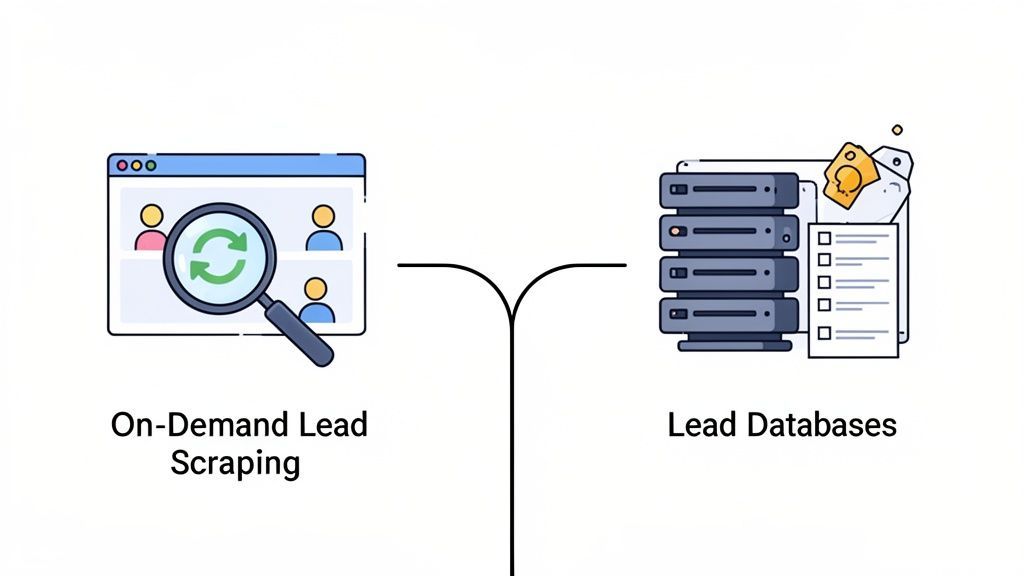
On the flip side, lead databases are your traditional, off-the-shelf option. These are massive, pre-compiled lists of business contacts you can buy for immediate use. Their main draw? Sheer convenience and scale. You can get your hands on thousands of contacts in just a few minutes.
Key Differences at a Glance
To make the right call, you have to see how these two methods stack up where it really counts for your business. The best strategy depends entirely on your goals. Are you running a hyper-targeted outreach campaign, or is this more of a broad-stroke marketing effort? For some excellent context on how to plug these data sources into your broader workflow, resources like CRM and Lead Generation Mastery can help connect the dots.
| Feature | Lead Scraping (Build) | Lead Databases (Buy) |
|---|---|---|
| Data Freshness | Real-time, pulled on-demand. As fresh as it gets. | Static. Updated periodically, so data can be stale. |
| Customization | Hyper-specific. You target exactly who you need. | Limited to whatever filters the provider offers. |
| Cost Model | Usually a flat subscription. Low cost-per-lead at scale. | Typically pay-per-lead or a large bulk purchase. High upfront cost. |
| Implementation | Requires a tool. Modern no-code options are fast to set up. | Instant access right after you pay. |
| Data Ownership | You own it. The data you collect is yours to keep. | You’re just licensing access. The data belongs to the provider. |
When it comes down to it, your strategy has to match your team’s priorities. If you live and die by precision, fresh data, and cost-effective growth, a modern scraping tool is the clear strategic move. As you build out your process, it’s always a good idea to keep an eye on the latest lead generation best practices for 2025 to stay ahead of the curve.
The Modern Approach to Building Lead Lists
Forget what you think you know about lead scraping. It's not about complex coding or spending hours on manual data entry anymore. Modern tools have completely changed the game, turning it into a simple, on-demand way for any sales, recruiting, or marketing professional to build a targeted, high-quality contact list.
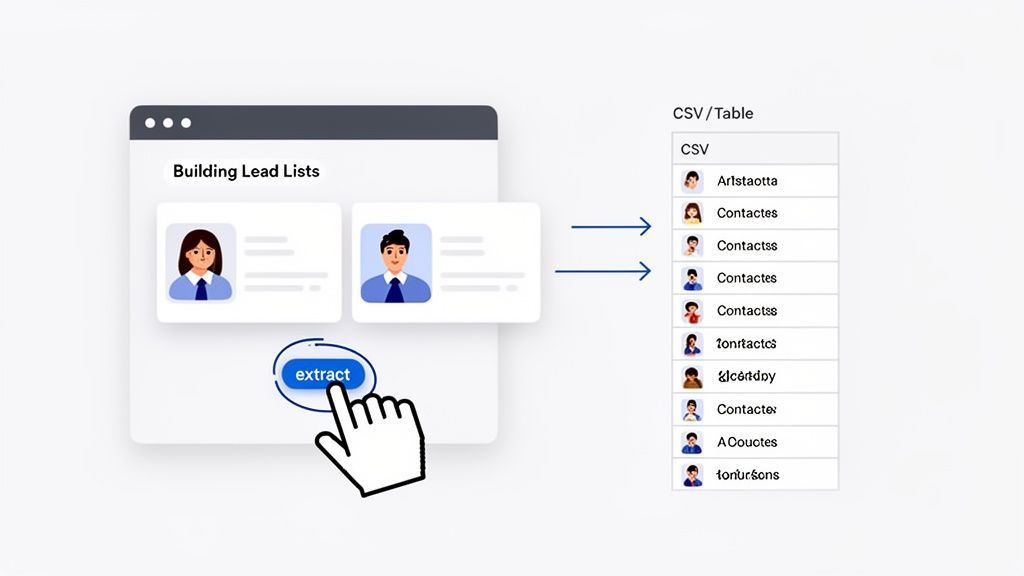
Imagine you're on a professional networking site, browsing an industry directory, or looking at a company's team page. You see the exact people you want to reach. With a modern no-code tool, you can pull their names, titles, and contact details straight into a clean, ready-to-use list with a single click. This is exactly what tools like ProfileSpider make possible for non-technical users.
Real-Time Data Is Your Ultimate Edge
The biggest win with lead scraping is freshness. The data you pull today reflects a person's real-world role and company right now—not three months ago when a database was last updated. For sales and recruiting teams, this real-time accuracy is a massive competitive advantage.
An outreach message based on fresh intelligence feels relevant and personal. It’s the difference between starting a real conversation and just adding to the noise in someone's inbox. This active, hands-on approach lets you jump on timely opportunities, like when a prospect starts a new job or a company announces a fresh round of funding.
How Today’s No-Code Scraping Tools Work
Modern lead scrapers like ProfileSpider are simple browser extensions designed for business users, not developers. They use AI to intelligently spot and organize public information on a webpage. The whole process is built for recruiters, marketers, and salespeople who just need good data without a huge learning curve.
Here's how simple the workflow is:
- Find Your Source: Go to any website with the profiles you want, like a professional network or a list of conference speakers.
- Activate the Tool: Open the ProfileSpider extension and click "Extract Profiles."
- Let AI Do the Heavy Lifting: The tool's AI scans the page, finds individual and company profiles, and grabs key data points like names, titles, emails, and social links.
- Manage and Export: All that structured data pops up right inside the tool. You can then sort it into lists, add notes, and export it as a CSV file for your CRM.
This one-click process puts the power of data collection directly into your hands, cutting out the bottlenecks and the need to wait on a dedicated data team. Whatever method you use for lead generation, the endgame is always effective list building. You can go even deeper by mastering email list building for higher conversions to make the most of your new contacts.
Get Laser-Focused with Precision Targeting
Pre-built lead databases lock you into their rigid filtering options. Scraping, on the other hand, gives you unlimited freedom to customize your lists. You aren't stuck with standard industries or job titles; you can build hyper-specific lists based on any public information you can find.
- Niche Roles: Target professionals with unique job titles that would never show up in a standard database dropdown menu.
- Event Attendees: Pull a list of attendees from a virtual conference and follow up with genuinely relevant prospects.
- Community Members: Gather contacts from niche online forums or communities specific to your industry.
This precision means every contact on your list is there for a reason, dramatically improving the efficiency and ROI of your outreach campaigns. To get a better handle on this, check out our guide on effective list building. The modern playbook is clear: stop buying generic lists and start building custom assets that are perfectly matched to your goals.
The Old Way: Buying Leads from a Database
Lead databases are the traditional answer to the question, "How do I get more contacts?" Think of them as massive, pre-packaged digital phone books, carefully put together, cleaned up, and sold by third-party data companies.
The biggest draw here is speed and convenience. In just a few minutes, you can buy a list of thousands of contacts from a specific industry or location, completely skipping the work of finding them yourself. These companies pour significant resources into verifying and enriching their data, aiming to give you a ready-to-use list you can plug straight into a broad marketing or sales campaign.
How These Databases Are Made
Building and maintaining a lead database is a huge, never-ending job. Data providers use a mix of automated web crawlers and human teams to collect and update contact information.
It usually boils down to a few key steps:
- Initial Data Collection: They pull information from public records, company websites, and business directories.
- Verification and Cleanup: They run checks to get rid of duplicates, fix formatting mistakes, and try to validate email addresses.
- Regular Updates: The data is refreshed periodically to keep up with job changes and company shifts, but this is never truly real-time.
Here's the catch: database information is static by nature. The second it's collected, it starts to go stale. Professionals change roles at an average rate of 10-20% per year, which means a big chunk of any list you buy is likely outdated from day one.
The Problem with Per-Lead Pricing
Unlike the subscription models common with modern scraping tools, lead databases usually operate on a per-contact cost. This makes scaling your efforts a straightforward—and often very expensive—calculation.
You'll typically run into two main pricing models:
- Pay-Per-Lead: You're charged a set price for every contact you download. This can be anything from a few cents to several dollars per lead, depending on how specific and high-quality the data is.
- Subscriptions or Bulk Credits: You buy a subscription that gives you a certain number of credits to "spend" on contacts each month or year. This gives you some cost predictability, but the price can shoot up fast when you need bigger lists.
This pricing structure makes databases a decent option for teams that need a large, general list for a single campaign. But if you're trying to build a dynamic, growing sales pipeline, the costs can quickly become a major roadblock. Building your own data asset often delivers a much better ROI in the long run. If you're curious, check out our guide on how to build and monetize your own B2B lead database.
While the convenience is tempting, relying only on databases means making sacrifices on data freshness, cost, and how precisely you can target your outreach. For many modern sales and recruiting teams, those trade-offs are just too big to ignore.
Data Quality: Real-Time Scraping vs. Static Databases
When you're weighing lead scraping against lead databases, the conversation always circles back to one thing: the quality of your data. This is where the two paths really diverge, and it impacts everything from your email bounce rates to whether your entire campaign sinks or swims.
Lead databases are sold on the promise of accuracy. Providers spend a lot of time and money curating, cleaning, and supposedly verifying their lists. But here’s the catch: their data is fundamentally static. It’s a snapshot in time. The second they capture it, it starts to decay as people switch jobs, get promoted, or move to new companies.
Lead scraping, on the other hand, gives you live, dynamic data. You're pulling information directly from the source—a professional profile, a company’s team page, you name it. What you get is the most current information available in that exact moment.
The Problem of Stale Data
Data decay is the silent killer of sales and marketing efforts. A list that was 95% accurate just a few months ago could be riddled with outdated contacts today. When you rely on a database provider for periodic updates, you’re always playing catch-up with reality.
The core issue with purchased lists is that you’re working with old information. For any outreach that depends on timing and relevance—like recruiting for a newly posted role or selling to a recent hire—the live data from scraping provides a definitive advantage over a potentially outdated database entry.
This lag time leads directly to missed opportunities and wasted effort. You might spend time crafting the perfect personalized email for someone, only to find out they left that role weeks ago. It immediately signals that you haven't done your homework. We dive deeper into this challenge in our guide on why enrichment APIs often return outdated leads.
Before we go further, let's break down the core differences in a simple format. This table should give you a quick, at-a-glance understanding of the trade-offs.
Lead Scraping vs Lead Databases: Key Differences
| Attribute | Lead Scraping | Lead Databases |
|---|---|---|
| Data Freshness | Real-time, captured on-demand | Static, updated periodically |
| Accuracy | High (tied to live source) | High initially, but decays over time |
| Scalability | Easy to scale with no-code tools | Highly scalable, instant access |
| Cost | Low, fixed subscription cost | High upfront cost, pay-per-lead |
| Customization | Highly customizable to specific needs | Limited to provider's available segments |
| Legal/Privacy Risk | Low with privacy-first tools | Provider handles compliance |
As you can see, the choice isn't just about getting names and emails; it's about the context and timeliness of that information. For targeted, high-value outreach, real-time data is a game-changer.
Real-Time Freshness Through Scraping
Lead scraping completely sidesteps the data decay problem because you control the timeline. You gather information right when you need it, which ensures it’s as relevant as possible.
This on-demand approach is a massive advantage in a few key situations:
- Targeting Recent Job Changes: Identify and connect with people the day they start a new role—a golden opportunity to offer relevant services.
- Recruiting for Urgent Roles: Find candidates whose profiles reflect the most current skills and experience for a position you need to fill now.
- Monitoring Competitor Activity: Scrape the team pages of your rivals to see who they're hiring and get clues about their strategic shifts.
A modern, no-code scraping tool like ProfileSpider makes this incredibly straightforward. It uses AI to intelligently pull profile information from any live webpage, turning what's on your screen into a structured, usable list in seconds. The accuracy is directly tied to the source page itself, which is almost always more current than what a third-party database can offer.
Weighing Accuracy Claims
Ultimately, the choice comes down to what you prioritize. Database providers do a lot of work cleaning and deduplicating their data to hit reliability rates that often top 95%. That sounds great, but the freshness of that "accurate" data is always questionable, with updates happening weekly or even monthly.
In contrast, a well-executed scraping process delivers unbeatable freshness. You’re getting real-time information that lets you craft truly personalized outreach. If your campaign is a numbers game that needs broad reach and can handle some data errors, a database might get the job done.
But for targeted, high-stakes campaigns where every detail matters, the real-time advantage of lead scraping is the only strategic choice.
Analyzing Cost Efficiency and Scalability
When you pit lead scraping against lead databases, you're looking at two completely different worlds in terms of cost and growth potential. The path you choose will have a real, direct impact on your budget, your ROI, and whether you can actually scale your outreach without alarming your finance department.
Lead databases run on a simple, but often punishing, per-contact model. Scaling up means your costs shoot up right alongside your ambition. Buying a list of 10,000 contacts can easily set you back thousands of dollars. That's a hefty upfront investment for what is essentially a static, aging asset.
This pay-per-lead structure becomes a direct roadblock to growth. Every time you want to explore a new market or fill a shallow pipeline, you’re back at the vendor's door, checkbook in hand, ready for another big purchase.
Subscription Models and ROI
Modern scraping tools completely flip the script on this financial model. Instead of paying for every single name on a list, you're typically looking at a flat monthly or annual subscription. This approach isn't just predictable; it's built for scale and delivers a much stronger return over time.
For one fixed price, your team can pull a huge volume of leads whenever they need them. As you generate more and more lists, your cost per lead plummets, making it an incredibly efficient way to keep your pipeline full.
A tool like ProfileSpider puts the power back in your team's hands. They can build unlimited, hyper-targeted lists without getting hit with the sticker shock of a massive database purchase. It's a shift from just buying data to investing in a reusable, in-house capability.
The difference in how each method sources data is fundamental to their cost-effectiveness, as this diagram shows.
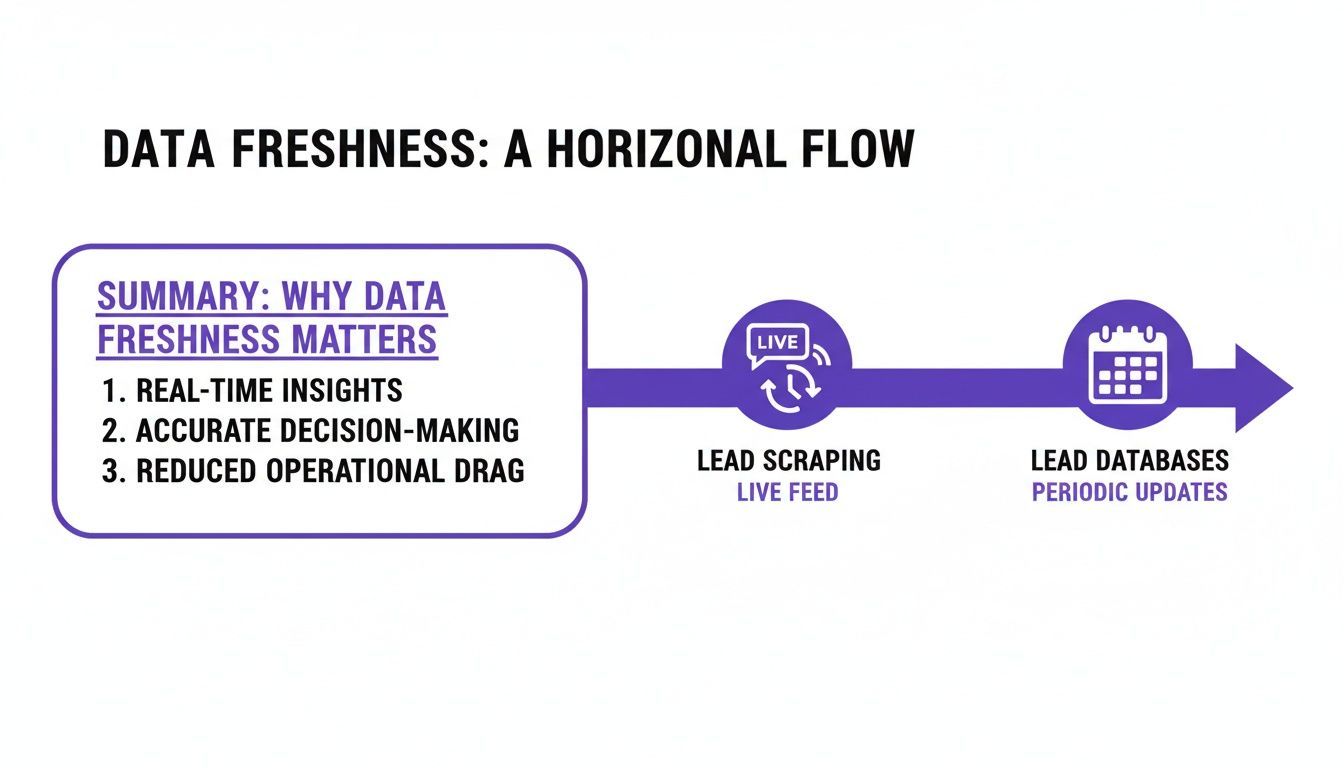
Scraping gives you a live, on-demand stream of information, while databases are just a snapshot in time. This distinction is everything when it comes to scalable, cost-effective growth.
Calculating Your True Cost Per Lead
Let's run some quick numbers. Say your sales team needs 2,000 fresh, targeted leads every month.
- Lead Database: Even at a conservative $0.50 per contact, you’re looking at $1,000 per month. Need to switch verticals or refine your targeting next month? That’ll be another $1,000, please.
- Lead Scraping Tool: A solid subscription might run you $50-$100 per month. For that one flat fee, the team can pull those 2,000 leads and thousands more without ever paying another dime.
This cost gap is a huge deal for growing businesses. For teams running consistent lead gen campaigns, the annual savings from picking a subscription-based scraping tool can easily fall somewhere between $1,000 to over $5,000. You can see more on how these pricing models compare in the market.
Operational Scalability On Demand
It’s not just about the money, though. Lead scraping gives you true operational freedom. Your team is no longer held hostage by a third-party provider's limited inventory or clunky filtering options. You have total autonomy to build any list you need, exactly when you need it.
This kind of agility is a massive competitive edge. It means you can:
- Quickly test new markets without making a huge financial bet on data.
- Instantly build lists for timely campaigns, like targeting people who just attended a virtual event.
- Empower everyone—from SDRs to marketers to recruiters—to source their own high-quality leads.
With a no-code tool like ProfileSpider, this capability is in everyone's hands. It turns practically any webpage into a potential lead source, allowing your team to scale its efforts intelligently. Your growth is driven by opportunity, not held back by your budget.
So, How Do You Choose? Lead Scraping vs. Lead Databases
Alright, let's get down to brass tacks. Which one is right for you? The honest answer is: it depends. There’s no silver bullet here. The best choice comes down to your immediate campaign goals, your long-term strategy, and how your team works.
If you just need a massive list of contacts for a broad-stroke awareness campaign—say, you're launching a new product and need to contact an entire industry—a lead database gets you off the starting line fast. You're trading precision for speed and volume, and sometimes, that’s exactly the right move.
When You Absolutely Should Prioritize Lead Scraping
But for most sales, recruiting, and marketing professionals, success hinges on something more than just a big list. This is where lead scraping really shines—when you need fresh data, hyper-specific targeting, and a cost-effective way to scale your efforts. It’s the go-to for anyone who can’t afford to waste time on outdated or generic leads.
Think about these high-stakes scenarios:
- Recruiters hunting for candidates who just updated their professional profiles with a very specific, in-demand skill.
- Sales teams pouncing on trigger events, like targeting companies that just landed a fresh round of funding or key executives who recently changed jobs.
- Market researchers who need real-time intelligence on competitor talent flow and team structures.
In these situations, fresh data isn't a "nice-to-have." It’s everything. For professionals who measure success by precision, customization, and control, a modern scraping tool is the more strategic, agile, and financially sound approach to building a pipeline.
The Real Advantage of Modern Tools
Here's the fundamental difference: a database is a static asset you buy. A scraping tool like ProfileSpider is a capability you build in-house. It’s about making your team self-sufficient, able to pivot and chase new opportunities without waiting on a vendor or being stuck with their inventory.
It’s the classic "give a person a fish vs. teach them to fish" scenario. A database feeds your pipeline for a day. A no-code scraping tool gives your team a skill that fills the pipeline for good. That shift from a one-time purchase to a sustainable process is what drives long-term, predictable growth.
A Quick Framework for Your Decision
Still on the fence? Ask yourself these three questions:
- Is my outreach time-sensitive? If your message is built around a recent event—a new hire, a funding announcement, a project launch—you need the real-time data that only scraping provides.
- Am I targeting a truly niche audience? If your ideal prospects have unique job titles, hang out in specific online groups, or fit a very narrow profile, the customization of scraping beats a generic database every time.
- Is cost-per-lead at scale a big deal? If you plan on generating thousands of leads every month, the flat subscription of a scraping tool will almost always deliver a better ROI than paying per-contact for a database.
If you answered "yes" to even one of these, lead scraping isn't just an option—it’s the strategic path forward for your team.