

Enrichment APIs often give you stale leads for a few core reasons: the data itself decays incredibly fast, the APIs rely on aggressive caching to stay speedy, and there are often major sync lags between the different databases they pull from. For sales and marketing teams, this means the "fresh" lead you just paid for might already be weeks or even months out of date, sending your outreach efforts to a dead end.
This article is part of our broader guide to lead scraping. If you want the complete end-to-end workflow—including lead sources, scraping methods, enrichment, data quality, CRM activation, and compliance—see: Lead Scraping Guide: How to Scrape, Enrich, and Convert Leads at Scale.
The Hidden Cost of a Single Outdated Lead
Picture this: your top sales rep spends a week prepping for a make-or-break call with a key decision-maker. They've researched the account, personalized the pitch, and are ready to close... only to find out the contact left that company six months ago.
This isn't just one wasted call. It's a symptom of a much larger, more expensive problem that quietly sabotages modern sales pipelines. Stale data from enrichment APIs is a silent killer of productivity and revenue. These tools promise to hand you a complete, accurate portrait of your prospects, but the reality is often a fuzzy, outdated snapshot that sends your team on a wild goose chase. The frustration of pursuing ghosts—contacts who are long gone or were never there to begin with—is an all-too-common headache for sales, marketing, and recruiting teams.
The Ripple Effect of Bad Data
A single piece of bad data seems like a small hiccup, but its impact multiplies across your entire operation. It’s not just about one failed email or call; it’s a chain reaction that tanks efficiency, drains morale, and directly hits your bottom line.
- Wasted Sales Productivity: Every minute spent researching, personalizing, and calling a non-existent lead is a minute not spent on a real opportunity. That lost time piles up, driving your customer acquisition costs through the roof.
- Reduced Marketing ROI: When your email campaigns hit outdated lists, you get high bounce rates. This torpedoes your sender reputation, making it harder for any of your future emails to land in the inbox. Your perfectly crafted messages never even get seen.
- Damaged Brand Reputation: Reaching out to the wrong person or fumbling a job title makes your company look sloppy and unprofessional. It erodes trust before you’ve even had a chance to build it.
The heart of the issue is that B2B contact data goes bad at a shocking speed. Industry studies consistently show that over 30% of B2B data becomes obsolete every single year thanks to job changes, promotions, and company shakeups. Most enrichment APIs simply can't keep up with that constant churn.
Ultimately, putting blind faith in API data turns your lead generation strategy into a high-stakes guessing game. Each outdated record chips away at the value of your entire contact list. Getting this right is critical, and a big part of that is learning how to increase list value and charge premium rates by guaranteeing your data is actually fresh.
Let's dig into the fundamental reasons why this data decay happens and explore a more reliable, modern solution.
How Data Enrichment APIs Actually Work
To understand why enrichment APIs often deliver outdated lead data, you first have to pull back the curtain on how they operate. At its core, an API (Application Programming Interface) is just a messenger that lets two different pieces of software talk to each other. For a recruiter or sales professional, it's a tool that promises to automatically fill in the blanks on a prospect's profile.
Imagine you have a prospect's email address but nothing else. You send that single piece of information to the enrichment API. The API then consults its network of data sources to build a complete profile, returning details like their job title, company, and phone number—all in a matter of seconds.
The Data Matching and Collection Process
When an enrichment API receives your request, its first job is to find a match. It searches through a massive web of databases to identify the person or company. These sources usually include:
- Public Records: Information from business registries, government filings, and other public databases.
- Proprietary Databases: The API provider's own large, private collection of business and contact information.
- Third-Party Data Brokers: Data purchased from other companies that specialize in collecting specific types of information.
- Web Scraping: Automated bots that crawl public websites, news articles, and social media profiles for the latest updates.
Once it confirms a match, the API starts the "enrichment" process. It pulls in all the missing puzzle pieces—job titles, phone numbers, company size, social media links—turning your bare-bones lead into a rich, detailed profile.
The Fundamental Flaw: Static Databases
And here's the exact moment where it all goes wrong.
The core problem with most data enrichment APIs is that a huge chunk of their data comes from static databases. These are enormous, warehoused collections of information that are only updated periodically—sometimes weekly, monthly, or even less frequently.
An enrichment API often acts more like a librarian than a live detective. It retrieves information from its existing collection rather than investigating in real time. If the books on the shelf are old, the data you get will be just as stale.
This heavy reliance on warehoused data is the number one reason why enrichment APIs return outdated leads. While some APIs perform real-time checks for certain data points, many prioritize speed and cost by simply serving up cached, pre-collected information.
The professional world simply moves too fast for that model. A person's job title, company, or phone number can change overnight, but the API's database might not reflect that update for weeks. This is a critical distinction when comparing the best data enrichment tools on the market.
This built-in lag between when data is gathered and when it's delivered to you creates a permanent gap where data decay runs rampant. The "fresh" lead you just paid for might have been accurate when the API first found it, but by the time it lands in your CRM, it could already be a dead end.
The Top Reasons Your Enriched Leads Are Outdated
An enrichment API promises a complete, actionable lead profile in seconds. That’s the dream. But what you often get is a digital ghost—a contact who has already moved on, changed jobs, or been promoted.
This frustrating gap between promise and reality isn't just bad luck. It’s the direct result of systemic issues in how data is collected, stored, and delivered by many API providers. Let's break down the common challenges that turn your promising leads into dead ends.
The process looks simple enough on the surface. You send a request, and the API consults its sources to return a profile.
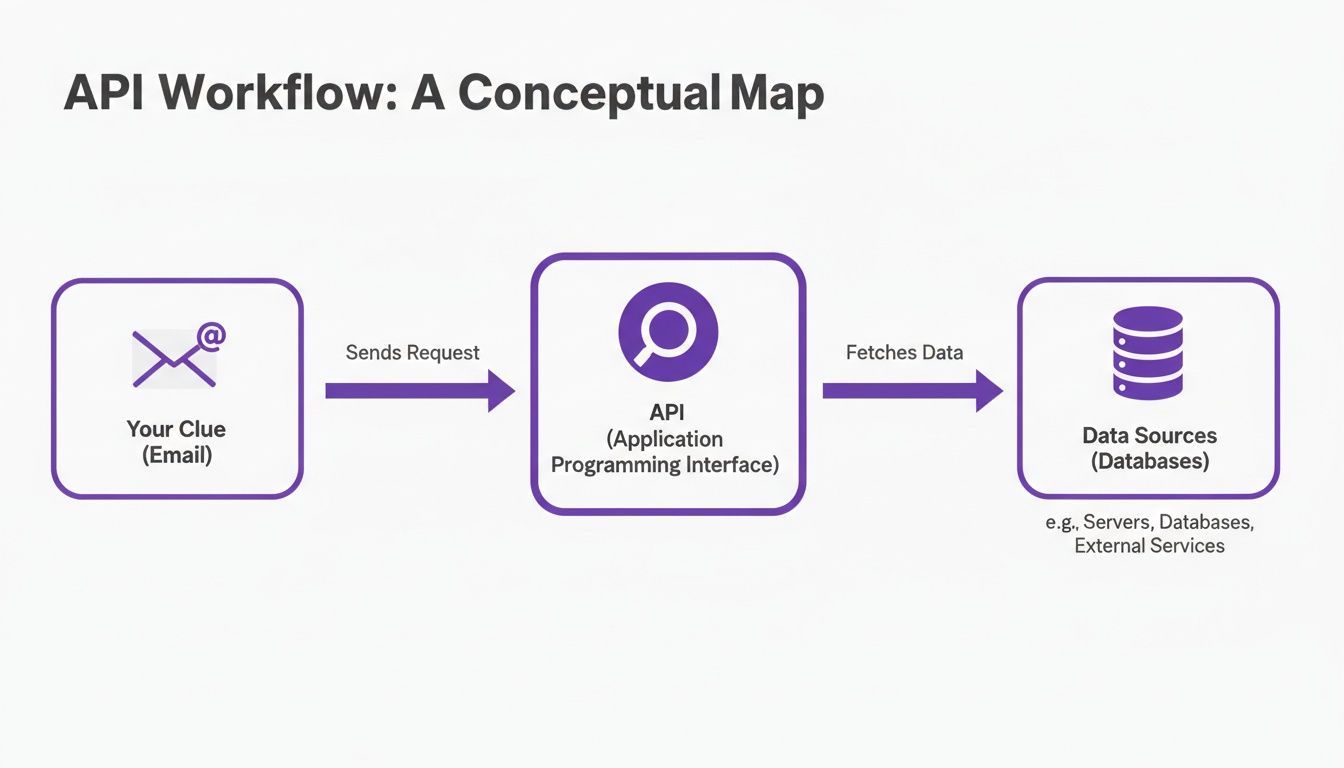
But as you can see, the API's output is completely dependent on the quality of its underlying sources. If those sources are stale, so is the data you get back. It’s that simple.
The Unstoppable Pace of Data Decay
The professional world is in constant motion. People change jobs, get promotions, switch departments, and move companies. This relentless churn is the single biggest enemy of data accuracy.
The numbers are stark: B2B contact data degrades at a blistering pace, with over 30% becoming obsolete every single year. This is a massive challenge for any database trying to keep up. Poor data quality isn't just an annoyance, either—it's estimated that businesses lose around 12% of their revenue because of it.
- Business Challenge: Your sales team launches a campaign targeting "VPs of Marketing." The API returns a list that was accurate three months ago. The problem? In that time, 15% of the contacts have already been promoted or changed roles, making your hyper-personalized outreach totally irrelevant.
Aggressive Data Caching for Speed
To deliver results in milliseconds, many enrichment APIs rely heavily on caching. Instead of performing a fresh search every single time, they store a saved copy of a lead's profile and serve that up to you.
While caching makes the API feel lightning-fast, it’s a recipe for stale data. You aren't getting a live look at the contact; you're getting an old photograph that could be weeks or even months out of date. The API is built to prioritize speed over accuracy.
- Business Challenge: Your CRM automatically enriches a new lead from a webinar signup. The API returns a cached profile showing her as a "Marketing Manager." In reality, she was promoted to "Director" last month. Your introductory email using her old title makes your outreach look sloppy and poorly researched.
Infrequent Database Syncs
Many enrichment providers build their services on top of massive, aggregated databases. They pull information from dozens of third-party sources and compile it into their own proprietary dataset.
The problem is that the syncs between their database and the original sources can be painfully infrequent. If a source database is only updated quarterly, the API serving you that data is always operating on a three-month delay, at best.
- Business Challenge: A lead enrichment tool pulls company data from a provider that syncs with government business registries only twice a year. Your team gets info that a target company has 50 employees. But they were acquired six months ago and now have 500. Your entire sales strategy for that account is now based on a completely false assumption.
Identity Resolution Errors
What happens when an API tries to enrich a common name like "John Smith" in a major city? It has to make an educated guess to distinguish between dozens, or even hundreds, of possibilities. This process, called identity resolution, is riddled with potential errors.
The API might merge profiles of two different people, pull data from the wrong social media account, or incorrectly link a personal email to a professional profile. The result is a Frankenstein's monster of a lead—a jumble of inaccurate and conflicting details.
- Business Challenge: A recruiter searches for "David Chen," a software engineer in San Francisco. The API mistakenly combines the profile of David Chen, a senior developer at a tech giant, with David Chen, a recent coding bootcamp graduate. The recruiter reaches out with a senior-level role, only to find they've contacted the wrong person entirely.
Data Parsing and Interpretation Mistakes
A huge chunk of enrichment data comes from automated bots that "scrape" or "parse" public websites and social media profiles. This process is complex and often handled by developers using code.
But this process is far from perfect. A bot might misinterpret a website's layout, incorrectly identify a personal project as a former employer, or fail to extract contact info hidden in a non-standard format. These parsing errors introduce subtle but critical inaccuracies into your lead data. Understanding why leads go cold is crucial, and it often starts with the flawed data you receive from these automated systems.
- Business Challenge: An API's scraper pulls data from a conference speaker page. It misreads the format and assigns the name of the event sponsor as the speaker's current employer. Your outreach email congratulates the lead on working for a company they have no connection to, immediately destroying your credibility.
Calculating the Real Business Impact of Bad Data

Outdated lead data isn't just a technical headache; it’s a silent revenue killer chipping away at your bottom line. We've talked about why enrichment APIs can serve up stale info, but now it's time to focus on the business impact. The true cost shows up in wasted hours, lost dollars, and opportunities that simply vanish.
When you start translating these abstract data quality problems into hard numbers, the need for a fix becomes impossible to ignore. This isn’t just an IT issue—it's a business problem that directly throttles growth.
Quantifying Wasted Sales Productivity
The first and most obvious cost of bad data is wasted time. Every minute a sales rep spends chasing a ghost lead—a wrong number, a bounced email—is a minute they could have spent nurturing a real conversation with a real prospect. That lost productivity adds up fast.
It's easy to put a number on it. Start by calculating the fully-loaded hourly cost of one of your sales development reps (SDRs), including salary, benefits, commissions, and overhead like software licenses.
Let's say an SDR costs your business $40 per hour. If they burn just five hours a week wrestling with bad contact info, that’s $200 per week, per rep, going straight down the drain. For a team of ten, you're looking at $2,000 per week—or over $100,000 per year—in squandered payroll.
This calculation paints a bleak picture. You’re essentially paying your team to fight against the very data that's supposed to help them. This inefficiency drives up your customer acquisition cost (CAC) and shrinks your team's real capacity.
The Hidden Costs of Marketing Inefficiency
Bad data also sabotages your marketing campaigns, creating costs that are a bit harder to see but just as damaging. Every outdated email address on your list pushes your bounce rate higher.
High bounce rates don't just waste the cost of sending that one email; they poison your sender reputation. Email providers see a lot of bounces as a red flag, making it more likely your next campaign lands in the spam folder, even for your valid contacts.
Consider the missed opportunity cost of a single failed campaign:
- Wasted Spend: If you spend $500 on a campaign targeting 1,000 prospects and 30% of that data is bad, you’ve just thrown away $150.
- Lost Revenue: More importantly, you never reached 300 potential customers. If your typical conversion rate is 2%, that’s six lost deals right there.
The Long-Term Damage to Your Brand
Perhaps the most insidious cost is the slow erosion of your brand's reputation. Reaching out with irrelevant information, using an old job title, or contacting someone who left a company months ago makes you look sloppy and out of touch.
This is a huge factor behind the stale data problem. A shocking 80% of marketers say they need better tools to handle lead data, but many are stuck with legacy systems that can't keep up. With B2B data decaying at a rate of 30% annually, teams are constantly working from behind. You can dig deeper into these lead enrichment trends to see the global scale of the issue.
Every piece of bad outreach chips away at trust. In a crowded market, that first impression is everything. Bad data guarantees you’re starting the conversation on the wrong foot, making it ten times harder to build the rapport you need to close a deal.
A Modern Solution to Keep Your Lead Data Fresh
Knowing why enrichment APIs return outdated leads is half the battle. The next step is building a system that fights back against data decay. Relying on a single API is a recipe for stale contacts and wasted effort. A modern sales or marketing team needs a proactive, multi-layered approach to keep its data fresh and accurate.
The goal is to shift from simply buying data to actively verifying it. This means adding a real-time validation layer to your process. Think of it as a "hybrid enrichment" model—you get the scale of bulk enrichment combined with the surgical accuracy of on-demand data extraction.
The Old Way: Manual Verification and Coding
Traditionally, verifying data meant manual work or complex coding.
- Manual Spot-Checking: A sales rep or researcher would get a list of leads and manually visit each person's LinkedIn profile or company website to confirm their details. This is incredibly time-consuming, prone to human error, and simply doesn't scale for large lists.
- Custom Scraping Scripts: A more technical approach involves writing code (usually in Python) to build a custom web scraper. This requires a developer to create and maintain the script, which can be expensive and slow. If the target website changes its layout, the script breaks, and you're back to square one.
Both of these methods are slow, inefficient, and create bottlenecks for fast-moving sales and marketing teams.
The New Way: One-Click, Real-Time Verification with ProfileSpider
This is where a modern, no-code tool like ProfileSpider overcomes these challenges. It provides a one-click alternative that delivers the accuracy of a custom scraper without any of the technical overhead.
ProfileSpider doesn’t rely on a massive, pre-compiled database that could be months out of date. It acts like an on-demand investigator, visiting a lead’s public profile (like on LinkedIn) and extracting the data that’s live on the page at that exact moment.
This unlocks a powerful, two-step workflow for any sales, marketing, or recruiting professional:
- Bulk Enrichment: Run your large lists through a traditional API to get a baseline of information quickly and cheaply.
- Just-in-Time Verification: For your highest-priority leads—the ones your top reps are about to call—use ProfileSpider for a final, real-time check right before outreach.
With a single click, you can instantly confirm a prospect's current job title, company, and other critical details, ensuring your team walks into every conversation with perfect information. You can see how this works in our guide to B2B lead enrichment services.
By adding this simple, no-code verification step, you practically eliminate the risk of contacting someone with the wrong title or at the wrong company. It's a modern strategy that blends the broad reach of traditional enrichment with the undeniable accuracy of live data, giving your team the confidence they need to connect and convert.
Building a Proactive Data Quality Workflow
Relying on a single enrichment API is like fishing with a net full of holes. You’ll catch some leads, but many more will slip through because of stale data. Winning the fight against data decay means shifting from a reactive, one-off fix to a proactive, continuous process. Good data isn't something you just buy; it's a standard you have to maintain.
Building this kind of data quality machine doesn't require a massive technical overhaul. It's about putting a simple, sustainable workflow in place that stops bad data before it poisons your pipeline. This ensures your sales and marketing efforts are built on a rock-solid foundation of accuracy.
Your Proactive Data Quality Checklist
To get from data chaos to data confidence, your team needs a clear, repeatable process. This framework combines smart automation with strategic manual checks to guarantee freshness where it matters most.
- 1. Audit Your Current Providers: Start by taking a hard look at your existing enrichment tools. Where are they getting their data? How often is it refreshed? Understanding their limitations is the critical first step to plugging the gaps.
- 2. Establish a Cleansing Schedule: Don't let your database slowly rot. Set up a recurring task—quarterly is a good place to start—to run your entire contact list through a cleansing process. This will weed out obvious duplicates and invalid contacts.
- 3. Implement 'Just-in-Time' Verification: This is the game-changer. For your highest-value prospects, relying on stored data is a huge gamble. Implement a final verification check right before outreach using a real-time tool like ProfileSpider. Because it extracts live data directly from a profile at the moment you need it, you get guaranteed, up-to-the-minute accuracy on crucial details like job titles and company info.
By layering on-demand extraction over your bulk enrichment, you create a powerful hybrid system. You get the scale of an API for your broad lists and the precision of a live check for the conversations that truly count.
Turning Process into Performance
The final steps are about making data hygiene a core part of your team's culture and tech stack. This ensures your workflow is a sustainable system that consistently delivers results. To really lock this in, consider exploring different ways of implementing workflow automation tools to handle routine tasks.
You can also set up automated alerts in your CRM to flag data anomalies, like leads missing key fields or contacts that haven't been updated in over six months. Finally, train your team on data hygiene best practices. When everyone understands the real cost of bad data, they become your first line of defense in maintaining a clean and powerful prospect database.
This modern, proactive approach transforms lead generation from a game of chance into a reliable engine for growth, ensuring every outreach effort is based on fresh, accurate, and actionable intelligence.