

The real difference between building and buying a lead list boils down to a simple trade-off: buying feels faster, but building delivers far better quality and ROI. It's a classic case of short-term convenience versus long-term value, and for modern sales and recruiting teams, the right choice is clearer than ever.
The Build vs Buy Decision Explained
Every sales, marketing, and recruiting team eventually hits this crossroads. Do you build your own targeted list from scratch, or do you buy a pre-made list to get going immediately?
Buying a list is tempting. It feels like a shortcut, giving you a huge volume of contacts in an instant. The problem is, these lists are almost always a mess. They’re notorious for having outdated, inaccurate information—after all, studies show B2B data decays at a staggering rate of over 22% per year. That means high bounce rates, wasted time for your sales team, and a real risk of damaging your brand's reputation with sloppy outreach.
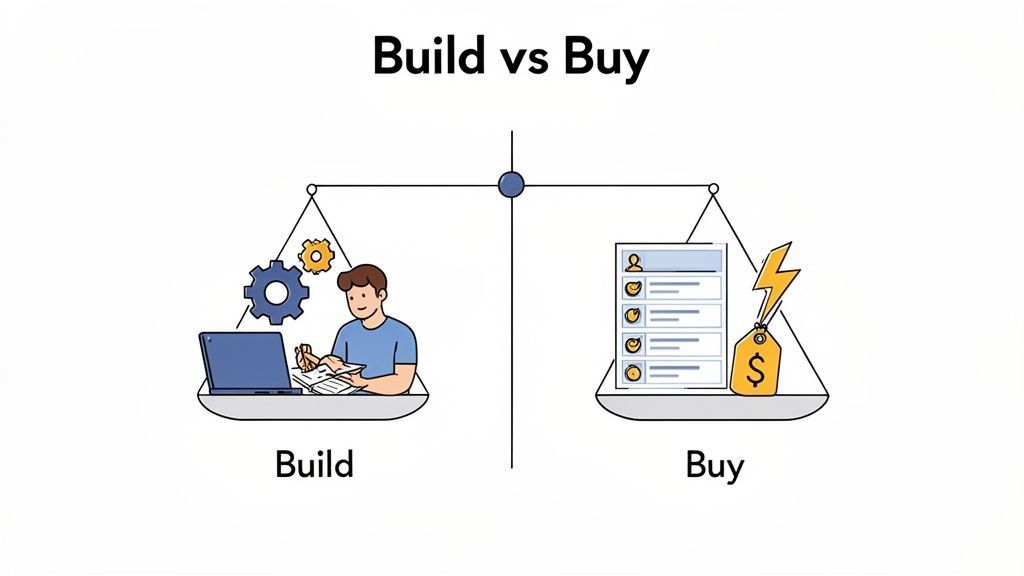
On the flip side, building a list has a reputation for being a slow, painful, manual slog. But that’s an old way of thinking. Modern tools like ProfileSpider have completely changed the game, letting you build hyper-targeted, accurate, and compliant lists in a single click, without any coding or grunt work. This approach puts you in the driver's seat, giving you total control over data quality from start to finish.
So, the choice isn't just about speed anymore. It's a strategic decision between a quick fix and sustainable growth. For any team that cares about genuine engagement and maximizing every dollar spent, building a proprietary list is almost always the smarter play.
To make this crystal clear, here’s a quick breakdown of how the two approaches stack up.
Quick Comparison: Building vs Buying Lead Lists
This table gives you a high-level look at the core differences you'll face when deciding between building a custom list and purchasing a ready-made one.
| Factor | Building Lead Lists | Buying Lead Lists |
|---|---|---|
| Data Quality | High (Fresh, targeted, verified at source) | Low to Medium (Often outdated and generic) |
| Upfront Speed | Slower (Requires initial research or setup) | Fast (Instant access to data) |
| Cost Per Lead | Lower long-term (Higher ROI) | Higher long-term (Hidden costs of bad data) |
| Targeting | Hyper-specific (Aligned with your exact ICP) | Broad and generalized |
| Compliance Risk | Low (Full transparency and control) | High (Unclear data origin and consent) |
| Long-Term Asset | Yes (A proprietary, valuable database) | No (A disposable, one-time purchase) |
Ultimately, building a list means you're creating a valuable, long-term asset for your business. Buying a list is more like a one-time rental—it gets the job done for a moment, but you're left with nothing to show for it afterward. This guide will dig into the true costs, workflows, and risks of each to help you make the right call.
Analyzing The True Cost Per Lead
When you're weighing whether to build or buy a lead list, it’s all too easy to fixate on the upfront price tag. A purchased list often looks like a bargain, dangling thousands of contacts for one flat fee. But that sticker price is pure illusion—it hides a ton of hidden expenses that chew through any perceived savings.
The real cost per lead goes way beyond that initial transaction.
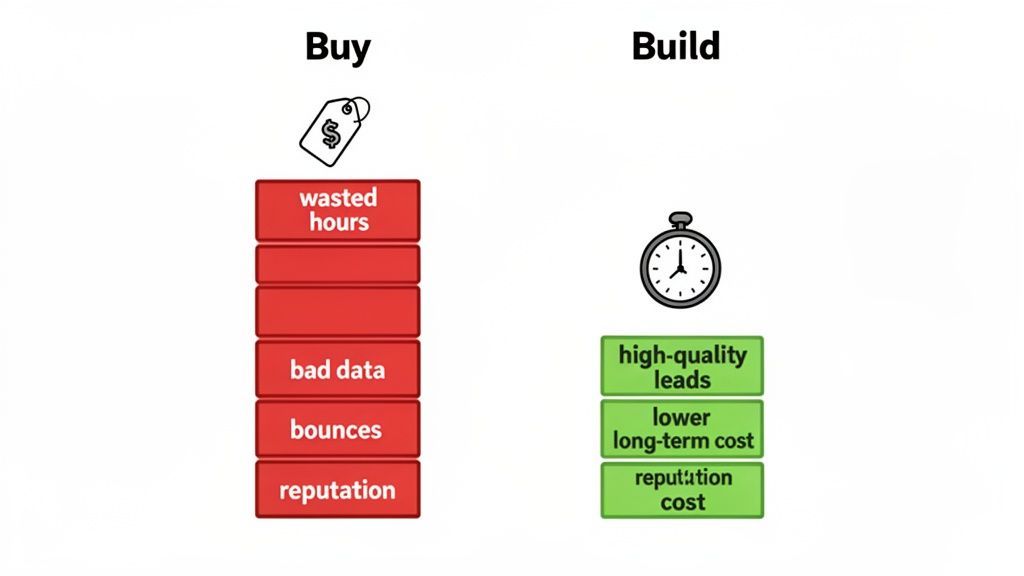
Most of the financial drain from a purchased list comes from its notoriously bad data quality. Stale information leads to high email bounce rates, which can absolutely tank your domain's sending reputation and land your outreach in spam folders. Even worse, it wastes your team’s most precious asset: their time. Every hour a sales rep spends chasing a dead-end contact is a direct hit to your bottom line.
The Hidden Costs Of Purchased Lists
Let’s get real about the impact. Your team gets a new list, fires up an outreach campaign, and immediately discovers that a huge chunk of the contacts have changed jobs, the companies shut down, or the details are just plain wrong. This isn't some minor headache; it's a productivity killer.
This wasted effort has a very real, quantifiable cost. In a revealing experiment by a B2B growth leader, prospects from a purchased list ended up costing $300 per scheduled meeting. By contrast, leads that were built in-house through targeted research came in at just $200 per meeting. That's a 33% savings, a number that starkly illustrates the financial drag of low-quality data.
But the financial bleed doesn’t stop there. Here’s how the hidden costs of a "cheap" list really stack up:
- Wasted Payroll: Every minute your sales or recruiting team spends verifying, cleaning, and qualifying bad leads is money flushed down the toilet.
- Reputational Damage: High bounce rates and irrelevant outreach can get your domain flagged as spam, sabotaging the deliverability of future campaigns.
- Opportunity Cost: Every moment spent on a bad lead is a moment not spent engaging a genuinely interested prospect who could have become a customer.
The real expense of a purchased list isn't the upfront fee. It's the cumulative cost of inefficiency, lost opportunities, and the operational drag it puts on your entire outreach engine.
The ROI Of Building With The Right Tools
On the flip side, building a lead list traditionally had its own cost problem: the mind-numbing time investment of manual research. The thought of a team member spending days copying and pasting data from websites is just as financially painful as buying a junk list.
This is where the equation changes completely with modern tools. The “build” approach is no longer synonymous with slow, manual labor. A one-click profile scraper like ProfileSpider flips this dynamic on its head, making the build strategy both lightning-fast and incredibly cost-effective.
Instead of paying a vendor for a generic, stale list, you invest in a tool that empowers your team to create hyper-targeted, fresh lists whenever they need them. You can go to a company’s team page, an event speaker directory, or an industry forum and instantly pull accurate contact info.
This method completely crushes the cost per quality lead. The investment shifts from paying for a questionable asset to equipping your team with a process for generating high-value assets continuously. For a full financial breakdown, you can dive into the real costs of buying lead lists and see exactly how modern tools offer a far superior alternative.
By building with an efficient tool, you pay once for the capability to generate unlimited, high-quality leads. This model delivers a much better return on investment, ensuring that every dollar spent goes directly toward building a pipeline of prospects who are actually a perfect fit for your business.
How Data Quality Shapes Engagement and ROI
When you get down to it, the whole "build vs. buy" debate for lead lists really boils down to one thing: data quality. A purchased list feels like a shortcut, but that feeling vanishes the second you see how much of it is stale, irrelevant, or just flat-out wrong. This isn't just a minor headache; it's a direct hit to your engagement and your return on investment.
Data decay is the silent killer of any pre-packaged list. People are constantly changing jobs, moving to new companies, and ditching old email addresses. This means the "fresh" list you just paid for could already be 30% inaccurate by the time you use it. That leads to high bounce rates, which torpedoes your domain reputation and sends your future emails straight to the spam folder.
The Real Cost of Stale Data
Bad data isn't just about a few bounced emails. It kicks off a domino effect that eats into your bottom line. Every dead-end contact your sales team chases is time and money down the drain. Every email that misses the mark chips away at your brand's credibility.
This is exactly why the build vs buy lead lists argument almost always favors building. When you create a list yourself from a live, public source, you're starting with data that's inherently more accurate and relevant.
When you pull a profile directly from a company’s team page or an event’s speaker list, you’re capturing data that is current right now. That freshness is what real engagement and solid ROI are built on.
Driving Engagement with Pinpoint Relevance
At the end of the day, good outreach is all about relevance. A purchased list is a blunt instrument, giving you a generic audience that might—or might not—match your Ideal Customer Profile (ICP). This is why engagement rates for bought lists are always so dismal.
Building your own list, on the other hand, puts you in the driver's seat. You control the targeting completely. This is where a modern tool like ProfileSpider really changes the game. Instead of settling for whatever a vendor has on the shelf, you can create hyper-targeted lists whenever you need them.
- Source from Niche Communities: Pull profiles from industry forums or online groups where your ideal customers are actually talking.
- Target Conference Attendees: Scrape the speaker or attendee lists from a recent industry conference to find professionals who are active and engaged.
- Go Straight to the Source: Visit the websites of your target accounts and extract profiles directly from their leadership pages. You'll know you're reaching the right decision-makers.
This kind of focused targeting means every single person on your list is there for a reason. Your outreach feels less like a cold interruption and more like a relevant conversation, which is how you get higher open rates and real replies.
What the Numbers Say About Built Lists
The performance gap here isn't just a gut feeling; the data makes it crystal clear. Demand generation analysis consistently shows that top B2B marketers see engagement from their in-house lists beat purchased lists by 2-3x. Opt-in or self-sourced contacts simply deliver better open rates, click-throughs, and conversions because they’re built on genuine interest or relevance. For a deeper dive, check out these B2B demand gen trends on ViB Tech.
A list you build is more than just a spreadsheet of names; it’s a strategic asset. Each profile is pre-qualified by where you found it, signaling that it aligns with your campaign. When you enrich this data, you’re not just cleaning up typos—you’re adding layers of valuable context. If you're hitting a wall here, understanding why your lead enrichment is failing can give you the insights you need.
By focusing your efforts on building fresh, high-quality lists, you stop wasting resources fixing bad data and start creating meaningful connections that actually grow your business. The superior engagement and ROI make it the obvious choice for any team that's serious about results.
Comparing List Generation Workflows
Your choice to build versus buy a lead list goes way beyond just cost and quality—it completely changes your team's day-to-day. Each path comes with its own distinct workflow, and they have very different implications for speed, efficiency, and the actual hands-on work needed to get a list ready for outreach.
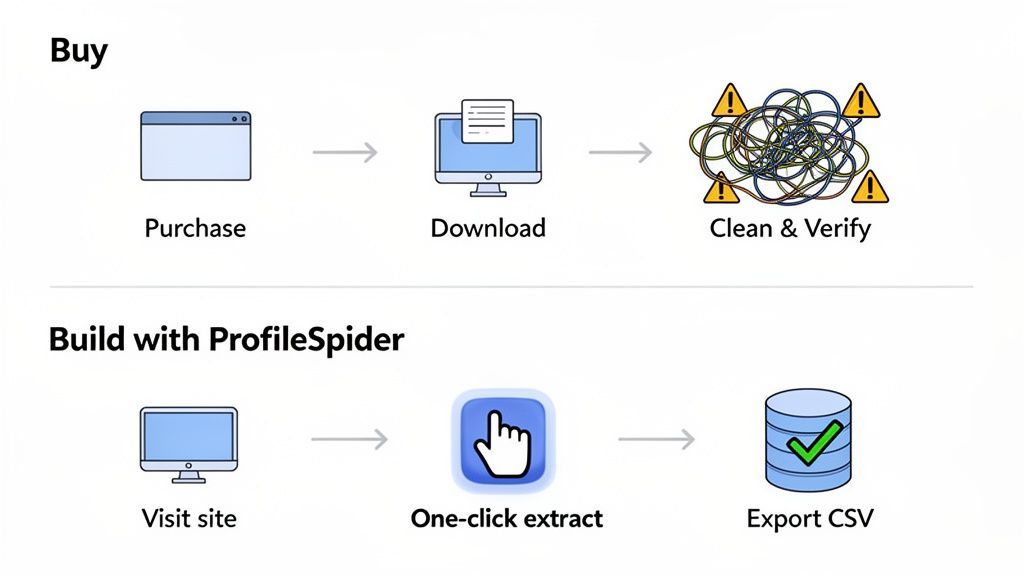
On the surface, buying a list seems like a shortcut. The process looks simple enough: purchase, download, and import. But that illusion of simplicity shatters the moment you open the file and the real work begins—the extensive and often painful process of data cleaning and verification.
The Deceptively Complex "Buy" Workflow
That "buy" workflow is anything but a one-and-done task. It’s really a multi-stage repair job that can easily eat up more time than just building a clean list from scratch with the right tools.
Here’s what that process actually looks like in the real world:
- Purchase and Download: This is the easy part. You get a CSV file with thousands of contacts.
- Initial Spot-Checking: You open the file and immediately see the red flags. Generic info@ emails, missing job titles, contacts from totally irrelevant industries—it's all there.
- Extensive Data Cleaning: Now the real grind starts. Your team has to scrub the list, either manually or with software, to remove duplicates, fix typos, and standardize the formatting.
- Verification and Enrichment: Next up is the critical step of confirming if the contacts are even at their listed companies anymore and if their emails are still valid. This usually means cross-referencing with LinkedIn or paying for another verification service, adding another layer of cost and hassle.
- Segmentation and Importing: After hours, or even days, of cleanup, you can finally segment the contacts that are still usable and import them into your CRM. Your final list is often just a fraction of the size you originally paid for.
The "Build" Workflow, Modernized
The old-school "build" workflow—manually copying and pasting data from websites—is notoriously slow and full of human error. But that's not the only way to build anymore. A modern lead generation tool transforms this tedious chore into a powerful, efficient process.
With a tool like ProfileSpider, the workflow becomes radically simpler and far more effective:
- Identify a Target Source: You navigate to a high-value source, like a company’s team page, a list of conference speakers, or a professional directory.
- Extract with One Click: Open the ProfileSpider extension and click "Extract Profiles." The tool scans the page and instantly pulls all the profiles it finds into a structured, clean list, right in your browser.
- Export and Use: You've got a clean, organized, and hyper-targeted list ready to go. Just export it as a CSV. The data is accurate and ready for immediate import into your CRM—no cleaning required.
This streamlined process makes building a list significantly faster than cleaning a purchased one. To really get this distinction, it's helpful to understand how browser-based collection tools differ from traditional scrapers, since modern tools are built for ease and efficiency.
The modern build workflow isn't about manual labor; it's about strategic sourcing. You invest your time finding the right audience, and the tool handles the data collection instantly, giving you a superior asset in less time.
Head-to-head, the numbers tell a brutal story. Recent data shows that old-school, manual list building produces a meager 1% response rate, while optimized tools can hit a staggering 45%. That 45x multiplier shows that the right workflow isn't just a minor tweak; it completely redefines the economics of building vs. buying. The same analysis points out that data inaccuracies plague 70-80% of homegrown efforts that don't use AI-powered verification, making a modern tool essential.
Ultimately, the effectiveness of any lead list, whether built or bought, comes down to one truth: your customer data is worth more than your equipment. Choosing a workflow that prioritizes data integrity from the very beginning is the most direct path to better engagement and a higher ROI.
Navigating Data Privacy and Compliance Risks
In a world where data privacy is king, compliance isn't just a box to check—it's a fundamental part of responsible lead generation. The choice to build versus buy a lead list has a direct, and often dramatic, impact on your company's risk profile. Getting this wrong has serious legal and ethical consequences.
When you purchase a list, you're essentially inheriting a black box of data. There’s no practical way to verify where that information came from, how it was gathered, or if the people on it ever gave their consent to be contacted. This complete lack of transparency places your business squarely in the crosshairs of data privacy laws.
The High Stakes of Purchased Data
Let's be blunt: purchased lists are a compliance minefield. They are frequently packed with data scraped without consent or pulled from sources that breach privacy policies. This exposes your business to massive penalties under regulations like GDPR in Europe and CCPA in California. A single slip-up can result in crippling fines and, just as critically, cause permanent damage to your brand’s reputation.
The core problem with purchased data is the broken chain of consent. If you can't prove how a contact's information was obtained and that they agreed to be contacted, you are operating on legally shaky ground from day one.
These risks aren't just theoretical. Countries across the globe have strict rules about handling personal data, from GDPR to the CAN-SPAM Act in the U.S. Before you even think about buying a list, you have to confirm the vendor has met every legal requirement for the regions you’re targeting. That's a burden of proof most vendors can't—or won't—provide, leaving you to carry all the risk.
Building a Compliant List with Modern Tools
Building your own list from public data sources offers a completely different, and far safer, path. It gives you total transparency and control over your compliance. When you pull information directly from a public website—like a company’s team page or a public speaker directory—you're working with information that is already openly available. This method creates a data trail that is clear and easy to defend.
This is where the design of your tools makes a huge difference. A solution like ProfileSpider delivers a major compliance advantage with its ‘local-first’ privacy model.
Here’s how this approach fundamentally slashes your risk:
- No Cloud Storage: All data extraction happens on your machine and is stored directly within your browser. ProfileSpider's servers never see, touch, or hold your data, which means you retain complete ownership.
- You Control the Data: Because the information never leaves your local computer, you have full command over how it's stored, used, and deleted. This sidesteps the risks that come with third-party data breaches.
- Transparent Sourcing: You always know the exact origin of your data because you’re the one who visited the source page and initiated the extraction.
This approach makes the 'build' method the clear choice for security-conscious, modern teams. To make sure your team is set up for success, it's a smart move to adopt a lead scraping compliance checklist to ensure your processes are solid from the start.
By taking ownership of your data collection, you shift from hoping you’re compliant to actively ensuring it. This proactive stance doesn't just protect your business; it builds trust with the prospects you want to reach.
Compliance Risk Assessment For Lead Lists
The table below breaks down the key compliance and privacy risks, comparing how building your list stacks up against buying one.
| Risk Factor | Building with Modern Tools | Buying from Data Vendors |
|---|---|---|
| Data Provenance | Clear and auditable. You know the exact source of every contact. | Unknown. Typically a "black box" with no verifiable source trail. |
| Consent Chain | Defensible. Based on publicly available information, not private consent. | Broken or non-existent. Impossible to verify if individuals consented to be on the list. |
| Regulatory Risk | Low. Scraping public data is generally a low-risk activity if done ethically. | High. Significant risk of violating GDPR, CCPA, and other privacy laws. |
| Data Security | High. Data is stored locally on your machine, under your full control. | Moderate to High. Relies on vendor's security, a common source of breaches. |
| Reputation Damage | Low. Transparent and ethical sourcing builds trust. | High. Contacting people without clear consent can damage brand reputation. |
Ultimately, building your own lists puts compliance firmly in your hands, transforming it from a liability into a controlled, manageable process.
The Final Verdict: When to Build vs. Buy
After digging into the costs, workflows, and risks, the choice between building and buying a lead list gets a lot clearer. The right answer really hinges on your strategy, but for any kind of high-value outreach, one path has a serious, long-term advantage.
Buying a list can feel like a quick fix, especially for new teams or anyone under pressure to fill the pipeline yesterday. And to be fair, there are a few very specific, limited situations where it might make sense.
When Buying a List Could Be an Option
Think about buying a list only for broad, low-stakes activities where perfect accuracy isn't the main goal.
- Initial Market Research: If you're just dipping your toes into a new market to get a general feel for the landscape, a purchased list can give you a wide, albeit flawed, dataset to start with.
- High-Volume, Low-Touch Campaigns: For campaigns with minimal personalization, where the cost of a bad lead is basically zero (like a massive brand awareness survey), a purchased list might do the job.
But even then, you're still dealing with the built-in risks of bad data and murky compliance. For pretty much every other business goal, building your own list is the smarter play.
This decision tree on lead list compliance really drives home the difference in risk between the two approaches.
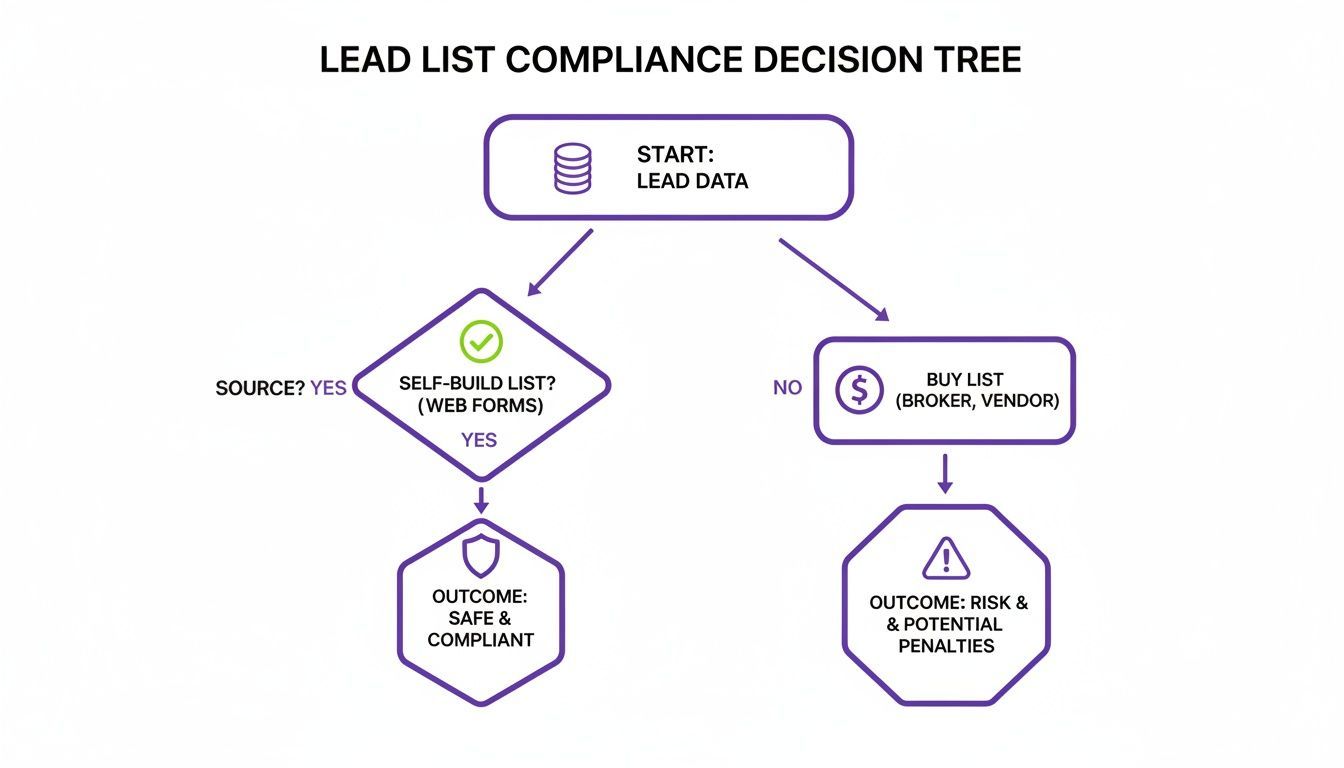
The visual makes it obvious: building your own list from public, verifiable sources is the safe, compliant route. Buying one? That’s where you start taking on significant risk.
Why Building Is Almost Always the Right Move
For any sales, recruiting, or marketing effort where the results actually matter, building your list gives you an unbeatable strategic edge. And the old excuse—that it takes too much time and effort—has been completely dismantled by modern tools.
The old argument that building is too slow is no longer valid. With a one-click tool like ProfileSpider, creating a hyper-targeted, accurate, and compliant list is often faster than the lengthy process of cleaning and verifying a purchased one.
When you build, you get complete control over every single factor that matters. You set the targeting, making sure every contact is a perfect match for your Ideal Customer Profile. You guarantee the data is fresh by pulling it straight from the source, which leads to way higher engagement rates and a much stronger ROI.
Most importantly, you own the entire process from start to finish. This turns your list into a valuable, proprietary asset for your business—a clean, targeted database you can keep growing and refining. That ownership also wipes out the compliance headaches that come with purchased lists, since you have a clear, auditable trail showing exactly where every piece of data came from.
The takeaway is simple: the small upfront effort needed to build a list with the right tool pays off in a huge way over the long run. You get better data, higher conversion rates, and total peace of mind on compliance. For any team focused on sustainable growth, the choice to build isn't just a preference—it's a strategic necessity.