


A warm lead is a potential customer who already knows something about your company and has shown a meaningful level of interest, but is not yet ready to buy.
They may have downloaded a guide, attended a webinar, replied to a message, visited important product pages, asked for more information, or been referred by someone they trust.
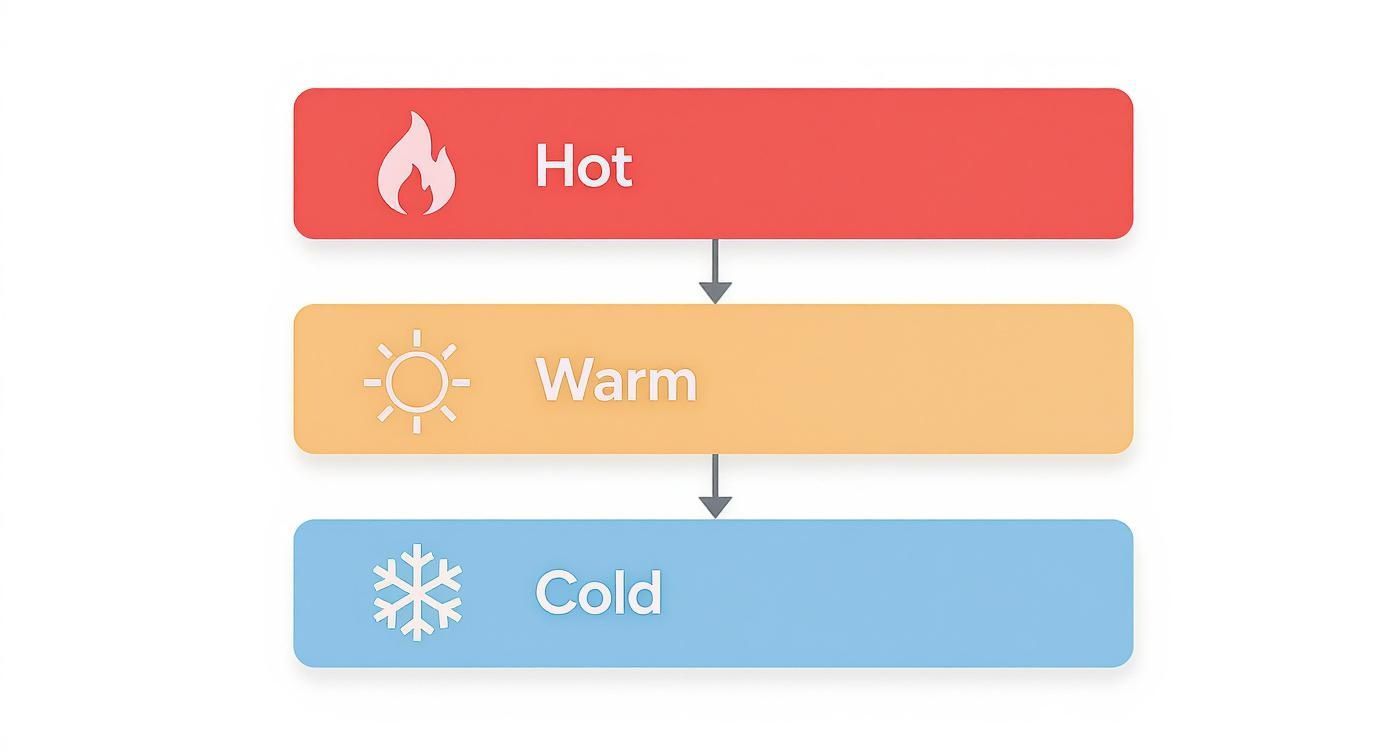
Warm leads sit between cold and hot leads:
- Cold leads have little or no prior relationship with your business.
- Warm leads have shown interest but still need education, trust, qualification, or better timing.
- Hot leads show clear buying intent and are ready for direct sales engagement.
This guide explains what warm leads mean in sales, how to identify them, how lead warming works, and how to convert warm prospects without pushing them too aggressively.
This article is part of our broader guide to lead scraping. For the complete workflow covering lead sources, scraping methods, enrichment, data quality, CRM activation, and compliance, read the Lead Scraping Guide.
Warm Leads Meaning
A warm lead is someone who has moved beyond complete unfamiliarity but has not yet reached a purchase decision.
They are considered warm because there is already some awareness, engagement, relationship, or relevance that makes them more receptive than a cold contact.
Simple Definition
A warm lead is a person or company that has shown interest in your business, content, offer, or market but has not yet demonstrated enough intent to be considered sales-ready.
Examples of Warm Leads
- A visitor downloads a buyer’s guide.
- A prospect attends your webinar.
- A subscriber clicks several product-related emails.
- A company repeatedly visits your pricing and comparison pages.
- A former customer begins engaging with your content again.
- A referral introduces someone who may need your service.
- A decision-maker asks for more information but does not request a demo.
- A person follows your company and regularly interacts with relevant posts.
- A prospect replies positively to an initial outreach message.
- A trial user signs up but has not yet activated the main feature.
A person asking for more details about a product is a typical example of a warm lead. They have shown interest, but more qualification may still be required before treating them as ready to buy.
Cold vs. Warm vs. Hot Leads
Lead temperature is a simple way to describe a prospect’s awareness, engagement, and readiness to buy.
| Lead Type | Awareness | Typical Behaviour | Recommended Approach |
|---|---|---|---|
| Cold lead | Low or none | No known engagement or prior relationship | Build relevance and awareness |
| Warm lead | Moderate | Engaged with content, replied, attended, visited, or was referred | Nurture, educate, qualify, and follow up |
| Hot lead | High | Requests pricing, a demo, a proposal, or buying information | Respond quickly and move toward a sales conversation |
What Is a Cold Lead?
A cold lead has not shown direct interest in your company. They may fit your ideal customer profile, but they do not yet know your business or have an established reason to respond.
Examples include:
- A company found through a public directory
- A contact on a prospecting list
- A person who matches a target role but has never engaged
- A business identified through market research
A well-targeted cold lead may be valuable, but relevance alone does not make the lead warm.
What Is a Warm Lead?
A warm lead recognises your company or has interacted with your content, product, team, or professional network.
They may understand the general problem you solve, but they are often still comparing options, building trust, waiting for the right time, or deciding whether the issue is important enough to act on.
The correct response is usually to provide relevant information, answer questions, and qualify their needs rather than immediately applying a hard sales pitch.
What Is a Hot Lead?
A hot lead is actively evaluating a purchase and has shown clear commercial intent.
Common hot-lead signals include:
- Requesting a demo
- Asking for pricing
- Requesting a proposal
- Starting checkout
- Asking implementation questions
- Booking a sales call
- Comparing plans or contract terms
- Confirming budget or timing
A hot lead usually requires prompt sales follow-up rather than a long educational nurture sequence.
How to Differentiate Warm and Hot Leads
The difference is mainly the strength and immediacy of intent.
| Signal | Warm Lead | Hot Lead |
|---|---|---|
| Content engagement | Downloads or reads educational material | Requests product-specific information |
| Website behaviour | Visits product pages | Repeatedly visits pricing or checkout pages |
| Communication | Asks general questions | Asks about price, contract, onboarding, or timing |
| Decision readiness | Still learning | Actively evaluating options |
| Recommended response | Nurture and qualify | Contact sales quickly |
Why Warm Leads Matter
Warm leads are valuable because your company is not starting the relationship from zero.
The prospect already has some awareness or context, which can make a relevant follow-up more natural than unsolicited cold outreach.
Benefits include:
- Less time spent explaining who you are
- More context for personalized communication
- Clearer evidence of interest
- Better prioritization for sales teams
- A shorter path to qualification
- More efficient use of nurturing content
Warm does not mean guaranteed to convert. A warm lead may still lack budget, authority, urgency, need, or the right timing.
Understanding how warm leads fit into the broader process is important when learning how to build a sales pipeline.
What Is Lead Warming?
Lead warming is the process of increasing a prospect’s awareness, trust, engagement, and readiness before asking for a purchase or sales commitment.
It moves a lead through a progression such as:
Unaware or cold
  ↓
Aware of the problem
  ↓
Aware of your company
  ↓
Engaged with useful information
  ↓
Interested in a solution
  ↓
Ready for a sales conversation
Lead warming is not about repeatedly contacting someone until they give in. It should help the prospect understand the problem, evaluate possible solutions, and decide whether your offer is relevant.
Lead Warming Examples
- Sending a practical guide after a content download
- Inviting an engaged subscriber to a relevant webinar
- Sharing a case study related to the prospect’s industry
- Answering a product question with useful context
- Showing a trial user how to reach the first valuable outcome
- Following up after a referral with a personalized introduction
- Sending comparison information after repeated product-page visits
What Makes a Lead Warm?
A lead becomes warm through a combination of fit, engagement, relationship, and intent.
1. Fit
The person or company resembles the type of customer your product can genuinely help.
Possible fit criteria include:
- Industry
- Company size
- Location
- Job role
- Use case
- Technical requirements
- Budget range
2. Engagement
The lead interacts with your company, content, product, or team.
Examples include:
- Email clicks
- Content downloads
- Webinar attendance
- Repeat website visits
- Replies
- Trial activity
- Event participation
3. Relationship
The lead may already have some connection to your company.
Examples include:
- Referral from a customer or partner
- Former customer
- Previous applicant or prospect
- Existing professional network connection
- Member of the same community or association
4. Intent
The lead shows signs that they may be actively considering a solution.
Examples include:
- Visiting pricing pages
- Comparing products
- Asking about features
- Reviewing implementation content
- Checking case studies
- Returning repeatedly within a short period
Warm Lead Signals to Track
Potential customers reveal interest through their behaviour, but no single action proves that a lead is warm.

Strong Warm-Lead Signals
- Attended a webinar
- Replied to a marketing or sales email
- Downloaded a detailed guide or template
- Visited the website several times
- Clicked product-related emails
- Asked a relevant question
- Was introduced through a trusted referral
- Started a trial
- Engaged with a product demonstration
- Returned after a previous conversation
Weaker Signals
- One email open
- One general homepage visit
- Following a social account
- Liking a single post
- Matching the ideal customer profile without engagement
Email opens should be treated cautiously because privacy technology and automated security scanners can register opens without deliberate human engagement.
Warm Inbound Leads
A warm inbound lead is someone who has come to your company through an inbound channel and has shown meaningful interest.
Examples include:
- An organic search visitor who downloads a guide
- A newsletter subscriber who clicks product content
- A webinar attendee
- A trial signup
- A person who completes a contact form
- A visitor who returns to pricing or comparison pages
Inbound leads are not automatically warm. A person may download something casually or visit once without serious intent. Qualification still matters.
Warm Outbound Leads
A warm outbound lead is a prospect contacted proactively but with some existing relationship, trigger, or contextual reason that makes the outreach warmer than a standard cold message.
Examples include:
- A mutual connection introduces the prospect.
- The prospect previously interacted with your company.
- A former customer moves to another company.
- The prospect attended the same event.
- The prospect replied to an earlier message.
- The company publicly announced a need related to your product.
- An existing account expands into a relevant market.
Outbound does not become warm merely because the targeting is accurate. There must be some real signal, relationship, or relevant event.
How to Score Warm Leads
Lead scoring assigns values to characteristics and behaviours so teams can prioritize follow-up consistently.
Example Warm Lead Score
| Signal | Example Score |
|---|---|
| Matches target job role | +10 |
| Company matches target size | +10 |
| Downloaded a detailed guide | +8 |
| Attended a webinar | +12 |
| Clicked a product email | +6 |
| Visited pricing page | +15 |
| Returned to the website within seven days | +5 |
| Replied to outreach | +15 |
| Requested a demo | +30 |
| Outside target market | -15 |
| Unsubscribed | Remove from marketing workflow |
The score should combine:
- Fit: Is this the right type of account or person?
- Engagement: Are they interacting?
- Intent: Are they moving toward a decision?
- Recency: Did the activity happen recently?
A lead should not become sales-ready merely because of many low-value actions.
How to Nurture Warm Leads
Nurturing a warm lead means helping them move toward a decision without treating every sign of interest as an immediate sales opportunity.

1. Respond to the Specific Signal
Your follow-up should connect to the action the lead took.
Examples:
- Downloaded a guide: send a related checklist or practical example.
- Attended a webinar: send the recording and answer a common follow-up question.
- Visited a comparison page: share a relevant case study or decision guide.
- Started a trial: help them reach the first useful result.
- Came through a referral: mention the shared connection and explain the relevance.
2. Provide Value Before Asking for a Meeting
Warm leads often need education or confidence before they are ready for a sales call.
Useful nurturing content includes:
- How-to guides
- Case studies
- Templates
- Product comparisons
- Implementation checklists
- Short demonstrations
- Customer examples
- Answers to common objections
3. Segment by Context
A marketing director at a SaaS company should not receive the same follow-up as a recruiter, founder, or ecommerce manager.
Useful segmentation fields include:
- Role
- Industry
- Company size
- Content interest
- Product use case
- Lead source
- Stage in the buying process
For more on structuring useful audience segments, read our guide on how to build email lists.
4. Use Several Touchpoints Carefully
Warm-lead nurturing can include email, relevant content, events, product messages, and human sales follow-up. It should not become a high-frequency barrage across every available channel.
Example Warm Lead Nurturing Plan
| Timing | Channel | Action | Goal |
|---|---|---|---|
| Immediately | Acknowledge the action and provide the requested resource | Deliver value and establish context | |
| 2–3 days later | Share a related tip, guide, or example | Continue education | |
| 5–7 days later | Email or appropriate professional channel | Share a relevant case study or ask a simple qualifying question | Identify need and intent |
| After stronger intent | Sales conversation | Offer a relevant call, demo, or next step | Move from nurture to qualification |
| No engagement | Lower-frequency nurture | Reduce communication frequency | Avoid over-contacting the lead |
How to Convert Warm Leads
1. Follow Up While the Signal Is Recent
Interest tends to lose value over time. A recent reply, referral, trial signup, or product-page visit is usually more useful than the same event from several months ago.
2. Ask a Relevant Qualifying Question
Examples include:
- What are you currently trying to improve?
- What led you to look at this topic?
- Are you evaluating a solution now or researching for later?
- Which part of the process is creating the most difficulty?
- Who else is involved in the decision?
3. Match the Next Step to the Lead’s Readiness
| Lead Behaviour | Suitable Next Step |
|---|---|
| Downloaded introductory content | Send further educational material |
| Attended a product webinar | Offer answers or a focused demonstration |
| Visited pricing repeatedly | Ask whether pricing or plan selection needs clarification |
| Requested product details | Provide specific information and offer a conversation |
| Requested a demo or proposal | Route to sales immediately |
4. Remove Friction
Make it easy for the lead to take the next step:
- Provide a direct booking link.
- Answer likely questions before the call.
- Send the relevant plan or product information.
- Keep forms short.
- Avoid asking the lead to repeat information already provided.
5. Know When to Stop
If a lead repeatedly does not respond, unsubscribes, objects, or is no longer relevant, reduce or stop the outreach.
How to Stop Forgetting to Follow Up With Warm Leads
Warm leads are often lost because the follow-up process depends on memory or scattered notes.
Create a Follow-Up System
Track at least:
- Lead name
- Company
- Source
- Warm signal
- Date of last interaction
- Next action
- Next follow-up date
- Owner
- Lead stage
Use Tasks and Reminders
Your CRM or task system should create reminders based on the lead’s stage and most recent activity.
Examples:
- Follow up two days after a webinar.
- Review a trial user after three days of inactivity.
- Contact a referral within one business day.
- Reassess a warm lead after a defined cooling period.
Use Clear Statuses
- New warm lead
- Nurturing
- Awaiting reply
- Qualified
- Sales-ready
- Not now
- Disqualified
- Do not contact
How ProfileSpider Can Support Warm-Lead Research
ProfileSpider can help extract and organize professional or company information from relevant webpages after a warm signal has been identified elsewhere.
For example, a lead may become warm because they:
- Attended an event
- Replied to a message
- Were introduced by a partner
- Downloaded content
- Interacted with your business
You might then use ProfileSpider to collect and structure relevant public information from an appropriate page.
Depending on the webpage, ProfileSpider may extract:
- Name
- Job title
- Company
- Location
- Website
- Profile URL
- Visible email address
- Visible phone number
- Social links
- Description
- Source URL
Organizing Warm Prospects
ProfileSpider allows users to:
- Create lists
- Add tags
- Add notes
- Search and filter records
- Review duplicates within saved profiles
- Export CSV, Excel, or JSON
Possible tags include:
- Webinar attendee
- Referral
- Pricing-page interest
- Previous customer
- Warm outbound
- Needs follow-up
Important Limitations
ProfileSpider does not determine whether someone is warm based on email activity, website visits, LinkedIn engagement, or buying intent.
It also does not:
- Monitor lead behaviour across channels
- Automatically detect product interest
- Automatically find an email for every profile
- Provide bulk person-email finding
- Push records directly into every CRM
- Automatically start an outreach sequence
- Guarantee that extracted fields are complete or correct
Warmth must come from a genuine signal, relationship, or interaction. ProfileSpider can support the research and organization stage after that signal is identified.
For examples of connecting list building with follow-up processes, see these lead generation automation workflows.
Can You Buy Warm Leads?
A purchased list is generally not a list of warm leads for your business.
The people on the list may match your target criteria, but they usually have no existing awareness of or relationship with your company.
That makes them targeted cold leads rather than warm leads.
A third party may transfer a genuinely warm lead in limited situations, such as:
- A partner makes a direct referral.
- A marketplace user requests contact from suitable providers.
- An event attendee explicitly asks to hear from sponsors.
- A call-center agent qualifies interest and transfers the conversation.
The important distinction is whether the person has expressed relevant interest and understands who may contact them.
What Is a Warm Lead Transfer?
A warm lead transfer occurs when one person or system qualifies a prospect and then connects them directly with a salesperson or service provider.
A typical call-center workflow is:
- An agent speaks with the prospect.
- The agent confirms interest and basic eligibility.
- The agent explains that the call will be transferred.
- The prospect agrees to continue.
- The call is transferred to a sales representative.
The person performing this qualification may be called a lead warmer, qualification agent, appointment setter, or sales development representative.
Common Warm-Lead Mistakes
1. Treating Every Engagement as Strong Intent
One email open or social-media like is usually not enough to justify aggressive follow-up.
2. Treating Every Inbound Lead as Warm
Inbound describes how the lead arrived, not necessarily how interested or qualified they are.
3. Calling Targeted Cold Leads Warm
Accurate targeting does not create familiarity, engagement, or intent.
4. Contacting Warm Leads Too Aggressively
Interest in a guide or webinar does not automatically mean someone wants an immediate sales call.
5. Waiting Too Long
Recent intent signals are usually more useful than old activity.
6. Ignoring Fit
A highly engaged person may still be outside your target market or unable to buy.
7. Failing to Track the Original Signal
Without knowing why the lead is warm, outreach becomes generic and confusing.
8. Forgetting Exit and Suppression Rules
Stop or reduce communication when someone unsubscribes, objects, becomes irrelevant, or enters another active sales process.
Frequently Asked Questions
What is a warm lead?
A warm lead is a potential customer who knows something about your company and has shown interest but is not yet ready to buy.
What does warm lead mean in sales?
In sales, it means a prospect has some awareness, engagement, relationship, or intent that makes them more receptive than a cold contact.
What is an example of a warm lead?
A person who downloads a product guide and later returns to view relevant product pages is a typical warm lead.
What is a hot lead?
A hot lead is actively evaluating a purchase and has shown strong intent, such as requesting pricing, a demo, a proposal, or a sales call.
What is the difference between a warm and hot lead?
A warm lead is interested but still needs nurturing or qualification. A hot lead is closer to a decision and ready for direct sales engagement.
What is lead warming?
Lead warming is the process of building awareness, trust, understanding, and engagement until a prospect is ready for a sales conversation.
What is a warm inbound lead?
It is a person who arrives through an inbound channel and demonstrates meaningful interest, such as attending a webinar or repeatedly engaging with product content.
What is warm outbound?
Warm outbound is proactive outreach supported by an existing relationship, referral, previous interaction, or relevant trigger.
How do you generate warm leads?
Create useful content, tools, webinars, newsletters, events, trials, communities, referral programs, and other experiences that encourage relevant prospects to engage voluntarily.
How do you convert warm leads?
Respond to the original signal, provide useful information, ask relevant qualifying questions, personalize the next step, and move to sales engagement when intent becomes strong enough.
How long does a lead stay warm?
There is no universal expiration period. Warmth depends on the strength, recency, and context of the original signal. Leads should be reassessed as engagement and circumstances change.
Can AI identify warm leads?
AI can help analyse fit, engagement, recency, and intent signals, but the result depends on the quality of the underlying data and should not be treated as definitive proof of buying intent.
Can ProfileSpider identify warm leads automatically?
No. ProfileSpider can extract and organize public professional data, but it does not monitor engagement or determine whether someone has shown genuine interest in your business.
Can you buy warm leads?
Most purchased lists are cold because the contacts have not shown interest in your specific company. A lead may be genuinely warm when transferred through a transparent referral or qualification process.
What is the difference between an MQL and a warm lead?
A warm lead is a broad description of a prospect showing interest. An MQL is a lead that meets specific marketing-defined qualification criteria, often based on fit and behavioural scoring.