


When you're weighing ProfileSpider vs Apollo, it boils down to what you're trying to accomplish. ProfileSpider is your go-to if you need a universal, one-click tool to extract profiles from literally any website, and you want to keep that data private on your own machine. On the other hand, Apollo is a massive, cloud-based sales platform with its own huge database and built-in tools for outreach.
Choosing Your Ideal Profile Extraction Tool
In the high-stakes worlds of sales and recruiting, the right data tool isn't just a nice-to-have; it's a game-changer. Both ProfileSpider and Apollo bring serious power to the table, but they’re built on completely different philosophies. Understanding these differences is the key to picking the one that fits your workflow.
Think of ProfileSpider as a modern, no-code AI extractor that’s all about flexibility and privacy. It's a simple browser extension that lets you pull contact and company info from any website you're on with a single click. Crucially, all the data you grab is stored locally right in your browser, so you own it and control it completely.
Apollo, meanwhile, is more of an all-in-one, cloud-based beast. It’s a sales intelligence platform that gives you access to an enormous, pre-verified B2B database, plus all the bells and whistles for sequencing, analytics, and CRM integration. Its real strength is in providing a complete, end-to-end ecosystem for sales and marketing teams. To keep up, many teams are adopting advanced AI-powered lead generation strategies, which is exactly where these kinds of tools prove their worth.
Core Philosophy
The biggest split in the ProfileSpider vs Apollo debate comes down to their fundamental approach.
- ProfileSpider: It champions a flexible, "bring your own source" model. Its one-click AI extraction empowers you to build proprietary lists from any corner of the web—from niche industry forums to conference speaker pages—without any coding.
- Apollo: This operates more like a centralized data provider. You’re tapping into its massive existing database to find and enrich contacts, with a heavy focus on major platforms like LinkedIn.
The decision is straightforward: Do you need a tool to grab data from anywhere you find it (ProfileSpider), or do you need a tool that already has the data and serves it up to you (Apollo)?
This core distinction shapes every other aspect of how they work, from data privacy to who they’re best suited for.
ProfileSpider vs Apollo at a Glance
To really see the contrast, let's break down the fundamental differences between the two platforms. This table gives a quick, high-level summary.
| Feature | ProfileSpider | Apollo |
|---|---|---|
| Primary Function | Universal AI Profile Scraper | Integrated Sales Intelligence Platform |
| Data Source | Any Website (LinkedIn, GitHub, etc.) | Apollo's Centralized B2B Database |
| Data Storage | Local-First (In-Browser) | Cloud-Based (On Apollo's Servers) |
| Best For | Flexible Sourcing & List Building | End-to-End Prospecting & Outreach |
| Core Advantage | Universal Website Compatibility & Privacy | All-in-One Workflow & Data Volume |
Ultimately, this comparison highlights two very different tools designed for two very different workflows. One gives you the freedom to hunt, while the other gives you a map to a known treasure trove.
Understanding Core Architecture And Data Privacy
When you’re deciding between ProfileSpider and Apollo, their underlying design isn’t just a technical footnote—it shapes your entire workflow. How each tool handles data directly influences privacy, ownership, and the way you engage with your prospects.
ProfileSpider adopts a local-first model, meaning every profile you gather is stored in your browser’s IndexedDB. Nothing leaves your machine unless you explicitly click the “Enrich” button.
That setup hands you full control and peace of mind over your data.
The Local-First Advantage Of ProfileSpider
For sales reps, recruiters, and marketers, the lists you build are gold. ProfileSpider ensures those lists stay under your lock and key, as no data is ever sent to external servers without your consent.
- Complete Data Ownership: Your browser holds the info. You own your data—export, update, or delete entries on your schedule, anytime.
- Enhanced Privacy: With zero server-side storage of profiles, there’s no central breach point, and your lead-gen stays private.
- Fully GDPR Compliant: Local storage simplifies meeting strict data-protection rules without extra hoops.
This screenshot shows ProfileSpider’s clean, self-contained interface—your private, offline lead database in action.
Everything runs inside your browser. No internet? No problem—you can still view and manage your lists offline.
Apollo's Cloud-Native Platform
By contrast, Apollo lives in the cloud. When its Chrome extension saves a contact, that data is sent to Apollo’s central servers, feeding a massive shared B2B database.
This architecture powers features like team collaboration, sequence tracking, and advanced analytics. But it also means your data resides on Apollo’s infrastructure.
The fundamental trade-off is control versus convenience. ProfileSpider gives you maximum privacy and ownership; Apollo offers integrated team tools and analytics in the cloud.
Regardless of your choice, understanding legal boundaries around data collection is essential. For an in-depth look at website-scraping rules and best practices, see https://profilespider.com/blog/website-scraping-legal
Architectural Trade-Offs At A Glance
Here’s a quick comparison to highlight how a local-first approach stacks up against a cloud-native platform:
| Architectural Aspect | ProfileSpider (Local-First) | Apollo (Cloud-Native) |
|---|---|---|
| Data Storage Location | Your browser’s IndexedDB | Apollo’s remote servers |
| Data Ownership | You own 100% of your data. | Data lives within Apollo’s ecosystem. |
| Privacy & Security | High—no server-side storage of profiles. | Depends on Apollo’s security measures. |
| Collaboration | Solo-focused; share via professional file exports (CSV, Excel, JSON). | Built-in team features and shared lists. |
| Offline Access | Yes—you can manage lists without internet. | Requires connectivity to sync changes. |
Your ideal pick hinges on priorities. If unmatched privacy and total data control top your list, ProfileSpider’s local-first design is the clear choice. If you need a turnkey, collaborative sales platform with cloud-powered insights, Apollo is built for that scenario.
Comparing Data Extraction and Enrichment Features
At the heart of the ProfileSpider vs. Apollo showdown are two fundamentally different philosophies on how you get the data you need. Both tools are powerhouses for finding and enriching contact info, but how they do it makes all the difference. It comes down to whether you need a skeleton key for the entire web or a master key for one incredibly valuable building.
ProfileSpider is that skeleton key. Its main draw is the one-click AI profile extraction that works on any website you can point a browser at. We’re not just talking about the big social networks. You can extract structured data from a conference speaker list, a company’s “About Us” page, or a niche industry forum—saving hours of manual data entry.
The whole process is built for non-technical users. You land on a page, hit the ProfileSpider icon, and its AI gets to work, automatically capturing names, job titles, companies, and contact details. It’s smart enough to detect both individual and company profiles on any page, whether it’s a single profile or a batch page with up to 200 profiles.
Universal Scraping vs. Database Overlay
This is where Apollo takes a completely different path. Its strength comes from its massive, pre-vetted B2B database, which it layers directly on top of LinkedIn. When you’re on a LinkedIn profile, the Apollo extension cross-references it with its own data and—boom—serves up verified emails and phone numbers. It's incredibly fast but keeps you tethered to the LinkedIn ecosystem.
The core difference is the source of truth. ProfileSpider empowers you to build your own proprietary lists from any website you can find. Apollo gives you direct access to its existing, high-quality database, primarily through a LinkedIn window.
Think about a recruiter hunting for developers on GitHub or a marketer trying to spot influencers on Twitter. In those scenarios, ProfileSpider's universal website compatibility is a massive win. Its AI can pull complete profiles—names, titles, social links, contact info—from any site, giving it a huge edge over tools that live and die by a single platform.
A Closer Look at Enrichment Workflows
Both platforms have strong enrichment features, but the way they work mirrors their core design.
With ProfileSpider, enrichment is a distinct, intentional step. Let's say you've scraped a list of profiles, but many are missing emails. You simply select them and use the “Enrich” function. This tells ProfileSpider to visit the source URLs and extract missing details like emails, phone numbers, and social links. It’s a powerful bulk operation that puts you in full control.
Apollo’s enrichment, on the other hand, is usually instant. Because it’s just pulling from its own database, the contact info is right there when you view a LinkedIn profile. It’s a slick, seamless workflow designed for high-volume sales prospecting where speed is everything.
Here’s a quick breakdown of how they stack up:
| Feature | ProfileSpider | Apollo |
|---|---|---|
| Extraction Source | Any website with profile data. | Primarily LinkedIn, using its own database as the source. |
| Extraction Method | One-click AI scan of the live webpage. | Database lookup overlaid on LinkedIn profiles. |
| Enrichment Process | Separate "Enrich" command to find missing data. | Integrated, instant reveal of contact info. |
| Best For | Building unique prospect lists from diverse online sources. | Quickly finding verified contacts for LinkedIn-based leads. |
Ultimately, ProfileSpider is for the true prospectors and researchers—the people who hunt for leads in unconventional places across the web. If your job involves building and curating custom lists from multiple sources, understanding the power of a flexible B2B lead enrichment service is crucial. Apollo, in contrast, is purpose-built for the sales pro who needs reliable contact data for LinkedIn prospects, delivered fast within an all-in-one engagement suite.
Putting ProfileSpider vs. Apollo to the Test: Real-World Scenarios
A tool’s spec sheet only tells you half the story. The real test is how it fits into your day-to-day work. Let’s move past the feature lists and walk through a few common workflows to see where each platform shines. The right tool should feel less like a chore and more like an extension of your own process.
Think about a technical recruiter trying to build a pipeline of senior software engineers. The traditional method involves hours of manual copy-pasting from various sites, a tedious and error-prone process. The best candidates aren't just on LinkedIn; they’re contributing to GitHub repos, speaking at developer conferences, or showcasing work on portfolio sites. This is where ProfileSpider's one-click simplicity becomes a game-changer.

With a single click, that recruiter can scrape an entire list of contributors from a GitHub project or pull the speaker lineup from a conference website. ProfileSpider’s AI intelligently pulls out names, job titles, social links, and any contact info it can find. Suddenly, they have a proprietary talent pool built from sources that Apollo.io simply can’t access, saving hours of manual work.
High-Velocity Sales Outreach
Now, let's switch gears to a sales development representative (SDR). Their world revolves around high-volume, high-efficiency outreach. The daily mission: identify key decision-makers on LinkedIn, grab verified contact details, and get them into an email sequence—fast.
For this kind of workflow, Apollo’s all-in-one platform is tailor-made. The SDR can practically live on LinkedIn, using the Apollo overlay to instantly find verified emails and phone numbers from its massive database. From there, they can add prospects directly to a sequence and track every open and click without ever having to jump between different tools. It’s a seamless, integrated experience designed for speed.
Key Takeaway: ProfileSpider is built for the sourcing specialist—the recruiter, marketer, or researcher who needs to craft unique, high-value lists from anywhere on the web with no-code simplicity. Apollo is built for the sales executor—the person who needs a unified system to engage prospects at scale, primarily within the LinkedIn ecosystem.
Head-to-Head on Common Tasks
To drive the point home, let’s break it down into a few specific jobs and see which tool gets the win.
- Task: Build a list of VPs of Marketing in the SaaS industry.
- Apollo Wins: This is Apollo's bread and butter. Its database is built for this kind of search—you can filter by title, industry, company size, and more to get a list in minutes.
- Task: Source freelance graphic designers from Behance or Dribbble.
- ProfileSpider Wins: These creative portfolio sites are well outside Apollo’s lane. ProfileSpider can easily scrape these pages with one click to build a targeted list of designers you won’t find elsewhere.
- Task: Map out the entire team from a startup's "About Us" page.
- ProfileSpider Wins: Its one-click extraction is perfect for this. Just point it at the page, and it will grab every profile, giving you an instant organizational chart.
- Task: Find direct-dial phone numbers for 100 existing LinkedIn leads.
- Apollo Wins: Its deep B2B contact database and credit-based enrichment system are designed for exactly this kind of high-volume task.
While Apollo’s tight integration and generous free tier have made it a dominant player, ProfileSpider’s universal scraping power has carved out a loyal following among recruiters and sourcers who need to go beyond the usual channels. As you can find out why this distinction is so important, you’ll see that market position often comes down to serving a specific need exceptionally well.
Ultimately, the best choice comes down to mapping your daily tasks to the right tool. If your job involves creative sourcing and building proprietary lists from the far corners of the web, ProfileSpider’s flexibility is unmatched. But if your role is all about disciplined, high-velocity outreach inside the LinkedIn world, Apollo’s integrated system is tough to beat.
Unpacking the Price Tag: Where Does the Real Value Lie?
When you’re looking at ProfileSpider and Apollo, the price is just the first layer. You have to see how each tool's pricing reflects its entire philosophy. It's not about which one is "cheaper," but which model actually fits how you work and what you're trying to accomplish.
Apollo is a classic, all-in-one SaaS platform. You get a subscription, pay per user, and the cost scales with your team size and the features you need. They have a free tier that’s great for getting your feet wet, but the real power comes from the paid plans. You're not just buying a tool; you're buying into their entire sales engagement ecosystem—the database, the sequencer, the analytics, and all the integrations wrapped into one predictable monthly bill.
ProfileSpider comes at it from a completely different angle. It’s a specialized, no-code tool built for one core job: extracting profiles. Instead of a subscription, it runs on a credit system. This makes it incredibly efficient for its primary purpose, giving you a powerful way to scrape and organize data locally without a recurring fee breathing down your neck.
Apollo's Subscription and Credit Model
Apollo’s pricing is built for sales teams who need predictability. You know what you're spending each month, and that cost is tied to accessing their huge cloud database and all the surrounding features.
For example, Apollo.io's pricing starts at $37.45 per user per month. The free plan is a solid entry point, offering a handful of credits to let you test the waters. As you move up the tiers, you unlock more credits and advanced features for larger operations. You can find some interesting pricing comparisons on sites like kaspr.io.
This model is perfect for teams that need an all-in-one sales intelligence platform and want to budget for a fixed monthly cost.
ProfileSpider's Flexible Credit System
ProfileSpider flips the script with a pay-as-you-go credit system. You buy a bank of credits, and they're only used when you actually extract data. No monthly subscription, no per-seat fees.
This approach gives you a few major wins:
- Pay for what you use: Credits are only spent when the AI successfully grabs the data. No charge for blocked pages or failed attempts.
- No per-seat costs: The price is tied to the action of scraping, not how many people are on your team. This makes it a great fit for solo operators and teams that share scraping duties.
- Unlimited local value: Once you've used a credit to extract the data, it's yours. You can organize, manage, and export it from your local browser storage forever, without paying another dime.
Here's the key difference in a nutshell: With Apollo, your cost is tied to ongoing access to its ecosystem. With ProfileSpider, your cost is tied to the one-time act of getting the data, unlocking unlimited value after the fact.
If you want to see how other tools structure their pricing, checking out something like PostSyncer's pricing page can offer some perspective, even though it's in a totally different category. It shows how value is packaged based on the job the tool does.
So, the choice comes down to what you’re paying for. If you need a comprehensive, cloud-based sales platform with a predictable monthly bill, Apollo’s model is a solid, straightforward fit. But if you're looking for a powerful, cost-effective data extraction engine where you get maximum value after you’ve collected the data, ProfileSpider’s credit system delivers a much better ROI.
Making Your Final Decision
So, how do you choose? When you stack up ProfileSpider vs. Apollo, the right tool isn't about which one is "better" in a vacuum. It's about which one slots perfectly into your daily grind and gets you to your goal faster.
Choose ProfileSpider if your job is to build hyper-specific, proprietary lists from all corners of the web. It's the go-to for recruiters finding talent on niche job boards, marketers spotting influencers on up-and-coming social platforms, or researchers pulling data from academic directories. Because it’s a local-first tool, your data stays on your machine—a huge win for complete privacy and data control.
This decision tree helps visualize how different needs and budgets might steer you toward one tool or the other.
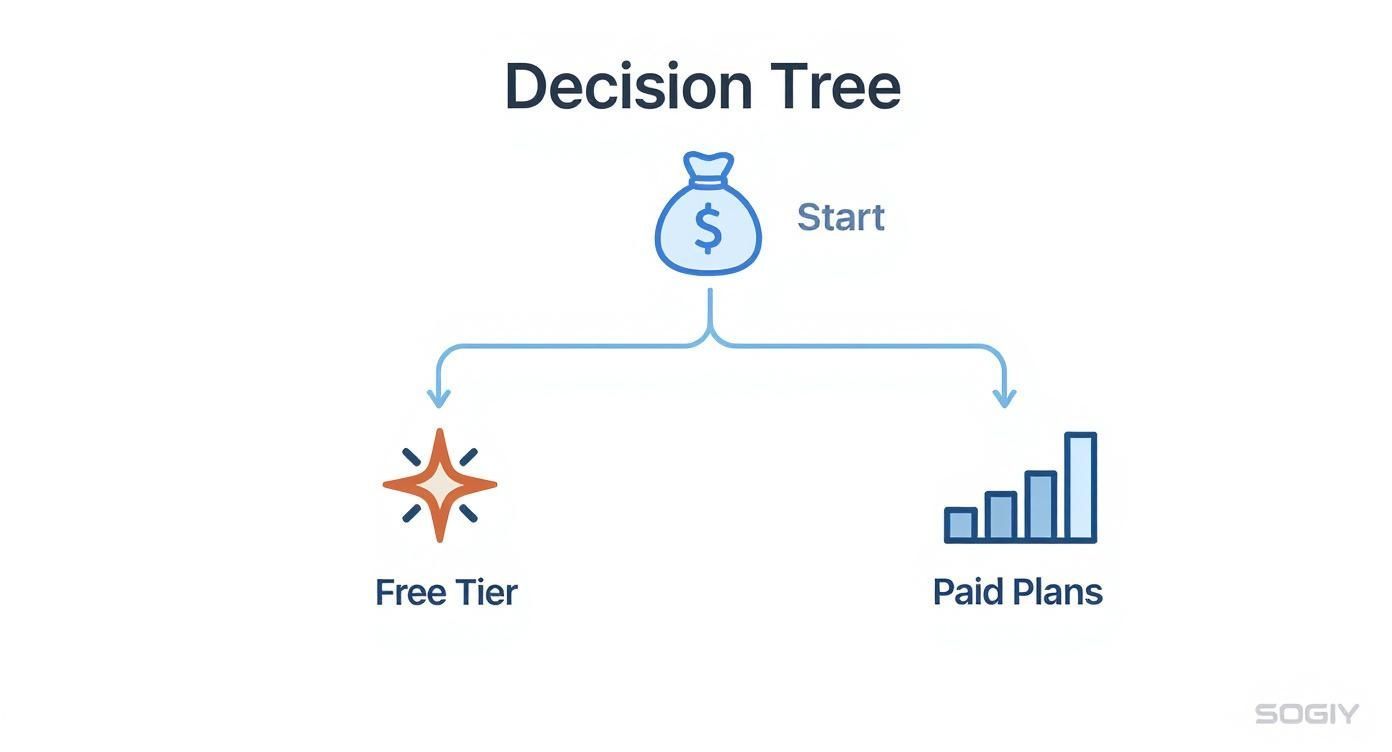
As you can see, your starting point—whether you need a powerful free tool or you're ready to invest in a paid plan—sets you on a path. From there, your specific goals for data sourcing and outreach will make the choice clear.
Your Quick Decision Checklist
To cut right to the chase, just answer these questions. Your gut reaction will probably tell you everything you need to know.
- Is LinkedIn your primary hunting ground? If yes, Apollo's deep integration is hard to beat for a seamless workflow.
- Do you need to pull profiles from diverse sources like GitHub, niche directories, or online forums? If so, ProfileSpider's ability to scrape almost any website is a must-have.
- Is total data privacy and keeping everything on your own computer a non-negotiable? If yes, ProfileSpider's local-first design is built exactly for that.
- Are you looking for an all-in-one platform with email sequencing and analytics built right in? If that's you, Apollo offers that complete, end-to-end solution.
- Is your main objective to build clean, targeted lists to export into your own CRM or ATS? If that’s the job, ProfileSpider's professional export options (CSV, Excel, JSON) are laser-focused on doing it exceptionally well.
The Bottom Line: Go with ProfileSpider for its unmatched scraping power across the web, ironclad data privacy, and pure list-building muscle. Opt for Apollo when you need a fully integrated sales engagement platform with a massive built-in B2B database and a workflow centered on LinkedIn.
By figuring out your main use case—flexible data sourcing versus integrated sales outreach—the right choice becomes obvious. The winner in the ProfileSpider vs Apollo debate is simply the tool that fits the job you need to get done today.
Decision Checklist: ProfileSpider or Apollo?
Answer these questions to determine which tool is the right fit for your needs.
| Consideration | Choose ProfileSpider If... | Choose Apollo If... |
|---|---|---|
| Primary Data Source | You source from many different websites, not just LinkedIn. | LinkedIn is your main source for leads and contacts. |
| Core Goal | Your main goal is building and exporting clean, targeted lists. | You need a single platform for finding, contacting, and analyzing leads. |
| Data Privacy | You need to keep all extracted data private and stored locally. | You're comfortable with a cloud-based platform that stores data for you. |
| Technical Needs | You need a flexible, no-code tool to extract data from any public site. | You need built-in email automation, sequencing, and call recording. |
| Workflow | You prefer to use specialized tools for different tasks (e.g., scraping, CRM, outreach). | You want an all-in-one solution that combines all sales engagement tasks. |
Ultimately, this checklist should make it crystal clear. One tool is a specialized extractor that gives you total control; the other is a comprehensive platform designed for sales teams. Choose the one that aligns with your role, and you'll be set up for success.
Common Questions: ProfileSpider vs. Apollo
We get a lot of questions about how ProfileSpider stacks up against big cloud platforms like Apollo.io. Let's break down the most common ones.
"Can ProfileSpider find emails like Apollo does?"
Yes, but it works differently. After you've scraped a list of profiles, you just click the “Enrich” button. ProfileSpider then revisits those profile URLs to hunt down missing emails and phone numbers.
It’s a different philosophy. Apollo taps into its massive, centralized database for instant results. ProfileSpider, on the other hand, performs a fresh search on-demand, which means it works on any site you’ve scraped—not just the big professional networks. This gives you a ton of flexibility for sourcing from niche communities or industry-specific sites.
"Is my data actually safe if it's stored locally?"
Absolutely. This is one of the biggest reasons people choose ProfileSpider. Its local-first design means everything is stored directly in your browser’s IndexedDB. No data is ever sent to external servers without your consent.
This keeps you in complete control and ensures you're on the right side of GDPR. You own your data, period.
"Storing data locally just makes sense. It dramatically cuts down on breach risks and keeps all that sensitive lead information under your lock and key."
- Privacy by Design: All extracted profiles are stored locally in your browser.
- No Sneaky Syncing: There's no automatic cloud backup or third-party access.
- You're in Control: You decide when to export or permanently delete your data.
Use Cases and Workflows
"Which tool is better for a recruiter who sources from lots of different websites?"
If you're a recruiter pulling talent from places like GitHub, Behance, industry forums, or specialized job boards, ProfileSpider is built for you. Its universal AI extraction engine can tackle any website you throw at it, so you're not stuck with manual copy-pasting.
Apollo's real strength is its deep integration with LinkedIn, powered by its own huge contact database. It's fantastic for that specific ecosystem, but ProfileSpider gives you the freedom to hunt for talent anywhere on the web.
"Can I get my data into my CRM or ATS?"
Of course. ProfileSpider lets you export your data to CSV, Excel, or JSON formats. You can choose custom fields to match your workflow, making it a clean, simple process to import directly into your CRM or Applicant Tracking System for seamless integration.
Making the Final Call
Still on the fence? Here’s a quick checklist to help you decide.
- Where do you spend your time? If 90% of your work is on LinkedIn, Apollo’s deep integration might be a real time-saver for your outreach.
- How important is data privacy? If you need zero external data transfers and full ownership, ProfileSpider’s local-first approach is the clear winner.
- Try before you buy. Take both for a spin. ProfileSpider gives you 10 free credits to play with, and Apollo has a free plan with a limited number of email credits.
- Watch the clock. Run a few of your typical workflows in both tools. See which one genuinely cuts down on manual tasks and saves you the most time.
Hopefully, this clears things up! The best way to know for sure is to get your hands dirty and see which tool feels like a better fit for your day-to-day work.
Our team is always here to chat about data privacy, extraction workflows, or anything else on your mind.
Ready to see the local-first approach in action? Visit profilespider.com to start your free trial and see how it compares. You'll see why 73% of our users made the switch for total data privacy.