

AI data extraction is a modern way to use smart technology to automatically read, understand, and pull specific information from websites and documents. For recruiters, sales teams, and marketers, it eliminates the soul-crushing, manual task of copying and pasting data, letting you gather leads, contacts, or competitor information in seconds instead of hours.
What is AI Data Extraction in Practice?
Imagine you’re a recruiter trying to build a list of 50 promising candidates from a conference speaker page.
The Traditional Method (Manual Grind): You’d start a tedious, mind-numbing cycle. Highlight a name, copy it, switch to a spreadsheet, and paste it in. Then, you'd repeat that for their job title, company, and social media links—one by one, for all 50 people. This manual work is not only painfully slow but also riddled with human error. One typo could mean a bad lead or a missed opportunity.
This is the exact problem AI data extraction solves. Instead of copying and pasting, you use a tool that acts like a highly efficient digital assistant. It reads a webpage, understands the context—knowing "John Doe" is a name and "CEO" is a job title—and pulls all that information into a clean, structured list for you.
The Shift from Manual Labor to Smart Automation
The real value of AI data extraction is its ability to turn messy, unstructured web content into clean, organized, and usable data—almost instantly. What once took an afternoon of manual labor can now be done with a single click.
This is where a no-code tool like ProfileSpider comes in. It simplifies the entire workflow into a one-click action. You visit the conference speaker page, click one button, and ProfileSpider automatically extracts all the profiles into a neat list. The hours of manual copy-pasting are gone, freeing you up for the work that actually requires a human touch, like building relationships with prospects or interviewing top talent.
This technology fundamentally changes the economics of lead generation and research. What once took a team member a full day to accomplish can now be completed before their first coffee break, dramatically increasing productivity and reducing operational costs.
Manual vs. AI Data Extraction: A Quick Comparison
The table below gives a clear breakdown of the practical differences between the old manual grind and the new AI-powered workflow, highlighting why so many professionals are making the switch.
| Aspect | Manual Data Extraction | AI Data Extraction (with a tool like ProfileSpider) |
|---|---|---|
| Process | Manually copy and paste each piece of data from a website into a spreadsheet or CRM. | A single click tells an AI tool to automatically scan, identify, and organize all relevant data from a page. |
| Speed | Extremely slow, often taking hours or days to build a sizable list of contacts or profiles. | Incredibly fast, processing hundreds of profiles in just a few minutes, turning a day's work into a minute's task. |
| Accuracy | High risk of human error, including typos, missed fields, and incorrect formatting. | Consistently high accuracy, as AI models are trained to recognize and correctly categorize data fields. |
| Scalability | Very difficult to scale. Doubling your output requires doubling your manual effort and time. | Highly scalable. You can process thousands of pages and profiles with minimal additional effort. |
This clear distinction is why professionals in sales, recruiting, and marketing are rapidly adopting these new methods. It's no longer just about collecting data; it's about collecting it intelligently and efficiently. For a deeper look into how AI is changing the game, check out our guide on the best AI scraper tools out there.
How The Technology Actually Works
You don't need a computer science degree to understand how AI pulls data from a webpage. The concept is quite simple: think of the AI as a smart assistant that learns to "read" a website much like a person does, but at an unbelievable speed. It spots patterns, understands context, and knows what to look for without needing rigid, pre-defined rules.
At its core, AI data extraction relies on a few key technologies working together to turn a messy webpage into a clean, organized list you can actually use.
The visual below shows just how much this AI-powered process improves on the old, tedious manual methods.
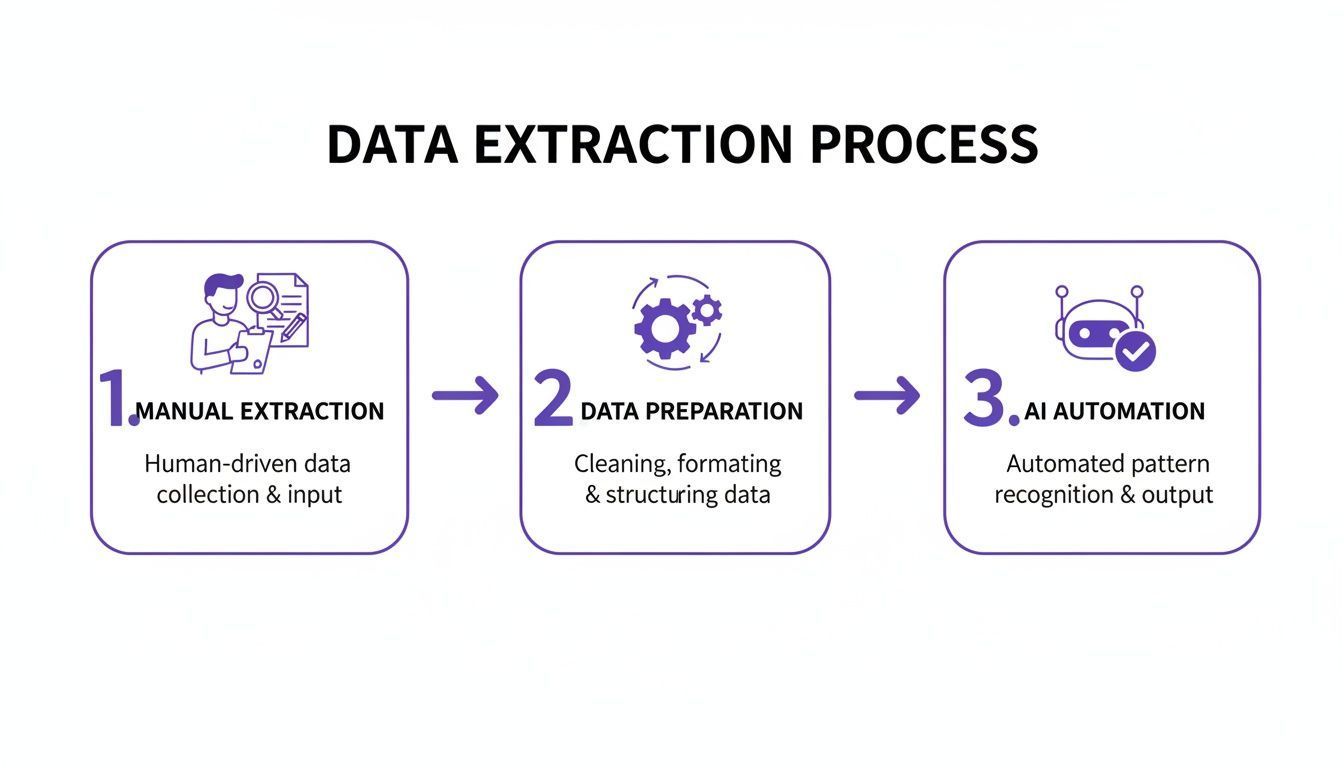
This workflow highlights the shift from error-prone copy-pasting to a fast, reliable system that delivers structured data ready for action.
Making Sense of a Webpage's Structure
First, the AI needs to understand the website's layout. Every webpage is built with code—like HTML—that acts as its skeleton. This underlying structure is called the Document Object Model (DOM).
For non-developers, the DOM is essentially the website's blueprint. It tells the AI where everything is: the "About Us" section is here, the "Contact" info is there, and the employee list is in a specific table. An AI tool uses what's called DOM parsing to read this blueprint, allowing it to navigate the site efficiently and find the sections where valuable info like names and job titles are likely to be.
Understanding Language and Context
Once the AI knows where to look, it needs to understand what it's seeing. This is where Natural Language Processing (NLP) comes in. It's the technology that allows computers to make sense of human language.
Think of NLP as the AI's language comprehension skill. It’s what teaches the software that "CEO" is a job title, "San Francisco, CA" is a location, and "john.doe@company.com" is an email address—not just random strings of characters.
This ability to grasp context is what separates modern AI extraction from older, rule-based scrapers that would break if a website changed its layout. The AI isn't just matching keywords; it's understanding relationships and meaning.
Recognizing and Extracting Key Information
The final piece of the puzzle is entity extraction. After using the DOM to find the right area and NLP to understand the text, the AI identifies and pulls out specific pieces of information, known as "entities."
This process relies on a few different techniques:
- Pattern Recognition: Perfect for data that follows a predictable format, like phone numbers or email addresses.
- Contextual Analysis: For trickier data, like telling a person's name apart from a company name, the AI analyzes surrounding words to make an accurate call.
- Machine Learning Models: Advanced tools like ProfileSpider use models trained on millions of professional profiles. This helps them recognize data fields with impressive accuracy, even on websites they’ve never seen before.
This combination of tech is what makes modern tools so powerful and flexible. To see it in action, check out how VCs commonly extract data from PDF pitch decks automatically to streamline their deal flow. The same principles apply. For you, it just feels like a single click, but a sophisticated process is happening behind the scenes to turn web content into actionable data.
How Automated Data Extraction Changes the Game
Bringing AI into your data extraction workflow is more than a minor tweak—it's a fundamental shift in how sales, recruiting, and marketing professionals work. This technology has a direct, tangible impact on productivity, speed, and decision-making, giving a massive advantage to anyone who adopts it.
The days of burning hours on mind-numbing manual data entry are numbered. That time can now be invested in what actually moves the needle: building relationships, closing deals, and finding the perfect candidate.
Fueling Growth with Smarter Data
The massive investment flooding into the AI market directly translates into more powerful, accessible, and affordable tools for professionals. This isn't just abstract market growth; it means real benefits for your daily work. The demand from data-heavy roles in sales and recruiting has fueled innovation, leading to tools that are smarter and faster than ever.
The broader AI market, which powers these extraction tools, hit USD 539.45 billion in 2026 and is projected to rocket to USD 3,497.26 billion by 2033. This growth is driven by the real-world needs of businesses desperate for better data. You can discover detailed insights on the data extraction market outlook.
All this investment means tools like ProfileSpider are becoming incredibly sophisticated. They can navigate complex websites, understand subtle data points, and hand you clean, structured information with a single click—all without requiring you to write a single line of code.
From Cost Center to Competitive Edge
For years, gathering data at scale was a major operational headache. You either had to hire a team for manual data entry or sink money into brittle, developer-dependent scraping scripts. Both options were slow, expensive, and difficult to scale.
AI data extraction completely flips that script. It transforms a time-consuming cost center into a strategic asset.
- Turbo-charge Lead Generation: Sales teams can build hyper-targeted prospect lists from conference websites or online directories in minutes, not days. This speed allows them to act on opportunities before the competition.
- Supercharge Talent Sourcing: Recruiters can quickly map out entire teams at rival companies or find passive candidates from niche professional networks, building a richer talent pipeline in a fraction of the time.
- Get Smarter Market Research: Marketers can efficiently pull data on competitors, track industry trends, and build comprehensive outreach lists based on fresh, accurate information.
By automating the grunt work of data collection, businesses free up their teams to make smarter, faster decisions. The conversation shifts from how we get the data to what we do with it.
Companies using AI data extraction aren't just saving a few hours. They are operating with a level of speed and insight that is impossible to achieve manually, creating a powerful and sustainable competitive advantage.
Practical Use Cases For Sales And Recruiting
Theory is great, but results are what matter. The true value of AI data extraction emerges when it's applied to the daily challenges that sales teams and recruiters face. It’s about ditching tedious manual tasks and creating high-speed workflows that drive business growth.
Instead of losing hours to copy-paste marathons, professionals are now building high-quality prospect lists and finding top-tier candidates in minutes.
This isn't a niche trend; it's a massive shift. Worker access to AI is set to jump by 50% in 2025, and companies plan to double their AI projects in just six months. With the global AI market hitting USD 390.91 billion in 2025, tools like ProfileSpider are perfectly positioned to change the game for sales and recruiting. You can explore more insights on the state of AI in the enterprise to see the bigger picture.
Building A High-Value Prospect List In Minutes
Imagine you're in sales, and a major industry conference just published its speaker list online. That list is a goldmine of potential leads.
The Old Way: You'd spend your entire afternoon glued to the screen. Open the speaker page, copy a name, title, and company. Paste it into a spreadsheet. Repeat 100 times. Then, you'd start hunting down their social profiles and email addresses one by one. Half your day is gone.
The AI-Powered Way: With a no-code tool like ProfileSpider, you go to the same speaker page and click "Extract Profiles." The AI instantly scans the page, identifies each speaker, and pulls their name, job title, company, and contact links into a structured list. The entire process takes less than a minute.
This workflow transforms a tedious data entry task into a powerful, strategic advantage. We have a full guide that shows you exactly how to use AI scraper tools to generate sales leads.
Sourcing Top-Tier Passive Candidates
For recruiters, the ultimate prize is the passive candidate—the talented professional who isn't actively job hunting but would be perfect for a role. A company’s "Team" page is one of the best places to find them.
The Traditional Method: A recruiter visits a competitor’s team page and begins the manual copy-paste routine. It’s slow, prone to errors, and impossible to do at scale across multiple companies.
The AI Solution: Using an extraction tool like ProfileSpider, the same recruiter visits the page and captures the entire team's profiles with a single click. In seconds, they have a clean list of names, titles, and links to professional profiles.
This approach lets recruiters map out entire departments at target companies in a flash. They can build a rich pipeline of qualified candidates without wasting countless hours on research, shifting their time from data collection to actually engaging with people.
Gathering Actionable Competitor Intelligence
Marketers can also use AI data extraction to gain a serious competitive advantage. By analyzing a competitor’s team page, you can see who they're hiring in marketing, sales, or product.
This isn't just trivia; it’s actionable intelligence. A sudden increase in sales hires could signal a push into a new market. A group of new engineers? They're likely preparing for a major product launch. This insight helps you anticipate their moves and stay one step ahead.
How To Choose The Right AI Extraction Tool
Picking the right AI data extraction tool can be overwhelming. The secret? Ignore the technical jargon and focus on what actually matters for your work: simplicity, privacy, and efficiency.
Many tools are designed for data scientists, requiring coding skills or complicated setups. For a non-technical professional in sales or recruiting, you need something that just works—a tool that lets you grab leads without calling IT. A great tool should feel intuitive, delivering clean data with minimal friction. This is where modern, no-code solutions built for business users shine.
The No-Code Simplicity Check
First and foremost: ease of use. If a tool claims to be "no-code," it must be simple enough for anyone to use. You shouldn't need a tutorial on APIs or spend your afternoon configuring complex templates.
Look for a one-click workflow. The ideal tool lets you land on any webpage, click a single button, and see the profiles appear. For busy professionals, this is essential.
This is the core philosophy behind ProfileSpider. Its interface is designed for speed, allowing you to extract contacts instantly without any technical setup.
This design means even a first-time user can start building a lead list seconds after installing the browser extension.
Prioritizing Local-First Data Privacy
Next up is data privacy, a critical point that’s often overlooked. When you use a cloud-based scraper, your data is often processed and stored on someone else's servers, creating security and compliance risks.
A local-first approach is the gold standard for privacy. It means all the data you extract is saved directly on your own computer. You own it. You control it.
A local-first privacy model means your valuable lead lists and candidate data never leave your machine. You are the sole owner of the information, eliminating the risks associated with third-party cloud storage.
This is a cornerstone of how ProfileSpider works. Every profile and list you create is stored locally. Your data is yours and yours alone, giving you total confidence and control.
Evaluating Efficiency And Scalability
Finally, the right tool has to be powerful enough to keep up with you. Does it process an entire page of contacts at once, or does it make you click on each profile individually? To build serious lists, you need a tool that can handle volume.
Look for features that support bulk operations. A top-tier AI data extraction tool should be able to:
- Extract dozens or even hundreds of profiles from a single page in one go.
- Allow you to easily manage, tag, and organize contacts.
- Offer simple export options (like CSV or Excel) to get your data into a CRM.
The AI market fueling these tools is exploding, growing from $98.456 billion in 2021 to a projected $310.7 billion by 2025. This investment is driving the creation of incredibly efficient tools. You can learn more about the AI market's explosive growth to understand its impact on business intelligence.
By focusing on simplicity, privacy, and efficiency, you can find a tool that genuinely helps you. For those in sales and recruiting, ProfileSpider was built to check all these boxes. You might also want to check out our comparison of the best AI lead generation scrapers to see how it compares to other options.
Staying Ethical With Data Privacy Best practices
Using powerful AI data extraction tools comes with the responsibility to use them ethically. When gathering professional data, respecting privacy and a website's terms of service is a non-negotiable part of building trust and protecting your brand.
The goal should always be to focus on publicly available professional information and use it to make genuine connections, not to misuse data.

The Power of Local-First Data Control
A major factor in handling data ethically is understanding where that information is stored. Many cloud-based tools save your extracted lists on their servers, which can introduce security risks.
This is where a local-first approach provides a clear advantage.
When a tool operates on a local-first model, all the data you extract is saved directly to your browser on your own machine. You maintain complete ownership and control, and your data never touches a third-party cloud server.
ProfileSpider was built from the ground up on this principle. Every profile you extract is stored locally, making you the sole controller of the information you gather. This dramatically reduces privacy risks and puts you in control of your data governance. For a deeper dive into navigating complex regulations, a resource like a practical AI GDPR compliance guide can be incredibly helpful.
Core Best Practices for Responsible Extraction
To keep your data gathering efforts both ethical and effective, stick to a clear set of guidelines. For a full breakdown of the rules and regulations, check out our lead scraping compliance checklist.
Here are a few essential best practices to keep in mind:
- Focus on Public Business Data: Stick to extracting information that’s publicly shared in a professional context, like job titles, company names, and work-related contact details on company websites or professional networks.
- Respect Website Terms: Always be mindful of a website's Terms of Service. Avoid aggressive scraping that could slow down a site's performance or violate its policies.
- Provide Clear Value: When you reach out to the contacts you’ve found, ensure your communication is relevant and offers genuine value. Your outreach should be a professional introduction, not unsolicited spam.
- Maintain Data Accuracy: Regularly review and clean your extracted lists to keep the information current. Using outdated data leads to poor engagement and reflects badly on your brand.