

When we talk about "lead data freshness," we're asking a simple question: how accurate is your contact information right now? For sales professionals, marketers, and recruiters, it's the single most critical variable determining the success of any outreach campaign.
Why? Because up-to-date leads are the ones that drive real engagement. Stale data, on the other hand, wastes time, drains budgets, and tanks your ROI.
And when direct email addresses are missing or outdated, freshness becomes even harder to maintain. That’s where a structured email discovery workflow helps. If you know a prospect’s name and company domain, the ProfileSpider Email Pattern Generator can generate likely business email formats so you can verify them and refresh stale records instead of abandoning them.
This article is part of our broader guide to lead scraping. If you want the complete end-to-end workflow—including lead sources, scraping methods, enrichment, data quality, CRM activation, and compliance—see: Lead Scraping Guide: How to Scrape, Enrich, and Convert Leads at Scale.
Why Lead Data Freshness Is Non-Negotiable
Think of your lead database like produce in a grocery store. Fresh leads are vibrant, valuable, and ready to be used in your next outreach campaign. Stale leads are like forgotten, rotting vegetables in the back of the fridge—they spoil everything they touch.
This isn't just a metaphor. Stale data leads directly to bounced emails, disconnected calls, and a damaged brand reputation. Ignoring the accuracy of your lead data isn’t a passive choice; it’s an active drain on your team's resources and your company's profitability.
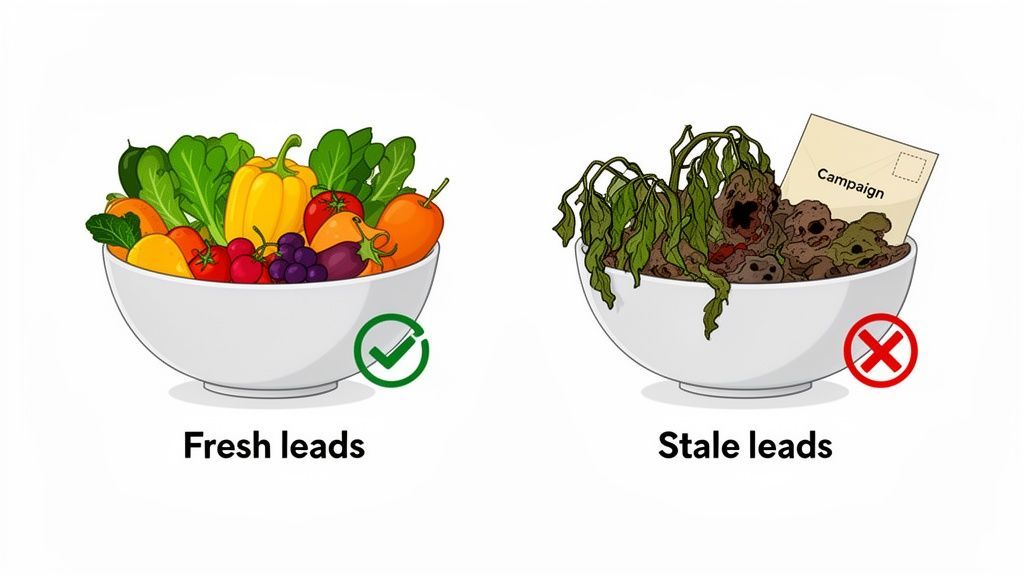
The real enemy here is data decay—the natural process where contact information becomes outdated and inaccurate. People change jobs, companies merge, email addresses get updated, and phone numbers are disconnected. In today’s fast-moving business world, this decay happens much faster than you might think.
For a deeper look at how quickly B2B contact data becomes outdated, read our guide to email decay rates in B2B.
The Alarming Rate of Data Decay
The speed at which B2B data goes bad is genuinely shocking. Recent research shows that contact information decays at a staggering rate of 70.3% per year. Let that sink in: nearly three-quarters of your database could be useless in just twelve months. This isn't a slow leak; it's a firehose. You can learn more about these data freshness statistics and their impact and see just how quickly job-hopping and constant company restructuring have accelerated the problem.
For anyone in sales, marketing, or recruiting, this is a critical reality check. A contact you find today could be invalid in a matter of weeks. The fallout is massive: sales reps waste an average of 27.3% of their time chasing dead ends from outdated data. That’s about 546 hours every year for each rep.
Imagine—that’s nearly three full months of productive time that could be spent on high-value prospects and actually generating revenue. For recruiters, the problem is just as severe, making continuous data validation essential for hitting hiring targets.
The Ripple Effect of Stale Data
To get a clearer picture of how this plays out, let's compare the impact of working with fresh versus stale data in a typical business setting.
The Impact of Stale vs. Fresh Lead Data
| Business Metric | Impact of Fresh Data | Impact of Stale Data |
|---|---|---|
| Sales Productivity | Reps connect with the right people, closing deals faster. | Reps waste hours on bad numbers and bounced emails. |
| Marketing ROI | Campaigns reach their intended audience, boosting engagement. | High bounce rates and low deliverability sink campaign performance. |
| Sender Reputation | High deliverability keeps your domain in good standing with ESPs. | Bounces and spam complaints get your domain blacklisted. |
| Customer Experience | Outreach is relevant, timely, and builds trust. | Irrelevant or misdirected messages annoy prospects and damage your brand. |
| Business Growth | A clean pipeline is filled with real, actionable opportunities. | Missed connections with key decision-makers mean lost deals. |
As you can see, the consequences aren't isolated. They create a domino effect that undermines your entire growth engine.
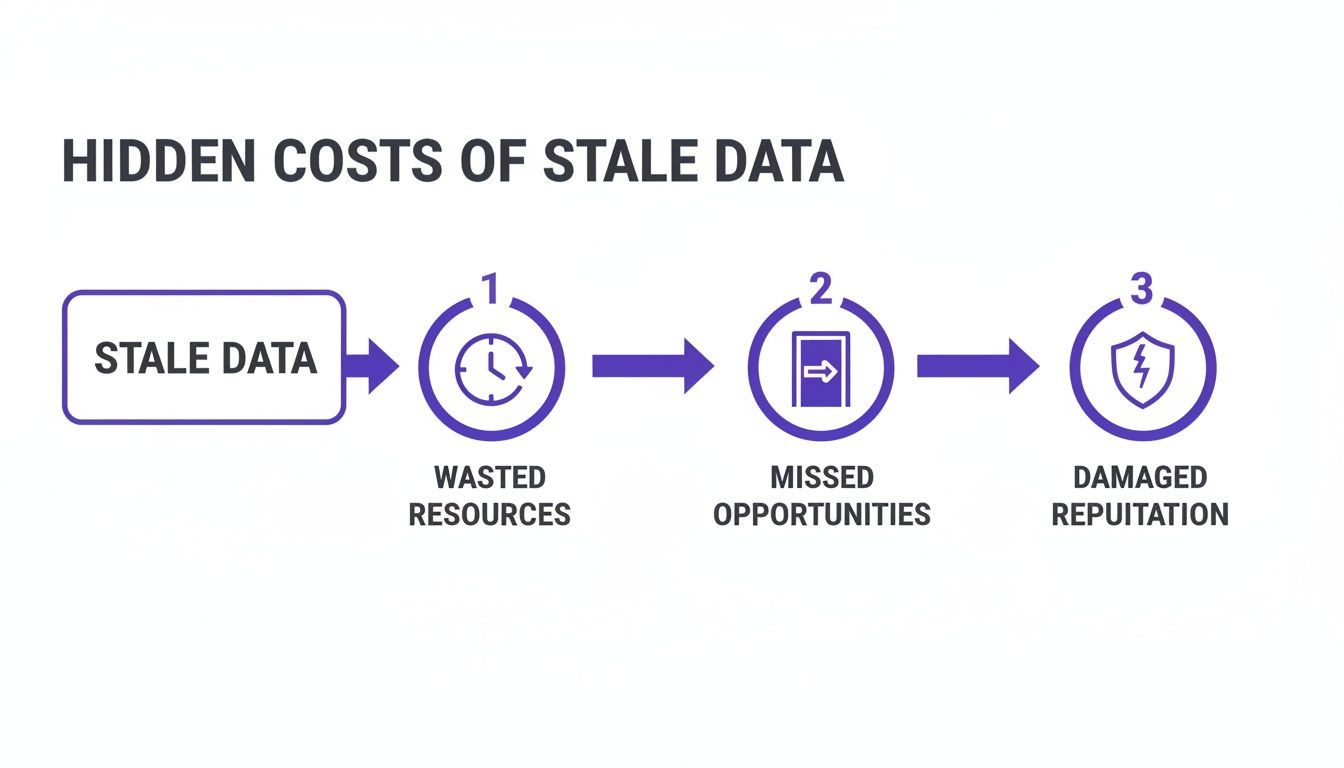
The Hidden Costs of Stale Data
Let's break down the damage into four key areas:
- Wasted Time and Resources: Your team is burning hours trying to contact people who have moved on or have incorrect details. Every minute spent on a dead lead is a minute not spent on a live one.
- Reduced Campaign ROI: Your marketing budget is effectively being thrown away. Every email that bounces and every ad that targets the wrong person is a sunk cost with zero return.
- Damaged Sender Reputation: This one is a killer. High bounce rates signal to email providers that you're a potential spammer, which can get your entire domain blacklisted. Suddenly, none of your emails get through.
- Missed Opportunities: This is the most painful consequence. While you're chasing ghosts, your competitors are connecting with the decision-makers you were trying to reach. You lose the deal before you even get a chance to compete.
The good news is that this is a solvable problem. This guide will walk you through practical strategies and modern tools to keep your data clean, your pipeline healthy, and your outreach effective.
What’s Causing Your Lead Data to Decay?
If your lead database is going stale, it’s not because your process is broken. It's because you're fighting against the relentless pace of the modern business world. Understanding the forces behind this decay is the first step toward building a proactive strategy to maintain lead data freshness.
These aren't one-off problems; they are constant market realities that make manual verification an impossible task for any growing business.
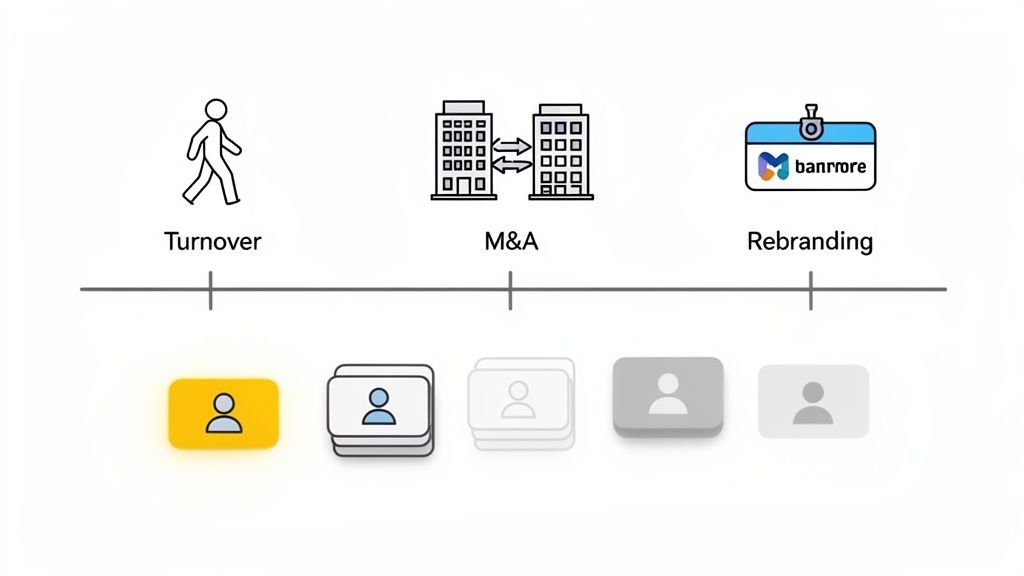
Here's a good way to think about it: your CRM is a snapshot in time. The problem is, the professional world it’s trying to capture is a fast-moving video. Every single day, small shifts and massive upheavals make pieces of your data obsolete.
The Great Reshuffle: Constant Employee Turnover
The single biggest driver of data decay is employee turnover. People are more mobile in their careers than ever before, constantly chasing new opportunities or making complete career changes. The moment an employee leaves a company, their corporate email and phone number are deactivated, turning a golden lead into a dead end.
For a recruiter, this is a daily frustration. You find what looks like the perfect candidate profile, only to realize they left that role three months ago. For a sales rep, it’s even more painful—the champion you’ve been carefully nurturing for a big deal is suddenly gone, and you’re right back at square one.
With millions of people switching jobs every month, a huge chunk of your contact list is guaranteed to go bad in any given quarter.
This is exactly where email pattern generation becomes useful. If you know the person has moved to a new company, you may not need to throw the record away. You can update the company domain, generate likely new business email patterns, and verify them before adding the refreshed address to your CRM.
Corporate Shake-Ups: Mergers and Acquisitions
Nothing invalidates a lead database faster than a merger, acquisition, or corporate restructuring. When two companies join forces, a cascade of changes is unleashed that has an immediate impact on your data's accuracy.
These events trigger several key changes at once:
- Email Domain Switches: The acquired company almost always adopts the parent company's email domain (e.g.,
@oldcompany.combecomes@newcompany.com). - Job Title Shuffles: Roles are consolidated or redefined, giving your contacts new titles and responsibilities overnight.
- Team Realignments: Entire departments might be folded into others or dissolved completely, making your organizational chart obsolete.
Suddenly, a carefully curated list of 100 contacts at a target company could have outdated emails, titles, and reporting structures, making any outreach attempt futile without a complete data refresh.
Evolving Identities: Rebranding and Domain Changes
Even without a merger, companies rebrand to reflect a new market position, a new name, or a new focus. This almost always involves changing the company website and, you guessed it, the email domain for every employee. A promising lead like jane.doe@startup.com becomes unreachable the day her company rebrands to growthcorp.com.
This kind of shift can be subtle and easy to miss, but it has the same effect as a job change—your emails bounce, and the connection is severed. These changes are a big reason why enrichment APIs return outdated leads; their databases often haven't caught up with a recent rebrand.
In these situations, the ProfileSpider Email Pattern Generator gives you a fast way to rebuild likely addresses using the new company domain. You still need to verify those generated emails before outreach, but it gives you a structured way to recover contacts that would otherwise be lost.
The Slow Creep of Tech and Title Changes
Beyond big, headline-grabbing events, smaller internal shifts constantly chip away at your data's quality. A company might switch its phone provider, making an entire block of numbers useless. At the same time, job titles are in a state of constant evolution.
Just think about these common shifts:
- A "Marketing Manager" gets promoted to "Director of Demand Generation."
- An "IT Specialist" now goes by "Cloud Infrastructure Engineer."
It’s the same person, but their responsibilities—and their purchasing power—may have changed dramatically. Reaching out with a pitch tailored to their old role is not just ineffective; it makes you look like you haven't done your homework. This slow creep of outdated information gradually erodes the quality of your entire database.
Each of these drivers points to one critical truth: data decay isn't a problem to be solved once, but a reality to be managed continuously. The only winning strategy is to start with the freshest data possible and have a system for ongoing verification.
The Real Cost of Letting Your Lead Data Go Stale
Ignoring data freshness isn't a passive mistake—it's an active drain on your profitability. When your lead data decays, the problem quickly snowballs into real financial and operational losses that hit your bottom line. This goes way beyond a few bounced emails.
The financial hit can be staggering. Some estimates show businesses losing as much as 30% of revenue every year simply due to poor data quality. On the flip side, cleaning up your data can boost sales close rates by 15% in just six months. This shows that focusing on data freshness isn't just about plugging leaks; it's about opening up a firehose of new revenue.
So, where exactly is all this money disappearing? Let's break it down.
Wasted Time and Squandered Budgets
The most immediate cost of stale data is wasted resources. Your sales team feels this every single day. They spend hours dialing disconnected numbers, researching contacts who left their jobs months ago, and writing personalized emails that bounce right back. Every minute a rep spends chasing a ghost is a minute they aren't spending with a qualified prospect who's ready to talk.
It’s just as bad for marketing. A huge slice of your budget—poured into ad campaigns, email automation, and content—is completely wasted when you're targeting people who don't exist anymore at a company. You're essentially paying to shout into an empty room, which tanks your ROI and makes it impossible to know if your campaigns are actually working.
When your lead enrichment is failing due to bad data, the result is a slow but steady bleed of time, money, and morale across your entire go-to-market team. Learn more about the root causes in our guide on why your lead enrichment is failing.
The High Price of Missed Opportunities
While wasted resources are a direct hit to your budget, the cost of missed opportunities is often much bigger. Outdated information means you fail to connect with key decision-makers at the exact moment they're ready to buy.
Think about these all-too-common scenarios:
- A key executive at a target account moves to a new company where they have an immediate need and budget, but your CRM still has them at their old job.
- Your ideal prospect gets promoted into a decision-making role, but you miss the window to congratulate them and start a conversation because your data is six months old.
- A competitor connects with your champion just days after they started a new role—a role you didn't even know they had.
In every case, the opportunity was lost not because your product was weak or your pitch was bad, but because your intelligence was stale. You were working off an old map of the battlefield while your competitors had real-time satellite imagery. This is especially true if you source leads externally; you have to understand the hidden risks associated with buying leads, which are often decaying before they even hit your CRM.
Long-Term Damage to Your Reputation
Finally, we get to the most insidious cost: the slow, painful erosion of your brand and sender reputation. High email bounce rates are a massive red flag for Internet Service Providers (ISPs) like Gmail and Outlook. When a big chunk of your emails fail to deliver, it makes you look like a spammer.
This sets off a devastating chain reaction:
- Lower Sender Score: Your domain's reputation starts to plummet.
- Spam Folder Placement: ISPs begin routing more of your emails directly to the spam folder, even for valid contacts who want to hear from you.
- Domain Blacklisting: In the worst cases, your entire domain can be blacklisted. Suddenly, none of your emails—sales, marketing, or even customer support—can get through.
Rebuilding a damaged sender reputation is a long, expensive, and frustrating process. It’s a self-inflicted wound caused by neglecting data hygiene, and it can cripple your outreach for months. Keeping your lead data freshness in check is the single best defense against this preventable disaster.
Building a Modern Data Freshness Workflow
Knowing your data goes stale is one thing; doing something about it is what separates winning teams from the rest. A smart data freshness workflow isn't about scrambling to clean up messes after the fact. It’s about building a proactive system that ensures your information is accurate from the moment you acquire it.
This means leaving old, manual methods behind.
The Problem with Traditional Methods
The traditional approach to data freshness often involves periodic CRM audits and manual spot-checks. A sales manager might task their team with spending a few hours each quarter verifying contacts. They'll manually search for people on social networks, check company websites, and update records one by one.
While well-intentioned, this method is fundamentally flawed:
- It’s painfully slow: By the time you’ve verified a list of contacts, a good portion of them are already out of date again.
- It’s inefficient and expensive: You're paying skilled sales reps or marketers to do low-value data entry instead of revenue-generating activities.
- It’s not scalable: As your database grows, manual verification becomes an impossible and frustrating cycle.
A modern, effective strategy must start at the very beginning—with how you get your leads in the first place.
Start Fresh: The Foundation of Your Workflow
Here’s the most important principle of lead data freshness: start with the most current information possible. If you're relying on purchased lists or scraping old databases, you're starting the race several laps behind. The best data is pulled straight from the source, right when you need it.
This is where a modern, no-code tool like ProfileSpider becomes the cornerstone of your process. Instead of buying stale data, you can extract it live from any website with a single click.
With ProfileSpider's browser extension, you visit a webpage—like a company's "About Us" page, a professional networking site, or a niche directory—click one button, and its AI scans the page to pull structured profile data. This ensures the information you’re capturing is as up-to-date as the source itself.
That single click gives you a foundation of fresh data, putting you way ahead of teams working with information that could be weeks, or even months, old. It's a fundamental shift from reactive data cleanup to proactive data acquisition.
Use Email Patterns to Refresh Missing or Decayed Emails
Even with fresh profile data, you will often face one practical problem: the profile tells you who the person is and where they work, but it does not show their direct business email. This is where a structured email pattern step belongs in your freshness workflow.
The workflow is simple:
- Confirm the person and company: Use live profile data to confirm their current role and employer.
- Identify the current company domain: Use the company website, not an old CRM domain.
- Generate likely email formats: Use the ProfileSpider Email Pattern Generator to create common address patterns.
- Verify before outreach: Run the generated candidates through an email verification service.
- Update your CRM: Replace outdated addresses only when you have a verified result.
Email pattern generation is not a substitute for verification. It is a fast way to create likely candidates so you can validate them and refresh stale records safely.
Common Email Patterns Worth Testing
Most companies use predictable formats for employee email addresses. When you know the person’s name and company domain, you can generate a focused set of likely options instead of guessing randomly.
| Pattern | Example | Typical Use Case |
|---|---|---|
first.last@domain.com |
jane.smith@company.com |
Common in mid-market and enterprise organizations. |
first@domain.com |
jane@company.com |
Common in startups, agencies, and smaller teams. |
f.last@domain.com |
j.smith@company.com |
Often used when companies need unique addresses at scale. |
firstlast@domain.com |
janesmith@company.com |
Sometimes used by SMBs and founder-led companies. |
first_last@domain.com |
jane_smith@company.com |
Less common, but still useful to test for certain organizations. |
The point is not to send to every possible address. The point is to generate a structured shortlist, verify it, and keep only the address that passes.
Automate Your Verification and Enrichment
Once you have fresh leads, the next step is to plug them into a system that keeps them verified over time. A modern workflow automates this using a mix of tools and APIs designed to keep your records current without manual effort.
This usually involves a few key layers of automation:
- Real-Time Email Validation: Before an email is sent, an API can check if the address is valid. This simple step can slash bounce rates and protect your sender reputation.
- Scheduled Data Enrichment: Automated services can periodically scan your CRM for incomplete or aging records. These tools then fill in the gaps with updated job titles, company info, and contact details from large third-party databases.
- Trigger-Based Updates: Advanced systems can use trigger events—like a contact announcing a new job on a professional network—to automatically flag a record for review, helping you react to changes almost as soon as they happen.
- Email Pattern Refreshing: When a domain changes or a contact moves companies, generate new pattern candidates and verify them before updating the record.
As part of any solid workflow, you have to regularly confirm key details about your leads. For B2B, that means making sure your contacts are still in the roles you think they are. A good guide to verifying employment history can be a huge help here.
Once you’ve captured and enriched your records, the next step is to run them through a structured lead list validation workflow. This helps you catch duplicates, missing fields, formatting issues, and risky contact data before those problems damage deliverability, reporting, or campaign performance.
Comparing Data Freshness Methods
To tackle data decay, you have a few options, ranging from old-school manual checks to fully automated workflows. Each comes with its own trade-offs.
Comparing Data Freshness Methods
| Method | Efficiency & Speed | Cost | Scalability | Best For |
|---|---|---|---|---|
| Manual Spot-Checks | Very Low | High labor cost | Poor | Small, static contact lists where changes are rare. |
| Periodic Audits | Low | High labor cost | Limited | Teams without automation tools, as a last resort. |
| Batch Verification | Medium | Moderate | Good | One-off list cleanups before a major campaign. |
| Automated Enrichment | High | Moderate SaaS cost | Excellent | Maintaining large, dynamic CRMs with minimal effort. |
| Email Pattern Generation + Verification | High | Low to moderate | Excellent | Refreshing missing or outdated business emails when you know the current company domain. |
| Real-Time Extraction | Very High | Low tool cost | Excellent | Proactive lead generation and ensuring data is fresh from day one. |
As the table shows, sticking with manual methods is a losing game when it comes to speed and scalability. Automated, real-time, and pattern-assisted approaches are built for today’s pace, giving you a much better return on your investment in both time and money.
Integrate Fresh Data into Your CRM
The most important step is getting all this fresh, verified data into your CRM where your team can actually use it. A powerful workflow is pointless if the updated info is stuck in a spreadsheet. This is where automation and integration really pay off.
Many modern tools, ProfileSpider included, make it easy to export data into CSV or JSON formats, which you can then import into any major CRM. For an even slicker setup, you can learn how to feed your sales pipeline automatically using webhooks or platforms like Zapier.
By combining real-time data extraction, email pattern generation, verification, and seamless CRM integration, you create a powerful, self-sustaining ecosystem. This modern approach turns data freshness from a tedious chore into a continuous, automated competitive advantage.
How ProfileSpider Delivers Maximum Data Freshness
Most data quality strategies are reactive. They focus on cleaning up a database after it’s already become a mess. This is like trying to purify a contaminated well—it's expensive, time-consuming, and you're never quite sure you got all the gunk out. A modern approach flips the script entirely: it starts at the source.
The secret to lead data freshness isn’t scrubbing old lists; it’s capturing the freshest possible data from day one. Instead of buying pre-packaged lead lists that are almost guaranteed to be stale, you need a way to pull data directly from live websites, in real time. This is where a no-code tool like ProfileSpider completely changes the game for sales reps, recruiters, and marketers.
Real-Time Extraction from Live Sources
The core principle behind ProfileSpider is simple yet powerful: your lead data should only be as old as the webpage it came from. When you land on a company’s team page or a professional network, the information you see is the most up-to-date version available. ProfileSpider grabs that data in that exact moment.
With a single click, its AI-powered engine scans the live page and extracts structured profile data. This means you’re not getting info from a database that was last updated three months ago; you’re getting it right now. This real-time capability is the single most important step in building a reliable lead database, letting you sidestep the data decay that makes purchased lists so frustrating.
AI-Powered Accuracy at the Point of Capture
Freshness is about more than just timing—it’s also about accuracy. Manually copying and pasting info is a recipe for disaster, where a single typo in an email address or a misspelled name makes a lead worthless. Custom-coded scrapers aren’t much better; they’re brittle and tend to break the second a website changes its layout.
ProfileSpider’s AI is built to intelligently identify key data points like names, job titles, companies, and contact info with remarkable precision. It understands the structure of a webpage, allowing it to correctly pull profile information even as website designs change. This built-in intelligence ensures the fresh data you capture is also clean data, free from the manual errors that can kill an outreach campaign before it starts.
Proactive Enrichment for Complete Profiles
Ever find a great prospect, but their profile is missing a direct phone number, social media link, or business email? A static list leaves you with an incomplete record. ProfileSpider tackles this head-on with its Enrich feature, which proactively hunts down missing details.
If a profile is missing information, the Enrich function can automatically navigate to linked pages—like a full profile page linked from a company directory—to find and fill in the gaps. It’s a multi-step process that builds the most complete, actionable lead profiles possible, all within a simple workflow.
For missing emails specifically, the Email Pattern Generator complements that workflow. Once you have a name and current company domain, you can generate likely business email formats, verify them externally, and update your lead record with a fresh contact path.
This on-demand enrichment and pattern-assisted discovery is a game-changer. You’re no longer forced to accept incomplete data or waste hours manually guessing email addresses. You can build a more complete picture of your prospect in minutes, not hours.
Contrasting Workflows: Traditional vs. ProfileSpider
To really see the difference, let’s compare the old way of building lists side-by-side with the modern ProfileSpider workflow.
| Aspect | Traditional Manual/Coding Method | The ProfileSpider Method |
|---|---|---|
| Data Source | Static databases, purchased lists, or slow manual copy-pasting. | Live, real-time data directly from any website. |
| Speed | Extremely slow and labor-intensive, taking hours or days. | Fast, with many profiles extracted in minutes. |
| Accuracy | Prone to human error, typos, and outdated information. | AI-powered extraction minimizes errors and improves consistency. |
| Email Discovery | Manual guessing or reliance on stale third-party records. | Use current names and domains with the Email Pattern Generator, then verify before outreach. |
| Freshness | Data is often stale before it even enters your CRM. | Data is as fresh as the source website at the moment of extraction. |
| Complexity | Requires coding knowledge for scrapers or tedious manual labor. | A no-code browser workflow built for sales, recruiting, and marketing teams. |
This table makes it clear why starting with a tool like ProfileSpider is foundational for any modern data quality strategy. You fundamentally shift your process from reactive cleanup to proactive, high-quality acquisition. It ensures your sales, marketing, and recruiting efforts are always built on a foundation of the freshest data available.
For a closer look at how these features work together, check out our complete ProfileSpider deep-dive.
A Proactive Plan to Keep Your Data Fresh
Let's be honest: data decay is happening faster than ever. By the time you manually clean a list, a good chunk of it is already going stale. This isn't just an annoying operational task; it's a direct, costly drain on your sales, marketing, and recruiting teams.
But what if you could flip this problem on its head? With the right approach, you can turn this constant liability into a genuine competitive advantage. A smart plan for lasting data quality doesn't start with scrubbing old databases. It starts the moment you capture a new lead, making sure it's as current as technologically possible right from the get-go.
The Modern Freshness Workflow
Getting to a high-performing lead database is simpler than you might think. It really just boils down to a repeatable cycle that leans on modern, no-code tools.
- Start with Maximum Freshness: Ditch the outdated, pre-packaged lists for good. Instead, use a tool like ProfileSpider to pull profile data in real time, directly from live websites. This one-click process ensures you’re always starting with the freshest, most accurate information available.
- Generate Missing Contact Paths: If the profile does not show a direct email, use the ProfileSpider Email Pattern Generator to create likely addresses from the current name and domain.
- Verify Before Sending: Never send blindly to generated patterns. Run them through an email verification service and only keep valid results.
- Integrate and Validate Continuously: Once you have high-quality data, feed it into a regular cycle of validation and enrichment. Automated services can verify contact details and fill in the blanks over time, keeping your entire database healthy and ready for action.
This strategy shifts your focus from reactive cleanup to proactive quality control. You end up spending way less time chasing dead ends and far more time engaging with people who are actually there.
Data decay is an inevitable market reality, but losing opportunities to it is a choice. By prioritizing lead data freshness, you build a resilient pipeline that fuels sustainable growth.
It’s time to move past the slow, manual methods that always leave you a few steps behind. An effective workflow starts with real-time data extraction, uses email pattern generation when direct emails are missing, verifies before outreach, and keeps that quality high across the entire lead lifecycle. Take control of your data, and turn it into your most valuable asset for winning new business.