

Apollo.io is a powerhouse for sales and marketing teams. With a staggering 270 million records processed every month and a contributor network of over 2 million people, it’s a vast ocean of potential leads. The platform is designed to give you a real-time, accurate firehose of data to fuel your outreach.
But as any sales professional, recruiter, or marketer in the trenches knows, a massive database doesn't always guarantee perfect data. The sheer scale of Apollo's database is both its greatest strength and a source of common frustration. One user summed it up perfectly: "Some of the client contacts are outdated. As a result, a lot of emails sent to addresses end up as spam or blocked."
This isn't just a small hiccup. It's a fundamental challenge that can quietly sabotage your entire outreach process, wasting time and tanking your campaign results.
This article is part of our broader guide to lead scraping. If you want the complete end-to-end workflow—including lead sources, scraping methods, enrichment, data quality, CRM activation, and compliance—see: Lead Scraping Guide: How to Scrape, Enrich, and Convert Leads at Scale.
The Hidden Costs of Inaccurate Apollo Lead Data
When your outreach is built on a shaky data foundation, the consequences ripple out, hitting everything from your team's morale to your bottom line. It’s more than just a few bounced emails; it's a series of costly breakdowns across your entire funnel.
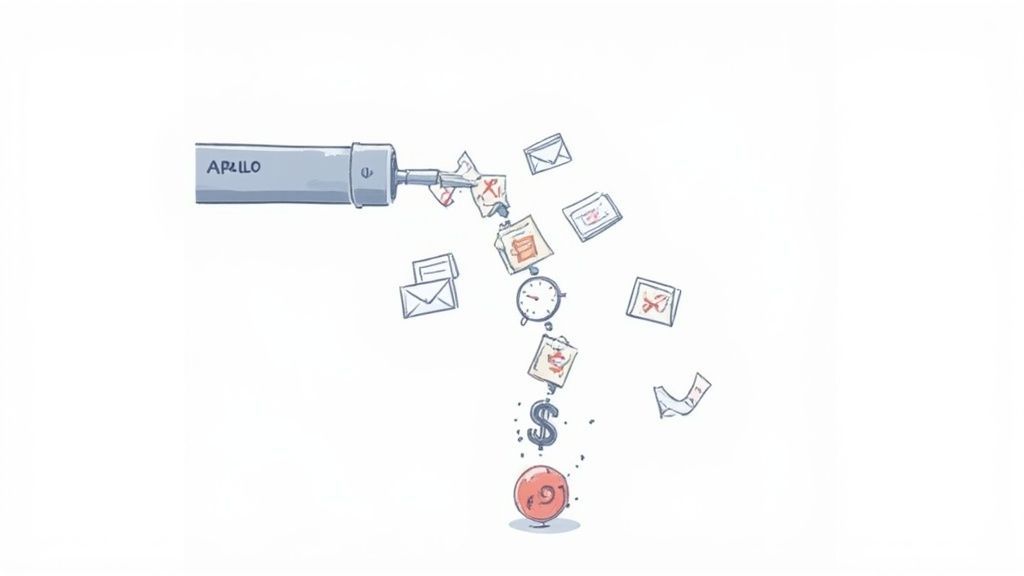
You can have the most powerful discovery tools at your fingertips, but if the underlying contact information is wrong, you're just spinning your wheels.
The fallout from bad data goes deep. Think about all the time your team spends crafting the perfect email sequence or personalizing a pitch. When that effort is wasted on a dead-end contact, it's not just a lost opportunity—it’s a drain on resources and a hit to your sender reputation. If your campaigns are falling flat, it's often the data, not the messaging, that’s to blame. Digging into why your cold email lead lists are not converting often leads right back to data quality.
The true cost of inaccurate lead data isn’t just the price of the tool; it's the cumulative loss of wasted time, missed opportunities, and the slow erosion of your brand's credibility.
How Inaccurate Lead Data Disrupts Your Sales Funnel
Bad data doesn't just cause isolated problems; it creates compounding issues at every step of your go-to-market motion. Let's break down how these seemingly small errors can lead to major business headaches.
| Sales Funnel Stage | Common Data Accuracy Problem | Direct Business Impact |
|---|---|---|
| Top of Funnel (Prospecting) | Stale contact info, incorrect job titles | SDRs waste hours on dead-end leads, reducing overall productivity and morale. |
| Outreach & Engagement | Invalid email addresses, wrong phone numbers | High bounce rates damage sender reputation; outreach never reaches the intended person. |
| Lead Nurturing | Wrong company firmographics or roles | Nurture sequences are irrelevant, personalization fails, and leads disengage. |
| Sales Qualification | Outdated decision-maker information | Sales cycles stall when you realize you've been talking to the wrong person. |
| Closing & Reporting | Duplicate records, inaccurate CRM data | Skewed analytics lead to poor strategic decisions and an unreliable sales forecast. |
As you can see, the impact is significant. These Apollo lead data accuracy problems aren't just technical glitches; they translate into real-world consequences that hold your business back.
Ultimately, these issues boil down to three core problems:
- Wasted Resources: Your reps are hired to sell, not to spend their days manually cleaning lists, verifying contacts, and chasing ghosts. Every minute spent on data hygiene is a minute not spent closing deals.
- Damaged Sender Reputation: High email bounce rates are a massive red flag for providers like Google and Outlook. They start seeing your domain as spammy, which torpedoes deliverability for everyone on your team.
- Lost Revenue: Every single email that lands in a non-existent inbox is a conversation that never happened. It’s a potential customer you never got to meet, a deal that never entered your pipeline.
The goal here isn't to criticize the platform but to frame this as a manageable challenge. Once you understand the real costs, you can shift from feeling frustrated to building a proactive strategy to ensure your data is an asset, not a liability.
Why Even the Best Databases Have Accuracy Gaps
Think of a massive lead database like Apollo's not as a static library of books, but as a live, constantly shifting map of the entire professional world. On this map, people are always moving, businesses are changing names, and new roads are being built. It’s impossible for any single mapmaker to capture every single change the second it happens.
This constant motion is the real reason even the most powerful platforms have data decay. Information that was 95% accurate last quarter might only be 70% accurate today. This isn't a fundamental flaw in the system; it's just the messy reality of gathering data on millions of people and companies. Once you understand where the weak spots are, you can start building a smarter, more resilient process for finding leads.
The Problem of Stale Data
The professional world moves at a breakneck pace. People switch jobs, get promoted, and leave companies. According to industry research, B2B data decays at a staggering rate of over 30% per year. In simple terms, if you let a contact list sit for three years, almost every single entry could be completely useless.
This constant churn is the number one cause of stale data. A perfectly verified email from six months ago might bounce today. The key decision-maker you were targeting last year might now be working for a competitor.
- Job Hopping: Employee tenure is getting shorter and shorter, which means job titles and company details need to be updated constantly.
- Company Shifts: Mergers, acquisitions, and rebrands can make entire chunks of your database obsolete literally overnight.
- Contact Info Invalidation: Businesses switch email systems, and people change their phone numbers. It’s a constant battle against dead ends.
This isn’t a problem that Apollo creates—it’s just a market reality that every data provider is in a constant race against.
When Data Enrichment Goes Wrong
Data enrichment is supposed to make your life easier. You start with a small piece of information, like a name and a company, and the platform adds more detail from other sources—think emails, phone numbers, or job titles. Apollo does this by pulling from millions of public sources and data contributors to build out those detailed profiles. But while it’s incredibly powerful, the process isn’t perfect.
Imagine trying to build a puzzle with pieces from ten different boxes. Most of them will fit together just fine, but every once in a while, you'll try to jam a piece in that looks right but is just slightly off.
Data enrichment errors pop up when automated systems try to match ambiguous or incomplete data points from different sources. This can result in a profile that's a weird Frankenstein's monster of multiple people or just plain wrong.
A classic example is when an algorithm mistakenly merges the profiles of two people named "John Smith" who happen to work in the same industry. Suddenly, you have a contact record with the right name but the wrong company and a bogus email address.
Parsing Mistakes and Duplicate Records
Finally, a couple of technical hiccups can throw a wrench in the works: parsing errors and duplicate records.
Parsing errors happen when an automated tool misreads information while scraping it from a public source, like a LinkedIn profile or a company website. The AI might grab a generic "info@" email instead of a person's direct one, or it might chop up someone's name incorrectly. These seem like tiny mistakes, but they create big problems when your team starts their outreach.
Duplicate records are the bane of every large database. They crop up when the same person gets entered into the system multiple times with slight variations. You might see "Jon Smith," "Jonathan Smith," and "J. Smith" all listed as separate contacts, even though they're the same guy. This totally skews your analytics, wastes your reps' time, and can lead to some seriously awkward moments—like when a prospect gets three slightly different emails from your team on the same day.
How to Audit and Measure Your Data Quality
You can't fix a problem you can't see. Vague complaints about "bad data" won't get you anywhere; you need to ditch the guesswork and get a clear, measurable handle on your lead quality. Auditing your Apollo.io lists is the first real step toward turning your data from a liability into a high-performing asset.
This isn't about running complex, soul-crushing diagnostics. It's about taking a small, manageable chunk of your data and putting it under a microscope to find out what's really going on. By setting a baseline for your data's health, you can finally track improvements and make smart decisions about where to point your outreach efforts.
This quick diagram shows the usual suspects that tank data quality over time.
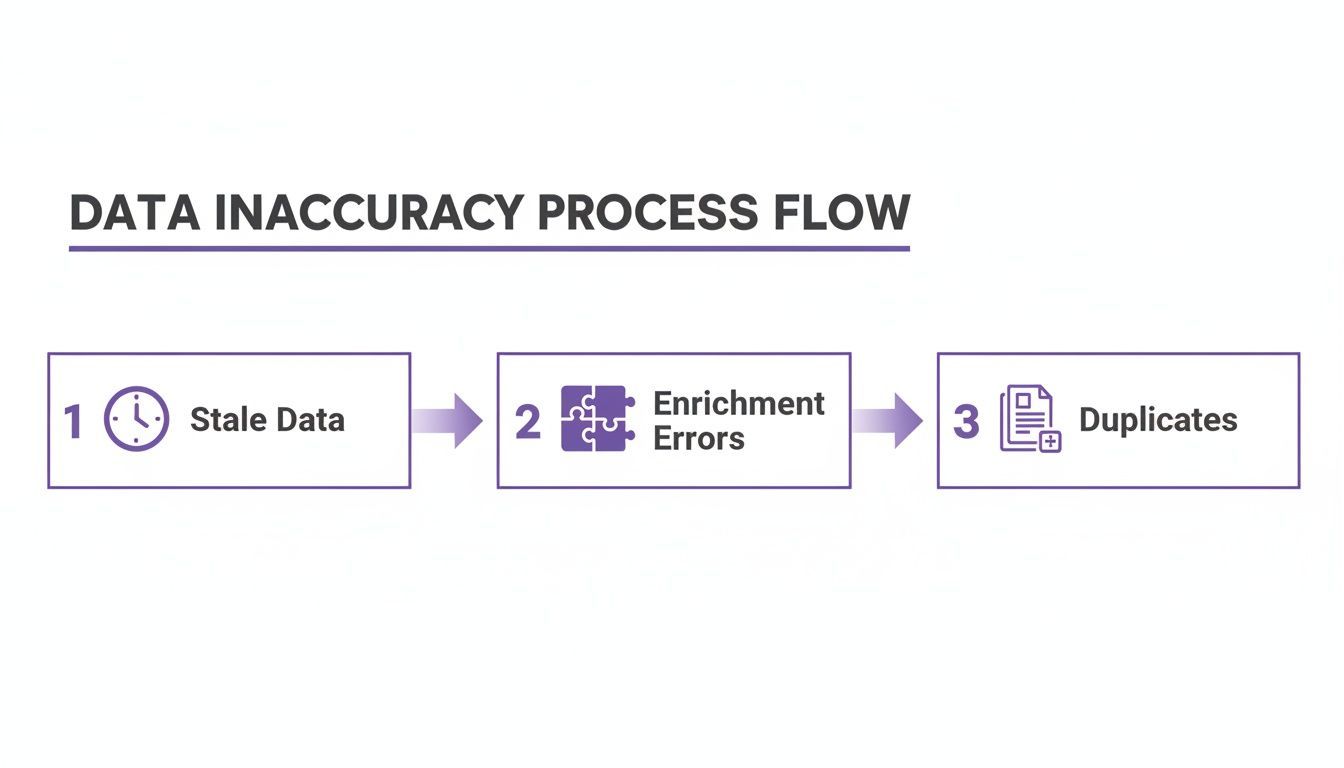
As you can see, data naturally goes stale, gets jumbled during enrichment, and gets clogged with duplicates. These are the core accuracy headaches every team eventually faces.
Establishing Your Key Data Metrics
Before you dive in, you need to know what you're even looking for. Let's skip the technical jargon and boil data quality down to a few simple metrics that actually matter to your business. Think of these as the vital signs for your contact database.
- Validity: Is the contact info real and deliverable? This is all about email addresses and phone numbers. An invalid email is a hard bounce waiting to happen, and a fake number is a total dead end.
- Completeness: How many of the essential fields are actually filled out? A record with just a name and company—but no email, job title, or phone number—is useless to your sales team.
- Uniqueness: How many duplicates are lurking in your list? Sending the same person multiple outreach messages because of redundant contacts is not only wasteful but also just plain embarrassing.
- Timeliness: How fresh is the information? This one is the toughest to pin down, but it's absolutely critical. A contact's job title and company from six months ago could be completely wrong today.
Turning vague complaints into specific numbers is the first step toward a real solution. A simple statement like, "Our last list had a 12% email bounce rate and 15% incomplete records," gives you a clear problem to solve.
A Practical Step-by-Step Audit Process
Ready to get your hands dirty? Here’s a simple, four-step process to audit a sample of your Apollo data and build a scorecard you can actually share with your team.
Before you start, it’s helpful to have a clear checklist to guide you. This isn't about getting bogged down in every possible data point, but about quickly identifying the most common red flags.
Your Data Quality Audit Checklist
Use this simple checklist to perform a quick health check on any of your Apollo lead lists. It’s designed to be fast and effective, giving you a clear snapshot of your data's accuracy.
| Audit Step | Metric to Check | Tool or Method | Goal |
|---|---|---|---|
| 1. Export a Sample | Representativeness | Export 100-200 recent leads | Get a realistic snapshot of typical list quality. |
| 2. Email Validation | Hard Bounce Rate | Third-party email validation tool | Measure the percentage of undeliverable emails. |
| 3. Manual Spot-Check | Timeliness & Accuracy | Cross-reference 10-20 contacts on LinkedIn | Check if job titles and companies are current. |
| 4. Spreadsheet Analysis | Completeness & Duplicates | Spreadsheet functions (filters, duplicate finder) | Identify missing critical data and redundant records. |
Once you've run through these steps, you'll have a much clearer picture of what's working and what's broken in your lead data pipeline.
Now, let's walk through the actual process.
Export a Representative Sample: You don't need to check thousands of contacts. Just export a recent list of 100-200 leads as a CSV or Excel file. Make sure this sample actually reflects your typical prospecting efforts.
Run an Email Validation Check: This is the quickest win you'll get. Use a third-party email validation tool (many offer free trials or a handful of free credits) to check the validity of the emails in your sample. This will instantly tell you your hard bounce rate.
Manually Spot-Check High-Value Contacts: Pick 10-20 of your most important prospects from the list. Manually look them up on a primary source like their current LinkedIn profile. Is their job title, company, and location correct? This manual check is your best indicator of data timeliness.
Analyze Completeness and Duplicates: Back in your spreadsheet, do a quick scan for empty cells in critical columns like email, phone, and title. Then, use your spreadsheet software’s duplicate finder function to see how many redundant entries you're dealing with.
After finding these inconsistencies, learning how to improve data quality is the logical next step for getting reliable reporting. This isn't just about a one-time list cleaning; it’s about setting a standard for what good data looks like.
While Apollo.io boasts a massive pool of contacts with its 270 million monthly processed records, real-world accuracy issues are still a problem. One study found that only 8% of sales and marketing pros felt their data was accurate enough—a challenge Apollo aims to solve but one that user reviews suggest is still a work in progress, often citing outdated information. This is exactly why running your own internal audits is non-negotiable if you want data that actually meets your standards.
Practical Strategies for Cleaner Lead Data
Spotting data accuracy problems is one thing; building a system to actually fix them is where the real value lies. Getting from diagnosis to action isn’t about finding a single magic bullet. It's about creating a tough, resilient process that treats data quality as an ongoing priority, not a one-time cleanup project.
This means combining internal discipline, wringing every bit of value out of Apollo's own features, and strategically layering in third-party tools when you need to be absolutely sure. This approach ensures your team is always working with the most reliable information possible, which feeds directly into better campaign performance and sales efficiency. A few core protocols can make a huge difference.
Establish Internal Data Hygiene Protocols
The best strategies always start with your own team's habits. Before any data ever touches your CRM or an outreach sequence, it needs to pass a basic smell test. The foundation of a clean database is a set of clear, non-negotiable rules for how your team handles data.
Think of it as a quality control checkpoint on an assembly line. Nothing moves to the next stage without passing inspection. The same has to be true for your leads.
- Mandatory Pre-Outreach Verification: Before any lead gets dropped into a sequence, make it a rule that your team does a quick spot-check. Seriously, a 30-second visit to the contact's LinkedIn profile to confirm their current job title and company is all it takes. This simple step stops you from wasting time on contacts who have already moved on.
- Schedule Regular List-Cleaning Sprints: Data decay doesn't take a day off, so neither can your cleaning efforts. Set aside a specific time—monthly or quarterly—for the team to review and purge old, unresponsive, or flat-out invalid contacts from your lists. This keeps your database fresh and your sender reputation in good standing.
Maximize Apollo's Built-In Features
Look, Apollo isn't perfect, but it does have tools designed to help you manage data quality. Too many teams barely scratch the surface of these features, leaving a ton of value on the table. Before you go shopping for external solutions, make sure you’re using what you’re already paying for.
Apollo’s own enrichment and verification can be your first line of defense. Turning these on means the platform is at least trying to provide the most current information it has as you pull new leads.
Key Insight: A lot of Apollo lead data accuracy problems can be cut down just by using the platform's features the way they were intended. Treat Apollo's verification as a helpful starting point, not the final word on a contact's accuracy.
Supplement with Third-Party Validation Tools
No single platform is the source of all truth. For your most critical campaigns or high-value accounts, backing up Apollo's data with dedicated, third-party validation services is a must. These specialized tools often use different data sources and methods, letting them catch errors Apollo might otherwise miss.
When you need to get serious about data quality, services built for Apollo.io list verification can be a game-changer. These tools do one thing, and they do it extremely well.
- Email Verification Services: These run deep checks on email addresses to see if they’re valid, deliverable, and not lurking in a spam trap. Running your list through one before a big campaign can slash your bounce rate.
- Phone Number Verifiers: Just like email validators, these services check if phone numbers are active and connected, saving your sales reps from the soul-crushing experience of calling dead lines all day.
- Real-Time Profile Scrapers: For the absolute highest level of accuracy, nothing beats checking the source. A no-code profile scraper can pull live data from a social profile right before outreach, guaranteeing the information is fresh.
This layered approach—your team’s diligence, Apollo’s scale, and the precision of specialized tools—creates a powerful data quality engine. Over time, this system doesn't just clean your existing data; it stops bad data from getting into your pipeline in the first place. If you're running into systemic issues, it's worth digging into why your lead enrichment is failing to build a more robust process from the ground up.
Verifying Leads in Real-Time with ProfileSpider
Even if you’ve got your internal processes dialed in and use the best validation tools, you're still playing a game of catch-up. You're working with data that might be hours, days, or even weeks old. While a platform like Apollo.io is an incredible engine for discovery, its data is fundamentally a snapshot from the past. For outreach that demands absolute certainty, you need a way to verify a contact's info right before you hit "send."

This is where a real-time, no-code scraping tool like ProfileSpider slots in perfectly to complement Apollo's massive scale. Think of it as your final, on-demand verification layer, giving you the "ground truth" straight from the source. It’s the move that bridges the gap between casting a wide net and making a precision strike.
The Ground Truth Workflow
The smartest strategy I've seen combines the strengths of both tools. You use Apollo for its powerful filters and massive database to build your initial list of prospects. Then, for your highest-priority leads, you use ProfileSpider to get an instant, up-to-the-second confirmation of their details.
This two-step process knocks out many common Apollo lead data accuracy problems by adding that crucial layer of real-time validation.
Apollo gives you the map, but ProfileSpider confirms the destination still exists right before you start driving. It makes sure you never waste a trip on outdated directions.
This workflow is a game-changer, especially for teams working in diverse markets. For instance, while Apollo adds a staggering 270 million contacts monthly, its database often gets a bad rap for accuracy in Europe. You don't have to look far to find reviews saying that while US data is solid, European contacts can be frustratingly out of date or incomplete. This can cripple campaigns that live or die on precision. You can actually get a deeper look at these regional data challenges on Apollo’s knowledge base.
How ProfileSpider Delivers Real-Time Accuracy
ProfileSpider is a one-click profile scraper that runs directly in your browser. It’s not pulling from some pre-existing, static database that gets refreshed periodically. Instead, it pulls information live from any webpage you're on—most often a professional profile on LinkedIn or a company's "About Us" page.
Here’s what this simple but powerful workflow looks like in practice:
- Discover Leads in Apollo: Use Apollo’s deep search filters to pull together a list of promising prospects who fit your ideal customer profile.
- Isolate High-Value Targets: From that list, cherry-pick the top 10-20 decision-makers you want to reach out to first.
- Visit Their Live Profile: Open each contact's LinkedIn or company profile page in a new browser tab.
- Perform a One-Click Scrape: With a single click, ProfileSpider instantly extracts the name, current job title, company, and any other available details right off the page.
This process gives you an undeniable, real-time record of your prospect's information. By combining Apollo’s broad discovery power with ProfileSpider's surgical precision, you build a system that maximizes both scale and accuracy. To see how these two tools stack up in different situations, take a look at our detailed ProfileSpider vs. Apollo comparison guide. This hybrid approach ensures your outreach is always sharp, relevant, and based on the absolute latest information, turning a potential data headache into a real strategic advantage.
Building a Resilient and Proactive Data Strategy
Let's be honest: tackling Apollo lead data accuracy problems isn't about finding a single magic bullet. It’s about building a smarter, more resilient system. Data decay is a constant, unavoidable force in sales, but it's a challenge you can absolutely manage with the right strategy.
The real shift happens when you move from a reactive stance—only scrambling to clean lists after a campaign tanks—to a proactive one. That's the key to sustainable growth. This all starts with getting real about the root causes, from natural data decay to those sneaky enrichment errors. Once you know why the data goes bad, you can build a structured approach to fight back.
The Core Pillars of a Proactive Strategy
A truly resilient data strategy never hangs its hat on a single tool or a one-off process. Instead, it layers multiple verification and hygiene steps to catch inaccuracies at every stage of your outreach workflow.
Here’s what that looks like in practice:
- Regular Audits: You can't fix what you don't measure. Setting up a regular, data-driven audit process turns vague complaints like "the leads are bad" into concrete, actionable metrics.
- Internal Protocols: Simple pre-outreach checks can save a ton of wasted effort. Think of a quick spot-check on a prospect's LinkedIn profile before they go into a sequence. It's a small step that prevents big headaches.
- Layered Tooling: This is where you get the best of both worlds. Combine Apollo’s massive scale for discovery with external validation tools to create a robust verification process. This tag-team approach catches errors that a single platform might miss on its own.
- Real-Time Verification: For those high-value prospects, you can't afford to be wrong. This is where ground-truth accuracy becomes non-negotiable. Using a tool like ProfileSpider for a one-click, real-time scrape right before you hit "send" ensures your information is absolutely current.
Ultimately, investing in data accuracy is a direct investment in growth. It’s not just about cleaning lists; it’s about protecting your sender reputation, boosting conversion rates, and letting your sales team operate at peak efficiency.
This proactive mindset transforms your data from a potential liability into your most powerful asset. By combining broad discovery with precision verification, you build a system that delivers results, consistently. To take this even further, see how a dedicated B2B lead enrichment service with ProfileSpider can add another layer of certainty, ensuring every lead is as accurate as possible.