


Getting a list of startup founders from a website means pinpointing their profiles on pages like 'About Us' or 'Our Team' and extracting that information. The goal is to turn a messy webpage into a clean, structured list of names, job titles, and companies. You could do this by hand or with custom code, but a no-code profile scraper like ProfileSpider boils the entire process down to a single click.
This guide will walk you through both the traditional, manual approach and the modern, one-click solution so you can see the difference for yourself.
The Old Way: Manual Founder Prospecting (And Why It's Obsolete)
Not long ago, finding startup founders was a soul-crushing manual task. For anyone in sales, recruiting, or marketing, it meant hours spent copying and pasting names from 'About Us' pages, conference speaker lists, and obscure industry directories. You were trying to build a targeted list, but what you got was a slow, painful grind.
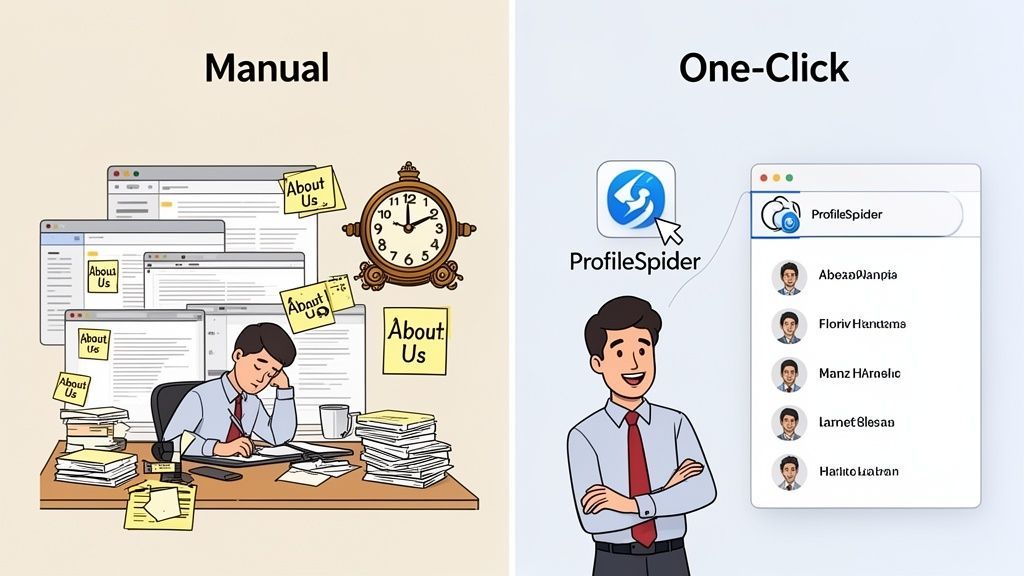
This old-school approach is a recipe for frustration and actively hurts business growth. The data you gather is a mixed bag—inconsistent, out-of-date, or just plain incomplete. One site might give you a founder's full name and title, while the next only has a first name. Trying to build a clean, usable database from this mess is a nightmare without a ton of manual cleanup.
The Real Business Cost of Copy-Pasting
The true price of this manual labor isn't just the mind-numbing boredom. It's a genuine bottleneck for the most important parts of your business. Every hour a skilled professional spends on data entry is an hour they aren't spending on what they were hired to do:
- For Sales Reps: Connecting with qualified leads and actually closing deals.
- For Recruiters: Engaging with top talent to fill critical roles.
- For Marketers: Launching targeted campaigns and analyzing market trends.
This way of working puts a massive drag on productivity. It effectively turns your best people into data entry clerks, wasting their expertise and gumming up the works for your entire lead gen and recruitment pipeline.
The bottom line is that manual scraping just doesn't scale. As your need for high-quality leads increases, the time and effort it takes to find them by hand grows exponentially. It’s a completely unsustainable workflow.
The New Way: One-Click Founder Scraping with ProfileSpider
Fortunately, how we scrape startup founders from a website has changed for the better. Modern tools have completely replaced this painful process. Instead of needing to code a custom script or resort to endless copy-pasting, a one-click solution like ProfileSpider transforms this headache into a simple, automated action. It’s built for business users—not developers—and can turn any webpage into an organized, ready-to-use list of founder profiles in seconds.
Step 1: Find High-Value Founder Sources
To get quality founder data, you have to know where to look. Sure, you could cast a wide net across social media or professional networks, but that's a recipe for a low-signal, high-noise list. The real gems are tucked away in curated online spaces that most people overlook.
Finding these spots is the difference between a generic contact sheet and a pipeline of genuinely valuable prospects. You're not just looking for names; you're looking for context. You want to find places where founders are gathered for a specific reason—they've been funded, they've won an award, or they're recognized experts. If you want to start with company discovery before extracting founder profiles, the ProfileSpider Company Finder can help you find relevant startups and companies to research.
Focus your efforts on niche platforms where the founder information is dense, relevant, and pre-qualified:
- Venture Capital Portfolio Pages: VCs love to show off the companies they've backed. Their portfolio pages are a direct line to funded startups, and they almost always list the founders. If you're a sales rep targeting funded SaaS companies, for example, you can scrape the portfolios of top VCs in that space and build an incredible list in minutes.
- Startup Incubator & Accelerator Cohorts: Think Y Combinator, Techstars, and other industry-specific programs. Their websites are treasure troves, listing current and past cohorts. Recruiters can find emerging talent here, and sales teams can get in front of companies long before they hit the big time.
- Industry Award Websites: "40 Under 40" lists, tech innovation awards, and other sector-specific honors are basically pre-built lists of high-achievers. Scraping these sites gives you a list of founders who have already been vetted and celebrated for their success.
- Event Speaker & Panelist Bios: Conference and summit websites are fantastic sources. Founders are often featured as speakers, and their bio pages usually include detailed professional histories and company info. Sometimes you even find direct contact details. It's a goldmine for targeted outreach.
This kind of strategic targeting also helps you sidestep outdated stereotypes. The whole "young tech bro" founder cliché? It’s a myth. Research from MIT and Northwestern actually found the average age of a successful startup founder is 42. This is a powerful reminder to look beyond the usual college-focused incubators. You can review the full study on startup demographics to get a better handle on where to find these experienced leaders.
By concentrating on these high-signal sources, you're making sure every profile you pull is likely to be a good fit. This is where a tool like ProfileSpider really shines. It can chew through all these different page layouts—from a simple awards list to a complex grid on a VC's site—and spit out structured, usable data with just one click. It’s all about working smarter, not harder, to build a list that actually converts.
Step 2: Extract Founder Profiles with a Single Click
Trying to pull a structured list of founders from a website used to be a major technical headache. You either had to spend hours manually copy-pasting or hire a developer to build a custom scraper. Now, the right tools have turned that whole mess into a simple, repeatable process that anyone can master.
The whole thing starts with a quick, one-time setup: just install the ProfileSpider Chrome extension. Once that's in your browser, you're set. No coding, no complicated setup. You’re ready to pull founder profiles from pretty much any site you visit.
A Real-World Founder Scraping Scenario
Let's say your goal is to build a list of founders from early-stage FinTech startups. A great place to start is a Venture Capital firm's website. You find their portfolio page, which is basically a goldmine—a list of all the companies they’ve funded, often with links to each startup’s "Team" or "About Us" page.
This is the perfect hunting ground.
You just navigate to that portfolio page, click the ProfileSpider icon in your browser's toolbar, and hit the "Extract Profiles" button. That's it. The AI takes over from there, doing the heavy lifting for you instantly.
Some of the best places to find these founder-rich pages are VC portfolios, incubator/accelerator cohort lists, and industry award sites. These are all pre-qualified sources packed with high-value prospects.
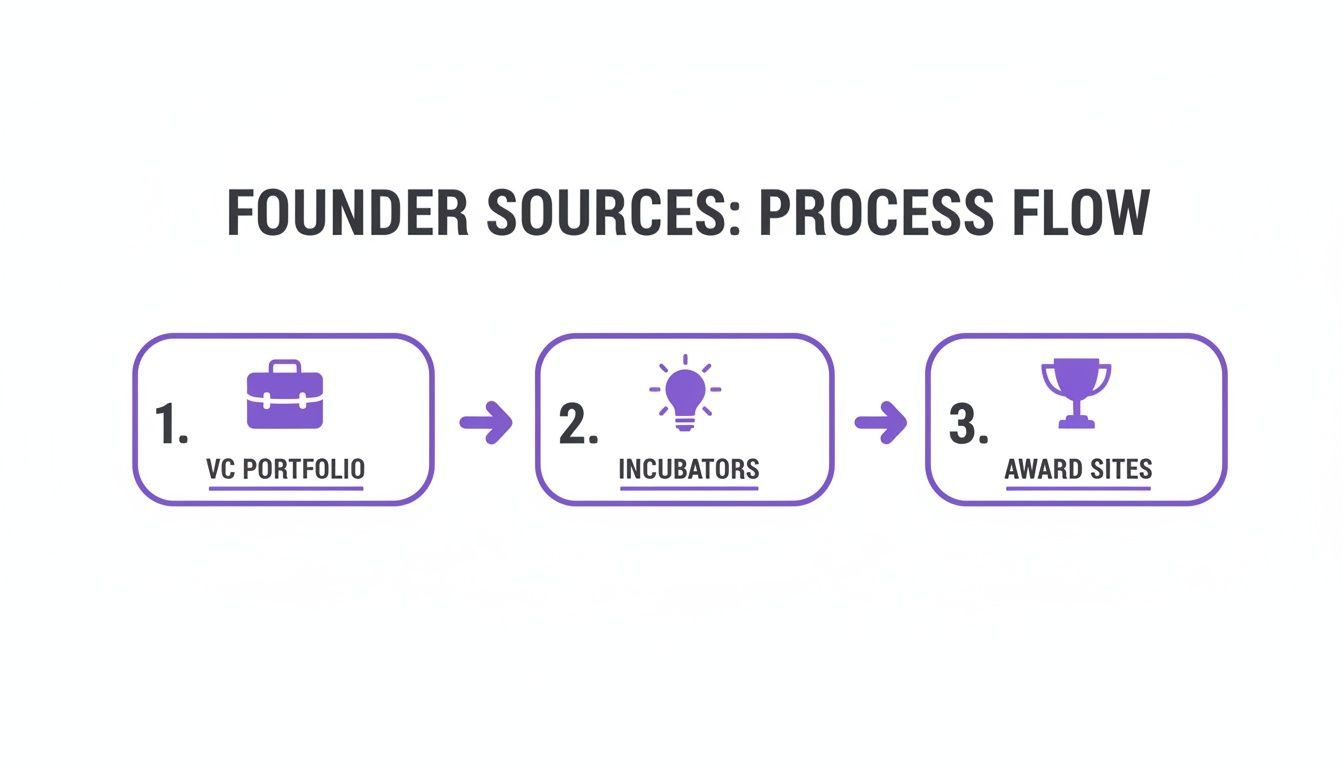
This whole process feels almost like magic, especially if you've ever had to do this kind of data collection by hand. To really appreciate the difference, let’s compare the old way with the new AI-powered approach.
Manual vs. AI-Powered: The Time Savings
| Task | Manual Method (Estimated Time) | ProfileSpider AI Method (Estimated Time) |
|---|---|---|
| Finding Source Pages | 30-60 minutes | 30-60 minutes |
| Identifying Profiles | 1-2 minutes per profile | Instant |
| Data Entry (per 100 profiles) | 2-4 hours | < 1 minute |
| Finding Social/Contact Info | 3-5 hours | 1-2 minutes (with enrichment) |
| Total Time for 100 Profiles | ~6-10 hours | ~5 minutes |
The time savings are staggering. What used to take a full day of tedious work can now be done in the time it takes to grab a coffee.
How ProfileSpider's AI Extracts and Organizes Data
ProfileSpider doesn't just scrape random text from the page. Its AI is smart enough to understand the context and structure of a website. It knows what a person's profile looks like—it spots the patterns, like a headshot next to a name, a title like "Founder," and those little social media icons.
Within seconds, the extension pops open a clean, organized table. Each row is a person, and the columns include the essentials:
- Full Name: The founder’s complete name.
- Job Title: Their specific role, like "Founder," "CEO," or "Co-Founder."
- Company Name: The name of their startup.
- Social & Website Links: Direct links to their LinkedIn, X (Twitter), or personal site.
What you get is a structured database, ready to use, pulled directly from a messy, unstructured webpage.
The real difference here is the speed and simplicity. Going from landing on a page to having a ready-to-use list of founders in under a minute is a massive advantage. For anyone in sales, recruiting, or marketing, this frees you up to focus on what actually matters—outreach and building relationships—instead of getting bogged down in data entry.
This automated workflow is the heart of modern, efficient prospecting. If you want to get into the nitty-gritty of how this works, check out our detailed ProfileSpider deep-dive. This is how you scrape startup founders from a website without writing a single line of code, letting you build hyper-targeted lists faster than ever before.
Step 3: Enrich and Manage Your Founder Data
Pulling a list of founders from a website is a great first step, but it's only half the battle. The real magic happens when you turn that raw data into a clean, organized, and actionable list of prospects.
Let's be honest: just grabbing names and titles isn't going to cut it. You need context, contact details, and a smart way to manage your outreach. Otherwise, you’re just staring at a spreadsheet of names that goes stale faster than you can say 'follow-up'.
From Raw Data to Real Intelligence
After you scrape startup founders from a website, ProfileSpider doesn’t just dump a file on you and call it a day. It acts like a mini-CRM right inside your browser, giving you the power to manage and improve your data on the spot.
One of the most valuable features you'll use right after an extraction is Enrichment. You’ll often find that a scrape from a team page pulls a name and title but misses a direct email or the person's LinkedIn profile. With ProfileSpider's 'Enrich' button, the tool automatically scours the social and website links it found for each person to hunt down those missing details. It's an automated way to fill in the gaps, saving you hours of manual digging for emails and phone numbers.
Smart Ways to Manage Founder Contacts
An organized database is a powerful one. As you start building your founder lists, keeping them clean and segmented from the get-go is crucial for running targeted campaigns and tracking your conversations.
Right inside ProfileSpider, you can start organizing your newly found profiles immediately:
- Build Custom Lists: Don't just throw everyone into one giant bucket. Get specific. Create targeted lists like 'Seed Stage AI Founders' or 'SaaS B2B Targets.' This makes it incredibly easy to pull the right group for any campaign.
- Add Helpful Notes: Did you meet a founder at a conference? Is someone a high-priority target? Add a note directly to their profile. Something like "Met at 2026 Tech Summit" or "Follow up Q3" adds invaluable context for personalized outreach.
- Use Tags for Quick Filtering: Tags are your best friend for sorting on the fly. You can use tags like
#fintech,#YC_Alum, or#priorityto instantly filter your entire database and find exactly who you need in seconds.
By using these features, you're not just collecting data—you're building a living, breathing prospecting system. It ensures every founder you've found is properly categorized and primed for the next step in your sales or recruitment funnel.
This level of organization is a non-negotiable for anyone serious about lead generation. If you want to go even deeper, you can learn more about the best data enrichment tools and see how they fit into a modern workflow. ProfileSpider builds these concepts right into its DNA, transforming a simple extraction tool into a full-fledged platform for managing founder relationships.
How to Scale Your Outreach with Bulk Scraping
For any professional building a serious list of founders, efficiency is the name of the game. A single extraction is helpful, but the real power kicks in when you start gathering data at scale. This is how you go from hunting for individual founders to systematically mapping out entire market segments in one go.
This shift isn't just a smart tactic; it’s a direct response to how modern business works. The global web scraping software market, valued at $875.46 million in 2026, is on track to hit $2.7 billion by 2035. That growth tells a story: businesses are moving away from clunky, in-house scraping solutions and turning to specialized tools that can process and act on data quickly. You can see more on this industry trend and the shift to a data-first AI revolution on actowizsolutions.com.
From a Single Profile to Hundreds
With a tool like ProfileSpider, you can scrape startup founders from a website in bulk. This is an absolute game-changer when you're dealing with high-density pages packed with valuable contacts.
Think about pages like:
- Directory search results: Pages listing dozens of companies and their key people.
- Comprehensive 'Team' pages: Capturing an entire organization's leadership in one fell swoop.
- Event attendee lists: Pulling all registered participants from a public page.
Depending on your ProfileSpider plan, you can pull up to 200 profiles from a single page. This turns what would otherwise be hours of mind-numbing copy-pasting into a simple one-click action, letting you build a substantial list from one high-value source.
Keeping Your Bulk Data Clean and Organized
A huge list is worthless if it's a mess. After you run a bulk extraction, the next critical step is getting that data in order. ProfileSpider helps you do this with bulk actions designed to keep your database clean. You can select multiple contacts at once to move them between lists or merge duplicate profiles that might have popped up from scraping different sources.
This simple housekeeping ensures your data is primed for outreach, preventing embarrassing duplicate emails or chaotic campaign segments. If you want to get into the weeds on this, we've got a complete guide on scraping leads at scale.
Pro Tip: Always clean and segment your data immediately after a bulk scrape. Moving contacts into dedicated lists (like 'SaaS Founders Q4') and merging duplicates right away will save you massive headaches later and make your follow-up campaigns far more effective.
Exporting Your Founder Data for Any Workflow
The final piece of the puzzle is getting your perfectly curated data into the tools you rely on every day. ProfileSpider bridges this gap with flexible export options that fit right into your existing workflow. You can export entire lists or just selected profiles into several universal formats.
- CSV & Excel: Perfect for importing into any CRM like Salesforce, an ATS like Greenhouse, or just a simple spreadsheet.
- JSON: A developer-friendly format ideal for custom integrations and deeper data analysis.
You can even customize the export by picking exactly which data columns you need. This creates a seamless handoff, moving information from ProfileSpider directly into your sales, recruitment, or marketing pipelines without any manual reformatting.
Navigating Data Privacy and Compliance
Let's talk about the serious stuff. When you scrape startup founders from a website, you're collecting personal data. That's a big responsibility, and how you handle it matters. Moving fast is great, but building a sustainable process means operating with integrity. Getting this right isn't just about dodging fines; it's about building a trustworthy brand.
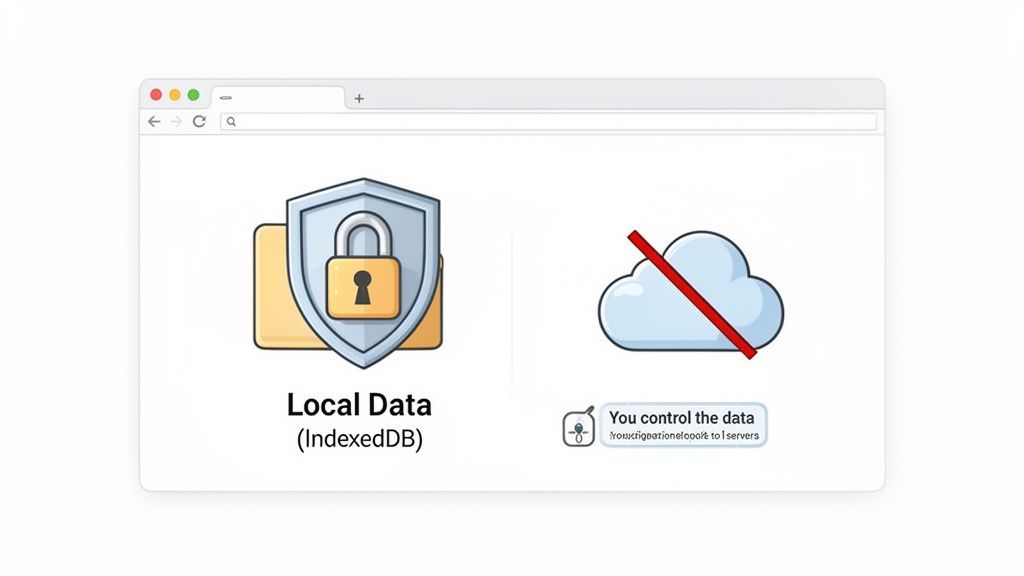
This is one area where ProfileSpider’s design philosophy really shines. Most cloud-based scrapers pull your data onto their own servers, creating a second copy you don't fully control. We went a different route with a local-first model.
All the founder profiles and contact lists you extract are saved directly and securely inside your own browser's storage (specifically, IndexedDB).
Your data never touches our servers. Period. You have complete control and ownership over the information you collect. That gives you the power to manage it, secure it, or delete it whenever you see fit.
Respecting Regulations and Website Rules
This local control is a huge piece of the compliance puzzle, but it’s not the whole story. Whenever you’re extracting data, you need to understand the rules of the road. Always check a platform's Privacy Policy for specifics on data handling and user rights. Generally, there are two main areas you need to pay close attention to.
- Website Terms of Service: Most websites spell out their rules for data collection in their terms. You should always respect a site's
robots.txtfile and any explicit policies against scraping. Being too aggressive can get your IP address blocked, so play nice. - Data Protection Laws (GDPR/CCPA): Regulations like GDPR in Europe and CCPA in California have strict guidelines for handling personal data. The safest and most common practice is to focus on collecting publicly available business contact information for legitimate business interests, like B2B outreach or recruiting.
Best Practices for Ethical Data Collection
Honestly, operating ethically just comes down to a few common-sense principles. Be transparent in your outreach and only gather the information that’s absolutely necessary for your specific goal.
We've written a more detailed guide on this topic, which you can read to learn more about ethical website scraping in our guide.
Ultimately, the tool is only half the equation. Your process and your principles define your professionalism. By pairing a privacy-first tool like ProfileSpider with a solid commitment to ethical data practices, you can build powerful founder lists while keeping your compliance risks low and your reputation high.