

Lead scraping might seem like the ultimate shortcut to a packed sales pipeline, but it’s a strategy loaded with hidden traps. You should absolutely steer clear of lead scraping when it crosses the line with data privacy laws like GDPR, violates a website's Terms of Service, or leaves you with a pile of low-quality, untargeted data that torpedoes your brand's reputation and email deliverability. Blowing past these warnings isn't just risky—it can land you in hot water with legal fines, platform bans, and a whole lot of wasted effort.
This article is part of our broader guide to lead scraping. If you want the complete end-to-end workflow—including lead sources, scraping methods, enrichment, data quality, CRM activation, and compliance—see: Lead Scraping Guide: How to Scrape, Enrich, and Convert Leads at Scale.
The Hidden Costs of Aggressive Lead Scraping
The dream of instantly building a massive contact list is powerful. But the "scrape everything in sight" approach often backfires, creating more headaches than it solves. For anyone in sales, recruiting, or marketing, knowing when not to scrape is just as important as knowing how to do it. These aren't just abstract risks; they have real consequences that can hit your company's bank account, its good name, and its access to the very platforms you rely on.
This quick decision tree can help you gut-check whether a scraping job is safe to run.
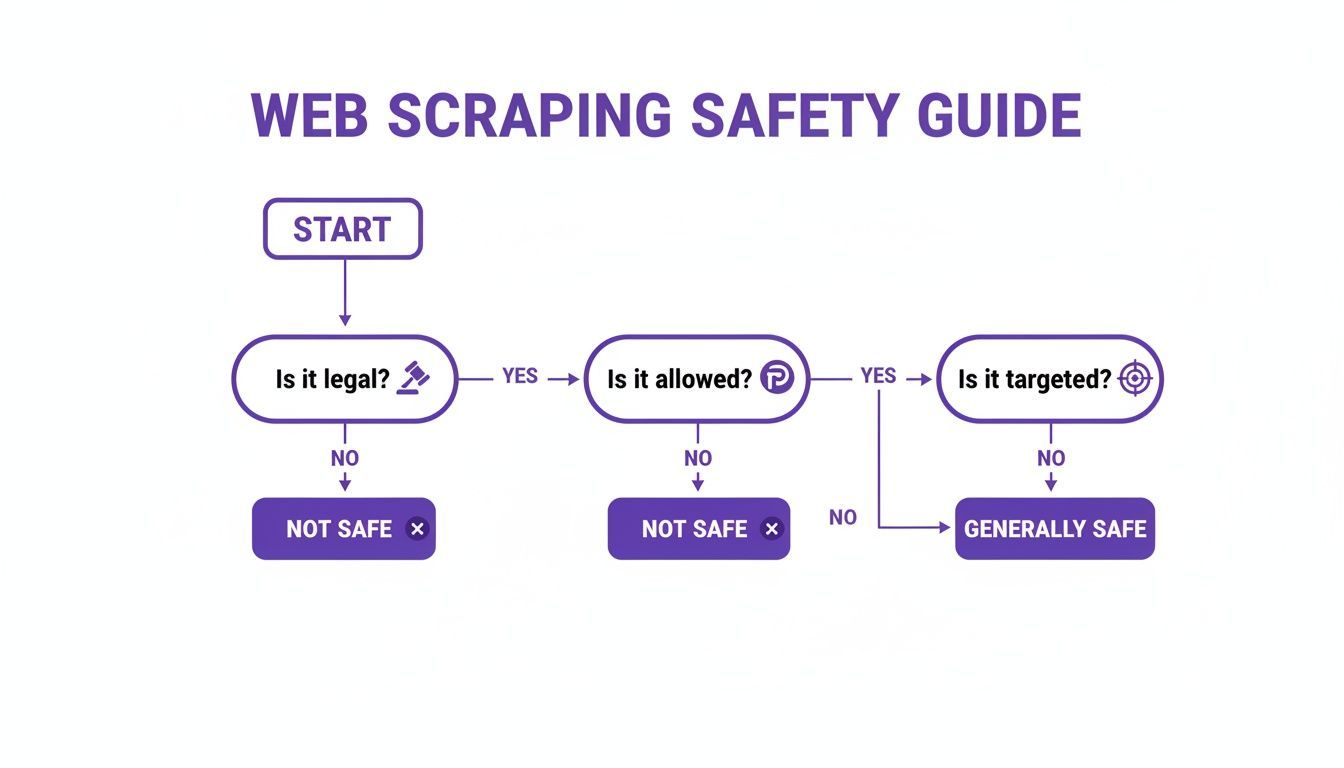
What this flowchart boils down to is a simple but critical sequence: legality, platform rules, and data relevance. These are the non-negotiable checkpoints you have to clear before you even think about hitting "start."
To make this even clearer, here’s a quick-glance table summarizing the main risks and what you should be doing instead.
Quick Guide: When to Avoid Lead Scraping
| Risk Category | When Not to Use Lead Scraping | Smarter Alternative |
|---|---|---|
| Legal & Compliance | Scraping personal data where laws like GDPR or CCPA apply without a legal basis. | Focus on consent-based lead generation, like newsletter sign-ups or gated content. |
| Platform Violations | Using bots or scrapers on sites like LinkedIn that explicitly ban them in their Terms of Service. | Use a compliant, one-click tool like ProfileSpider for manual, targeted profile extraction. |
| Data Quality | Grabbing bulk, unverified data that doesn't match your ideal customer profile. | Partner with other companies for co-marketing or use data enrichment services on your existing contacts. |
| Reputation & Deliverability | Blasting cold outreach to scraped lists, leading to high bounce rates and spam complaints. | Build relationships through content marketing, webinars, or industry partnerships. |
This table isn't just about avoiding trouble; it's about shifting from a quantity-first mindset to a quality-driven one that actually builds a sustainable pipeline.
Key Risk Areas to Consider
Before you fire up any scraping tool, you've got to weigh the potential fallout. The biggest dangers fall into a few key buckets that every growth-focused professional needs to understand.
Legal and Compliance Headaches: This is the big one. Data privacy laws like GDPR in Europe and CCPA in California have sharp teeth. They lay down strict rules about collecting personal info, and scraping data from people in these areas without a legitimate reason can lead to staggering fines.
Getting Kicked Off Key Platforms: Professional networks like LinkedIn are crystal clear in their Terms of Service: no automated data collection. Violating these rules is a fast way to get your account restricted or permanently banned, effectively cutting you off from your most valuable hunting ground for prospects or candidates.
Trashing Your Reputation: When you blast emails to cold, scraped lists, you're practically asking for high bounce rates and spam complaints. This does more than just annoy potential customers; it can get your company's domain blacklisted by email providers, crippling your entire marketing and sales outreach. There are many things sales tools don't tell you about lead scraping, and the damage to your sender reputation is at the top of the list.
A growth strategy that lasts is built on quality and compliance, not just sheer numbers. Understanding these boundaries is the first step toward building a prospecting process that’s both effective and ethical.
1. Navigating Data Privacy and Legal Minefields
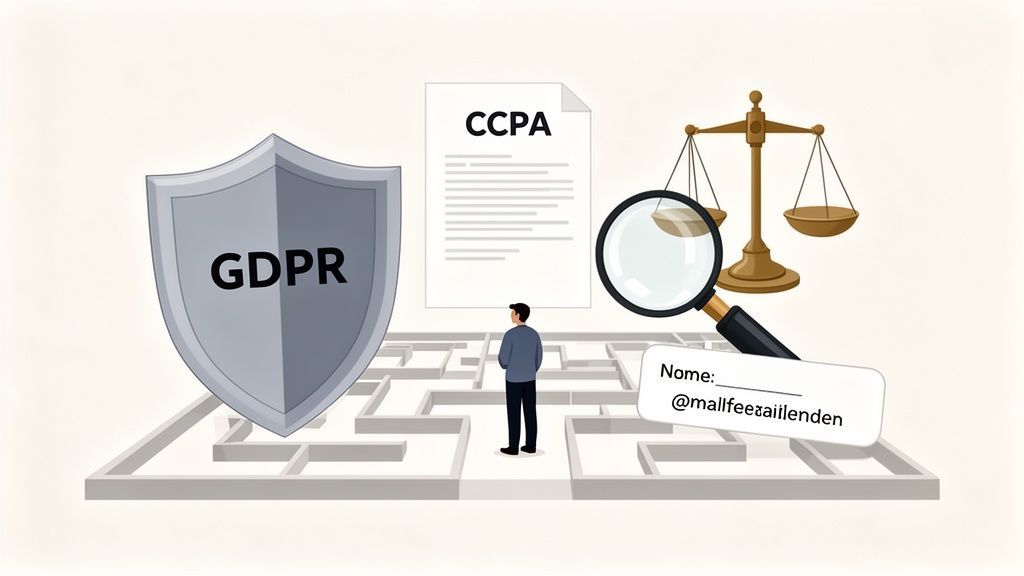
If there's one single reason to pump the brakes on lead scraping, it's the tangled web of data privacy laws. Regulations like Europe’s General Data Protection Regulation (GDPR) and the California Consumer Privacy Act (CCPA) aren't just headaches for corporate lawyers—they have teeth, and they directly impact how sales and recruiting teams operate.
These laws are all about protecting personal data. That absolutely includes the business-related info you’re after: names, work emails, job titles, and even professional social media profiles. Snatching up this information without a rock-solid legal reason is a high-stakes gamble that can leave your business facing some genuinely scary penalties.
The High Cost of Non-Compliance
Let's be clear: ignoring these rules isn't a minor slip-up. It can lead to eye-watering fines. Take GDPR, for instance. To collect personal data, you need a "lawful basis," like getting someone's explicit consent or having a carefully documented "legitimate interest." Spoiler alert: blasting a scraper across the web to hoover up thousands of untargeted contacts almost never cuts it.
The financial fallout can be brutal. GDPR fines can climb as high as €20 million or 4% of a company's global annual revenue—whichever is higher. This isn't just a hypothetical threat. In a major case, the UK's privacy watchdog slapped Clearview AI with a £7.5 million fine for scraping social media images, ordering them to delete all data on UK residents because their methods blew past GDPR-style rules. You can find more real-world examples in this overview of web scraping legal cases.
The takeaway? If your sales or recruiting efforts even might touch prospects in the EU or California (which, in a global market, is almost a guarantee), your scraping activities are under a microscope. Pleading ignorance about a contact's location just won't fly.
The core principle is simple: just because data is publicly visible doesn't mean you have the legal right to collect, store, and use it for commercial outreach. Treating data privacy as a cornerstone of your growth strategy is essential for long-term success.
Understanding Legitimate Interest
One of the most thrown-around and misunderstood concepts here is "legitimate interest." While it can be a valid legal basis for processing data, it demands a delicate balancing act. You essentially have to prove that your business's need for the data outweighs an individual's fundamental right to privacy.
Here’s a quick breakdown of the three-part test you have to pass:
- Purpose: Your reason for using the data has to be legitimate and specific. Think "targeted outreach to a specific role in an industry we serve," not "get more leads."
- Necessity: The scraping must be necessary to achieve that goal. Is there a less intrusive way to get the same result?
- Balancing: Your interests can't trample on the rights and freedoms of the people whose data you're collecting.
Mass scraping thousands of contacts from a public directory without any specific, targeted purpose? That fails the test, hands down. To make sure your prospecting is on the right side of the law, it's smart to consult detailed GDPR compliance resources. Building a compliant lead generation process from the start is always safer—and cheaper—than risking massive fines down the road.
2. Protecting Your Access to Essential Platforms
Forget about navigating complex laws for a second. There's a much more direct reason when not to use lead scraping: getting booted off the very platforms that fuel your business.
For most recruiters and sales pros, sites like LinkedIn are the lifeblood of their work. Losing access isn't a minor hiccup; it can bring your entire pipeline to a dead stop.
We all click "agree" on Terms of Service (ToS) without a second thought, but those agreements are actual legal contracts. When a platform's ToS clearly forbids automated data collection, and you do it anyway, you're giving them every right to take action. This isn't just an empty threat—these companies invest serious money into technical defenses to stop scrapers.
How Platforms Fight Back
Websites don't just stand by and let aggressive scraping happen. They're actively hunting for suspicious activity and have a whole arsenal of countermeasures to stop automated bots in their tracks.
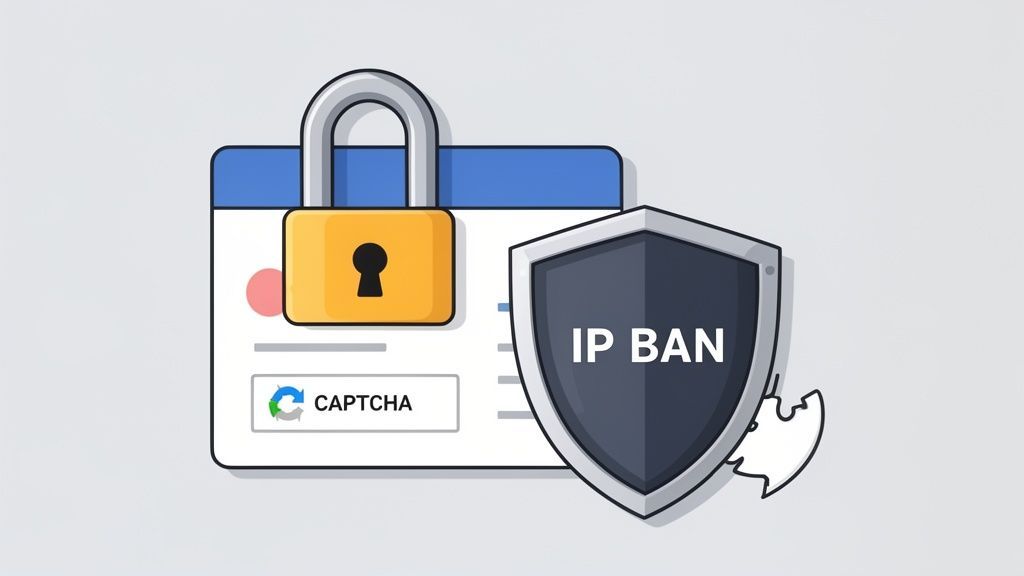
- CAPTCHAs and Behavioral Analysis: Those "are you a human?" tests are just the first line of defense. Platforms also use smart algorithms to spot non-human browsing patterns, like trying to view hundreds of profiles in just a few minutes.
- Rate Limiting: Every platform caps the number of actions an account can perform in a given time. Blowing past those limits is a huge red flag that screams "automation."
- IP Address Bans: If a platform sees repeated scraping attempts coming from the same IP address, it can just block that address completely. Suddenly, no one on that network can get in.
These technical roadblocks are all designed to make large-scale, automated scraping as difficult, unreliable, and risky as possible for your account.
The short-term win of a scraped list is never worth the long-term loss of your most valuable professional networks. Respecting platform rules is just basic good business for sustainable growth.
The Consequences of Getting Caught
The penalties for breaking the ToS can ramp up fast. At first, you might just get a warning or a temporary account suspension. But if you keep at it, you're looking at a permanent ban, which means your entire network and history get wiped out.
In some extreme cases, platforms have even gone after companies with lawsuits for systematically scraping their data.
Take LinkedIn, with its massive community of over 1 billion members. Its user agreement flat-out prohibits scraping, and they actively enforce that rule to protect their members' data. Getting kicked off a B2B resource that critical can do way more damage to a business than any scraped list could ever help. You can learn more about how LinkedIn handles scraping and account restrictions in our detailed guide.
This is exactly where smarter, compliant tools come into play. A solution like ProfileSpider is built to work with you, not against the platform. It helps you manually extract data with one click from profiles you're already legitimately viewing. This way, you gather the information you need responsibly without setting off automated alarms or breaking any rules, protecting the long-term health of your professional accounts.
3. The Business Case Against Low-Quality Scraped Leads
Let's set aside the legal threats and platform bans for a moment. There's an even more fundamental reason to steer clear of indiscriminate lead scraping: it's just plain bad for business.
When you chase quantity over quality, blasting out messages to mass-scraped, low-intent data, you're setting yourself up for failure. This isn't a growth hack; it's a fast track to dismal campaign performance and a ton of wasted resources.
Think about it. When you cold-contact someone who has never heard of you and has shown zero interest in what you do, you’re starting from a massive disadvantage. The numbers tell the real story here.
The Downward Spiral of Bad Data
Low-quality lists kick off a chain reaction of negative outcomes that can seriously harm your brand.
It helps to think of your sender reputation as a credit score for your email domain. Every negative signal—every bounce, every ignored email, every spam complaint—dings that score. Before you know it, you can't even get your emails into the inboxes of warm leads or paying customers.
Here’s how quickly the damage adds up:
- High Bounce Rates: Scraped data gets stale, fast. Emails bounce, which tells email providers you're using sketchy, low-quality lists.
- Low Open and Reply Rates: People who didn't ask to hear from you will just ignore or delete your messages, cratering your engagement metrics.
- High Spam Complaints: This is the big one. Even a tiny number of people marking your email as spam can have a devastating impact. It’s the most damaging signal you can possibly send.
Industry benchmarks show that poorly targeted B2B cold outreach often struggles to break a 15–25% open rate, with reply rates bottoming out at 1–3%. Even worse, most email service providers will flag or suspend your account if your spam complaint rate creeps over a minuscule 0.1–0.3% threshold. Suddenly, your entire domain’s deliverability is on the line.
A damaged sender reputation is incredibly difficult to repair. The fallout from one bad campaign can sabotage all future email marketing from your company, not just the outreach from a single salesperson.
From Mass Scraping to Strategic Targeting
The fundamental problem here is the complete lack of buyer intent. A good lead isn't just a name and an email; it's someone who has a problem you can solve and is at least passively looking for a solution. Mass scraping ignores this entirely, treating every contact as if they're equally valuable. They're not.
This is precisely why a targeted approach works so much better. Instead of casting a wide, shallow net, you should be using a spear.
Focus your energy on high-quality, relevant contacts who actually fit your ideal customer profile. Yes, you'll build a smaller list. But your conversion rates will be exponentially higher, which maximizes your ROI and, just as importantly, protects your brand's reputation for the long haul. Understanding this difference is often the key when you discover your lead enrichment is failing and you're not sure why. This isn't just a change in tactics; it's a crucial shift in mindset.
4. Smarter Alternatives to Indiscriminate Scraping
Okay, so you understand the risks and know when to pump the brakes on scraping. That’s step one. The next step is to lean into strategies that actually deliver better, safer results.
When you shift away from that old-school "quantity at all costs" mindset, you open the door to far more sustainable ways to build your sales pipeline. The real goal isn't just to collect a massive list of names; it's to build genuine relationships and spark real interest.
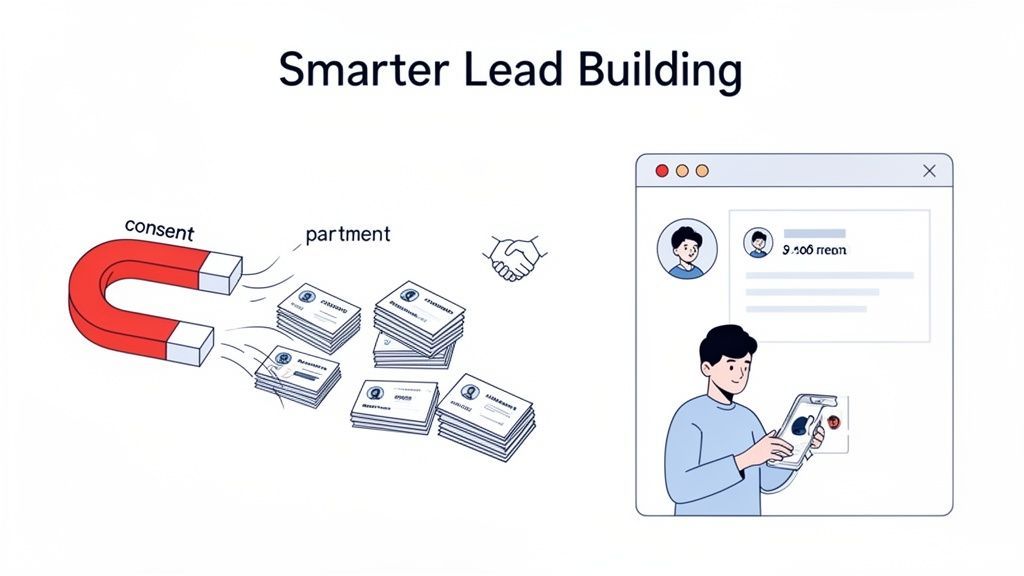
This means trading aggressive, automated scraping for smarter, consent-driven tactics. Instead of chasing down cold contacts, you start attracting warm leads who are already curious about what you have to offer.
Building a Pipeline with Inbound and Partnerships
Honestly, the most powerful alternatives to mass scraping all boil down to one thing: providing value upfront. These methods don't just bring in higher-quality leads—they also protect your brand’s reputation and keep you on the right side of the law.
- Create Lead Magnets: Put together something genuinely useful, like a deep-dive webinar, an industry guide, or an exclusive report. People will gladly give you their contact information in exchange for content that solves a real problem for them. Boom—you have their explicit consent to reach out.
- Leverage Industry Partnerships: Team up with businesses that serve a similar audience but don't directly compete. Think co-hosted events or co-branded content. This is a fantastic way to tap into a new, relevant audience that already trusts your partner.
- Engage in Manual, Targeted Prospecting: Forget casting a wide net. Instead, identify a small, hand-picked list of your absolute ideal prospects on professional networks. Actually engage with their content, then send a personalized, thoughtful message. This approach builds real connections and gets much, much higher response rates than a generic template ever will.
The most effective lead generation strategies are built on a foundation of value and trust. When you give prospects a compelling reason to engage, you build a pipeline of high-intent leads who are receptive to your message.
Introducing Strategic and Compliant Scraping
Now, this doesn't mean data extraction has no place in your workflow. Not at all. The key is to shift from indiscriminate scraping to strategic scraping.
This is exactly where a compliant, no-code tool like ProfileSpider comes into play. Instead of blindly grabbing thousands of contacts, you use it for very specific, high-value tasks.
For example, a one-click profile scraper can be a lifesaver for things like:
- Enriching Warm Leads: Quickly flesh out the contact information for companies that have already visited your website or for individuals who've engaged with your content.
- Organizing Event Lists: Efficiently gather and structure the contact details of attendees or speakers from a public conference list to make your follow-up process a breeze.
This approach respects platform rules and privacy laws because you're focusing on data you have a legitimate reason to process. It turns scraping from a risky gamble into a precise, effective tool.
Mass Scraping vs. Strategic Alternatives
It helps to see the different approaches side-by-side. Mass scraping might seem like a shortcut, but the hidden costs in data quality, risk, and reputation are enormous. Smarter alternatives require more thought upfront but deliver far more sustainable and profitable results in the long run.
| Method | Data Quality & Intent | Risk Level | Typical ROI |
|---|---|---|---|
| Mass Scraping | Very low. Data is often outdated, irrelevant, and lacks any buying intent. | High. Carries significant legal, platform, and reputational risks. | Low to negative. High volume but poor conversion and potential fines. |
| Lead Magnets | High. Leads have shown direct interest in your expertise and have consented. | Very Low. Entirely consent-based and compliant. | High. Leads are pre-qualified and warm, leading to better conversions. |
| Manual Prospecting | Very high. Each prospect is hand-picked for relevance and fit. | Very Low. Focused on genuine, personalized outreach. | Very high. Response rates are significantly better than automated outreach. |
| Partnerships | High. Taps into a trusted, pre-vetted audience with similar interests. | Very Low. Leverages an existing relationship of trust. | High. Cost-effective way to access a new, relevant audience. |
| Enrichment | High. Supplements existing data you already have a right to process. | Low. Compliant when used on leads you have a relationship with. | High. Improves the effectiveness of your existing sales and marketing efforts. |
Ultimately, choosing strategic alternatives isn't about doing less; it's about doing smarter. By focusing on quality over sheer quantity, you build a healthier, more predictable pipeline that fuels real growth without putting your business on the line.
5. The ProfileSpider Solution: Compliant Prospecting Made Easy
Trying to navigate the maze of data privacy rules and platform terms of service can feel like walking on eggshells. But it doesn't mean you have to give up on building lead lists entirely. It just means you need a smarter, safer way to go about it. The real shift is from risky, automated scraping to a more deliberate, manual approach that respects boundaries while still pulling in high-quality data.
This is where a tool like ProfileSpider becomes a game-changer for anyone who’d rather not take unnecessary risks. It's built from the ground up to support compliant prospecting. Think of it as an extension of your own manual research, not some blind, automated bot running wild.
A Local-First Privacy Approach
One of the biggest anxieties with cloud-based tools is wondering where your data is actually going. ProfileSpider puts that worry to rest with its local-first design. Any information you extract is stored directly in your browser—never on a third-party server.
This gives you complete control and ownership of your data, neatly sidestepping the privacy holes common with other platforms. You're the one who decides what to keep, what to delete, and when to export it to your own secure systems.
Designed for Compliant Workflows
Aggressive scrapers that automate thousands of page visits are a recipe for disaster. In contrast, ProfileSpider's one-click process is manual by design. It allows you to capture structured data only from profiles you are actively and legitimately viewing.
This workflow naturally keeps you in line with platform rules because it just mimics what a compliant user would do anyway.
The right tool lets you build high-quality lists without resorting to the risky, automated tactics that get accounts banned. It’s about precision and control, not just brute force.
Here are a few real-world examples of how professionals use ProfileSpider to prospect effectively and stay out of trouble:
- A recruiter spots the perfect candidate on a professional network. They use ProfileSpider to instantly save the profile details to a "Top Candidates" list, making follow-up a breeze.
- A salesperson lands on a company's "About Us" page and extracts the entire leadership team's profiles in one click, enriching their CRM contacts with accurate, up-to-date info.
- A marketer is putting together an outreach list for an upcoming industry conference. They quickly capture the public profiles of key speakers to build a perfectly targeted list.
In every one of these situations, the user is targeting relevant data they have a legitimate reason to be interested in. It’s a perfect illustration of how you can build valuable lists without wandering into the legal and reputational nightmares that indiscriminate scraping creates.